
Car Cover Size Chart for BMW 3 Series: Which Size Fits Your Generation

Quick Answer: The BMW 3 Series Fits a Midsize Sedan Cover Class
If you just want the answer: most BMW 3 Series generations fall into the midsize sedan cover class, which generally covers vehicles between 182 and 187 inches long. That's the fastest way to use a car cover size chart for BMW 3 Series shoppers, matching your car's overall length to that range before you add anything to your cart.
But "most generations" is doing some work in that sentence. The 3 Series has grown steadily since it launched, and the gap between an E46 and a current G20 is almost seven inches bumper to bumper. That's enough to push you into a different size bracket depending on which one you own. Buy the wrong bracket and you'll end up with a cover that bags at the mirrors on an older car, or won't quite reach the bumpers on a newer one.
M3 variants and the Touring (wagon) body style complicate things further. Wider fenders, different roof arcs, and longer cargo areas mean these cars don't always sit neatly in the same size class as the standard 4-door sedan from the same generation. A generic "one-size-fits-most" universal cover might technically stretch over any of these cars, but it won't fit any of them well. For a daily driver parked outdoors, that loose fit is exactly what lets wind get underneath, flap the fabric around, and scuff your paint over time. Getting the size class right from the start, and leaning toward a semi-custom or custom-fit option when you can, is what actually keeps a cover doing its job.
BMW 3 Series Size Chart by Generation
Here's a generation-by-generation breakdown using approximate factory length, width, and height specs. These numbers are rounded for sedan trims; coupe, convertible, and Touring variants shift slightly and are covered in the next section.
| Generation | Model Years | Length | Width | Height | Recommended Cover Size Class |
|---|---|---|---|---|---|
| E46 | 1999-2006 | ~176 in | ~68 in | ~56 in | Compact to midsize sedan |
| E90/E91/E92/E93 | 2006-2013 | ~181 in | ~71 in | ~56 in | Midsize sedan |
| F30/F31/F34 | 2012-2019 | ~182 in | ~71 in | ~57 in | Midsize sedan |
| G20/G21 | 2019-present | ~185-187 in | ~72 in | ~57 in | Midsize to full-size sedan |
A quick note on the M3: within every one of these generations, the M3 carries a wider track and flared fenders compared to the standard 3 Series. Width can run an inch or two beyond the base sedan figure above, which matters more than you'd think once you're trying to cinch a cover's elastic hem around the body.
The trend here is pretty clear. Each redesign added length and width, which is why a car cover size chart for BMW 3 Series owners needs to be read by generation, not as one blanket number. An E46 owner shopping off G20 dimensions will end up with a cover with several inches of slack pooling at each end.
Why Generation and Trim Change the Right Cover Size
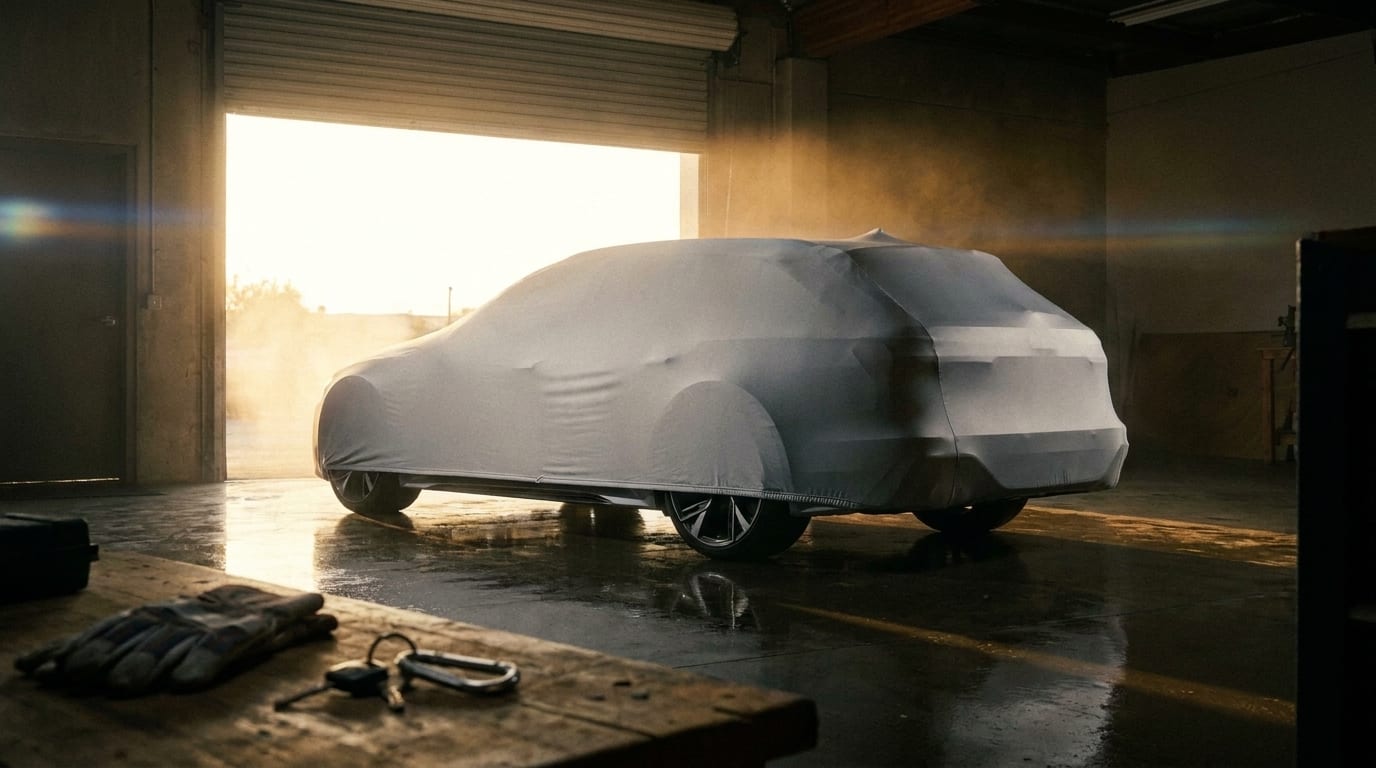
Generation is the first filter, but trim and body style matter almost as much. A sedan and a Touring from the same generation, say the F30 sedan versus the F31 Touring, share a front end but diverge at the C-pillar. The wagon's roofline runs flatter and longer toward the back, and the rear overhang measures differently. A cover sized for the sedan's sloped trunk will come up short, or bunch awkwardly, on the wagon's squared-off tailgate.
Factory add-ons shift the fit too. A rear spoiler, roof rails, or a shark-fin antenna all create points where a standard cover needs a little extra room or a cutout to seat properly. None of these require buying up a whole size class, but they're worth knowing about before you order; our fit modifications resource covers how to handle these add-ons without compromising the rest of the cover's fit. Aftermarket wide-body kits are a bigger deal. If your 3 Series has had wider fenders fitted, you've effectively moved it out of the stock width spec for that generation, and a "standard" size cover may not stretch comfortably over the car anymore.
Coupe and convertible variants add one more wrinkle. The E46 and E93 convertibles, along with their coupe counterparts, have a lower, more raked profile than the 4-door sedan from the same era. Roof height and the curve of the rear deck differ enough that these body styles often need their own listing rather than sharing the sedan's size class. If you're shopping for a 3 Series convertible or coupe, don't assume the sedan spec on a chart applies to you; check the listing specifically for your body style.
How to Confirm Your BMW 3 Series Measurements Before Buying

Charts get you close. Measuring your actual car gets you exact. Here's how to do it without much hassle:
- Park on level ground and measure bumper-to-bumper length down the centerline of the car.
- Measure width at the widest point, which is usually across the mirrors or the broadest part of the rear fenders, not the body panels themselves.
- Measure roof height from the ground straight up to the highest point of the roofline.
- Note mirror-to-mirror width separately. This one gets overlooked a lot, but it directly affects whether a cover's elastic hem or strap system can cinch down snugly without leaving a gap at the mirrors.
Before you match any of this to a size chart, confirm your exact generation and body style using the VIN or the trim sticker in the driver's doorjamb. BMW overlapped model years at generation transitions (there was crossover production between the E90 and F30, for instance), so going by model year alone can put you in the wrong bucket. If measuring by hand sounds like more than you want to deal with, CarCovers' sizing guide walks through the same process in more detail, and the cover finder tool will match your exact year and trim for you.
Semi-Custom vs Custom-Fit Covers for the 3 Series

A semi-custom cover is built to a size-class range, covering every midsize sedan from, say, 181 to 187 inches with one universal shape. A custom-fit cover is built to your specific year, generation, and body style, following the actual contours of your car.
The tradeoff comes down to money versus precision. Semi-custom covers cost less and are easier to find in stock, but they leave slack somewhere. That slack usually shows up around the mirrors, a spoiler, or the rear bumper, exactly the spots where wind gets a grip and starts working the fabric loose. For a car that spends most of its life in a garage, that's a minor annoyance at worst.
For a 3 Series that lives outdoors full time, it's worth considering the custom-fit route. A tighter, better-contoured cover resists flapping in wind, sheds water more predictably, and just looks less like a tarp thrown over the car. Our custom-fit car covers page breaks down what "custom" actually means across different materials and price points, so you can decide if the upgrade is worth it for your situation.
Common Sizing Mistakes BMW 3 Series Owners Make
The single biggest cause of returns we see traced back to one thing: buying "a cover for a BMW 3 Series" without checking which generation you actually have. The E46 and the G20 are different cars wearing the same badge, nearly seven inches apart in length. A listing that just says "3 Series" without a generation or year range attached is a red flag, not a shortcut.
Another mistake: assuming a cover sized for a different BMW model will work because it's "close enough." A 5 Series cover or an X3 cover is not interchangeable with a 3 Series cover. BMW's size classes don't scale in a straight line across model lines, so a size that fits a 5 Series sedan can be noticeably too large for a 3 Series, and an X3's taller SUV profile won't translate to a sedan roofline at all.
Last one: treating accessories as a sizing problem when they're really a fit-modification problem. A roof rail, antenna, or rear spoiler doesn't mean you need a bigger cover, it means you need a cover with the right patch or cutout in the right place. Buying up a size to "make room" for a spoiler usually just adds slack everywhere else instead of solving the actual issue.
Find the Right Cover for Your BMW 3 Series
Start with your generation and body style, match it to the chart, and you'll land on the right size class almost every time. From there it's a question of how exact you want the fit to be, and whether your 3 Series lives indoors or spends its nights outside facing the weather.
If you're ready to look at options built around these specs, browse the BMW-specific covers available for your generation rather than guessing at a generic size class. And if you've read all this and you're still not 100% sure where your car lands, run it through the cover finder toolit's a faster way to land on the right fit than cross-referencing specs by hand. Either way, worth getting right before you buy; a cover that fits well is one you'll actually keep using.
