
How Often Should You Replace a Car Cover? A Step-by-Step Guide
Why Car Cover Lifespan Matters More Than You Think
There's no single expiration date stamped on a car cover. So how often should you replace a car cover? For most drivers, the honest answer falls somewhere between one and five years, depending on the material, how much weather it eats, and how often you're pulling it on and off.
Leave a worn-out cover in service too long, though, and it stops protecting your paint and starts working against it. Trapped moisture sits against the finish. Worn fabric picks up grit and turns into fine sandpaper every time the wind shifts. UV and water protection fade out quietly, long before the cover looks obviously "dead." Mold sets up shop in the folds. None of that announces itself with a warning light.
This guide walks through what actually shortens a cover's life, the seven signs that yours is done, a five-step process for deciding, and a fast checklist you can run through right now, in under a minute, to settle the question for your own driveway.
What Actually Determines How Long a Car Cover Lasts
Material is the biggest factor. Multi-layer or breathable woven covers hold up far longer than thin universal-fit vinyl or single-layer polyester ones. The cheap stuff looks fine on day one, but it doesn't have the layered construction to handle repeated sun and moisture cycling. If you're not sure what you're currently working with, our breakdown of the best car cover materials is worth a read before you buy the next one.
Where the cover lives matters just as much. A cover parked outside daily, taking direct sun, rain, and wind, ages faster than one that only sees garage duty. That's not a small difference either; it can be the gap between a two-year cover and a five-year one. Our guide to using a car cover outdoors covers what outdoor exposure really does to fabric over time, and it's a good gut check if you're unsure which category your situation falls into.
How often you take the cover on and off counts too. Daily installation and removal causes friction wear at the seams and around the grommets that a cover left on for weeks of stationary storage simply doesn't experience. And climate extremes, whether that's intense desert UV, coastal salt air, or heavy snow load, will break down fabric ahead of schedule no matter how good the cover was to begin with.
7 Signs It's Time to Replace Your Car Cover
1. Fading or a chalky texture on the surface. That powdery residue you can wipe off with a finger is the UV coating breaking down. Once it's chalking, the protection underneath is going with it.
2. Water soaks in instead of beading up. A healthy waterproof coating makes water bead and roll off. If it's soaking through, that coating is gone.
3. Torn seams, frayed edges, or grommets pulling loose. These are structural failures, not cosmetic ones. Once a seam goes, the cover stops fitting the way it should.
4. A musty smell or mold spots that won't clean out. If you've cleaned the cover properly and the smell's still there, the fabric has absorbed moisture it can't release anymore.
5. Elastic hems or straps that have gone slack. A cover that used to hug the body and now flaps in a breeze has lost its tension for good. Elastic doesn't come back.
6. Cracking, stiffening, or shrinking when you handle it. Repeated heat and cold cycling degrades the material at a molecular level. A cover that used to fold soft and now feels brittle is telling you something.
7. New scratches on your paint that weren't there before. This is the one people miss. If the interior lining has broken down, the cover itself becomes the thing damaging your car, not the thing protecting it.
How to Decide When to Replace Your Car Cover: 5 Steps

Step 1: Inspect the fabric in direct light. Check the roofline and hood first, they take the harshest UV exposure. Look for fading, chalking, or spots where the material looks thinner than the rest.
Step 2: Run a water test. Pour a cup of water on the surface. Does it bead and roll off, or does it soak in within a few seconds? This alone tells you a lot about how much life is left.
Step 3: Check every seam, grommet, elastic hem, and strap. Run your hand along the stitching. Any fraying, stretching, or separation is a red flag, even if the fabric itself still looks decent.
Step 4: Smell and check the underside after the cover's been on a few days. Mildew often hides where you can't see it right away. If you catch a musty smell before you even lift the cover, that's your answer.
Step 5: Weigh the cover's age against its expected lifespan, not just an age. A basic outdoor cover typically lasts one to two years. A premium multi-layer outdoor car cover can run three to five. An indoor cover used in a garage can go five or more. Age alone doesn't settle it, though, combine it with what you actually found in steps one through four.
Quick Checklist: Replace or Keep?
Run through this in under a minute. Mark each one pass or fail.
- Fading or chalking on the fabric: yes / no
- Water beading test: pass / fail
- Seams and grommets: intact / frayed
- Odor or mold present: yes / no
- Elastic and straps: snug / loose
- New scratches on the paint: yes / no
Two or more fails, and it's time to shop for a replacement. One fail is worth watching. Zero fails means keep using it, and check again next season.
How to Extend Your Car Cover's Lifespan Between Replacements
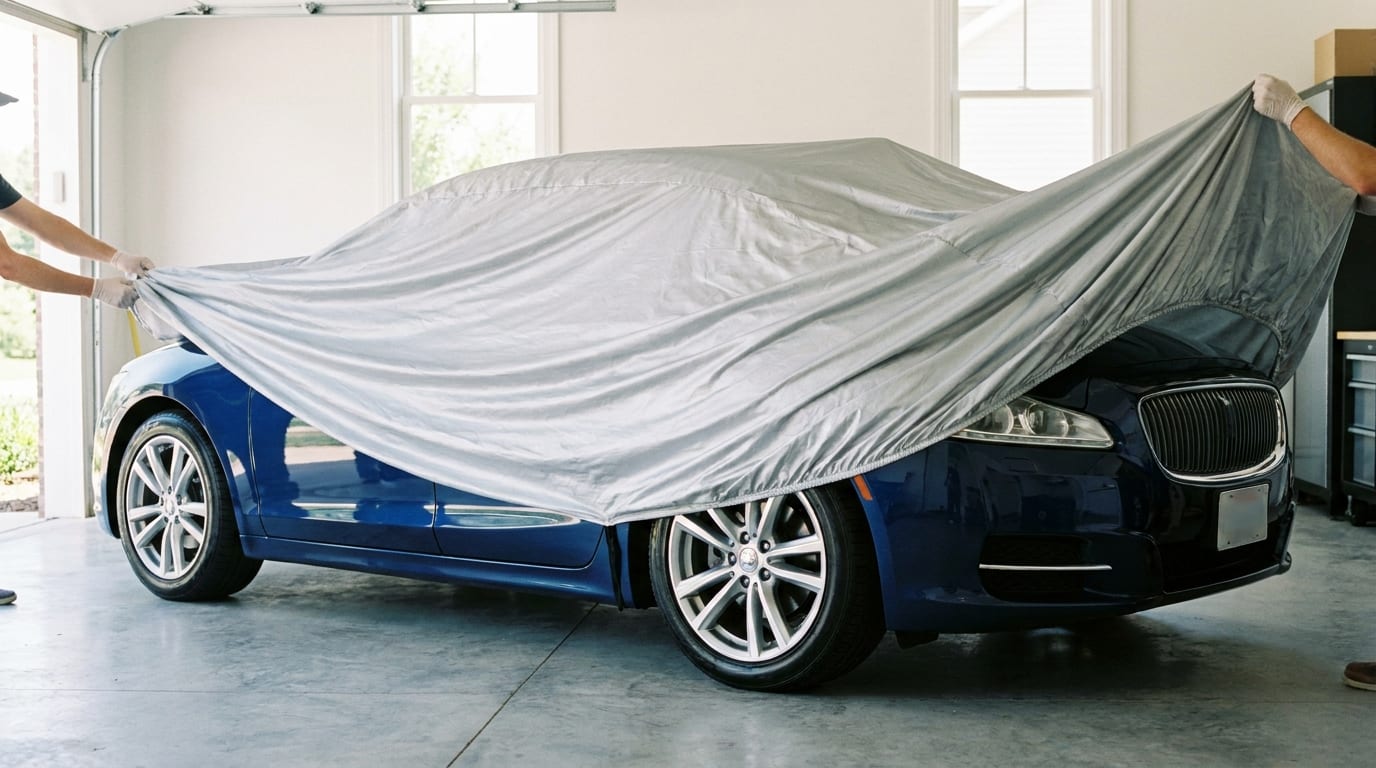
Cleaning matters more than most people think, and doing it wrong strips the very coatings you're trying to protect. Harsh detergents and machine washing can strip waterproofing right off the fabric, so stick to the proper cleaning method instead of whatever's under the kitchen sink.
Storage is the other half of it. A cover balled up on the garage floor or stuffed in the trunk develops creases, traps moisture, and can mildew before it ever sees the car again. Proper storage between uses adds real years to the fabric's life.
If you're parking outside regularly, add gust straps to cut down on wind friction, and consider a cable lock if theft or tampering is a concern in your area. Both reduce the kind of repeated mechanical stress that wears out seams and grommets early.
One habit to drop entirely: using a tarp instead of a real car cover. Tarps trap moisture against the paint with no breathability, and they do it faster than a properly designed cover ever would. Here's why a tarp isn't a substitute if you've been tempted to save a few bucks that way.
Bottom Line: Check Your Cover, Don't Just Guess Its Age
How often should you replace a car cover really comes down to condition, not a date circled on a calendar. A three-year-old cover stored in a garage might still have years left. A one-year-old cover baking outside in Arizona sun might already be done.
Run the checklist above quarterly, and definitely before winter hits or peak sun season rolls in. It takes a minute, and it saves you from finding out the hard way, with a fresh scratch on the hood.
If your cover's failing more than one or two of those checks, it's worth browsing options built for how you actually park, whether that's an outdoor cover made for daily weather exposure or an indoor one for garage storage. Qualifying covers come with a lifetime warranty, so it's worth checking what's covered before you buy. And if you want more guides like this one, our articles section is a good place to keep learning how to get more life out of the gear protecting your car.
