
How to Measure a Ford F-150 for a Car Cover (Step-by-Step + Diagram)

Ford's F-150 lineup covers more ground than almost any other vehicle on the road today. Between three cab styles and three bed lengths, two trucks that both say "F-150" on the tailgate can differ in overall length by well over a foot. That's exactly why knowing how to measure a Ford F-150 for a car cover matters so much before you buy one. Get it wrong, and you'll end up with a cover that flaps in the wind, pools water in the bed, or chews through the paint around your mirrors and antenna within a season.
This guide walks through the exact measurements a cover sizing chart or fitment tool will ask you for, plus a diagram you can reference while you're out at the truck with a tape measure. Whether you're eyeing a budget universal-fit cover or a custom-fit one built to your exact trim, the process starts the same way: with real numbers, not guesses.
Why Getting F-150 Measurements Right Matters
The F-150 comes in Regular Cab, SuperCab, and SuperCrew configurations, paired with 5.5-foot, 6.5-foot, or 8-foot beds. Mix and match those, and overall truck length swings from around 209 inches on a shorter SuperCrew to nearly 250 inches on a Regular Cab with the long bed. That's not a small difference. A cover sized for the wrong combination will either leave slack that catches wind like a sail, or come up short and expose the tailgate and bumper to rain and sun.
An ill-fitting cover doesn't just look sloppy. Loose fabric flapping against the hood and mirrors in a storm wears down the finish faster than no cover at all in some cases. Water that pools in low spots on a too-tight cover finds its way through seams over time. And if the cover's mirror pockets don't line up because you measured wrong, you're stuck stretching material where it shouldn't stretch.
This guide covers the process step by step, the same way a truck cover fitment tool would ask you to. It applies whether you're comparing a universal-fit cover against a total-length range or going custom-fit with exact measurement points.
Tools You'll Need Before You Start
You don't need anything fancy here, just the right tape and a little patience.
- A fabric or flexible tape measure, ideally 25 feet or longer. Anything shorter and you'll be doing awkward mid-measurement handoffs on a full-length truck.
- A notepad or your phone's notes app. Write numbers down the second you get them. Trust me, you will forget which side was 78 inches and which was 79.
- A second person. Not strictly required, but holding a tape measure steady across a cab roof by yourself is a wrestling match you'll lose.
- Your F-150's model year, trim, cab style, and bed length. This is printed on the door jamb sticker, or you can check the owner's manual. Specs vary meaningfully by generation, so don't assume your buddy's 2019 F-150 matches your 2022 one.
Step-by-Step: How to Measure Your F-150
Park on level ground before you touch the tape. A slope throws off height and length readings more than people expect.
Step 1: Total length. Measure from the very tip of the front bumper to the back of the rear bumper or tailgate, whichever sticks out farther. Keep the tape as straight and level as you can.
Step 2: Overall width. Measure at the widest point, which is almost always the mirrors. Record two numbers here: mirrors folded in, and mirrors extended. Some covers are designed to tuck around folded mirrors, others expect them extended, so both figures matter.
Step 3: Height. Measure straight up from the ground to the highest point of the cab roof. If you've got a roof rack or a tall antenna, note that separately since it changes clearance needs.
Step 4: Bed length. This is measured on its own, from the top of the tailgate (closed) back to the rear of the cab. Bed length is one of the biggest swing factors in how well a cover sits, so don't skip it just because you already have total length.
Step 5: Ground clearance and add-ons. Note ride height, plus anything that changes the stock silhouette: bed rails, a tonneau cover, a lift kit, oversized tires. These all push the truck's real-world dimensions past factory spec.
Step 6: Verify. Cross-check your numbers against Ford's published spec sheet for your exact year and trim. If something's off by more than an inch or two, remeasure that section before you move on.
Measuring Diagram: Key Points Reference
Here's the full picture of what you're capturing. Six points, each one feeding into how a cover is cut or sized.
| Measurement | Where to Start | Where to End | Why It Matters |
|---|---|---|---|
| Overall length | Front bumper tip | Rear bumper or tailgate | Determines base cover length range |
| Width (mirror to mirror) | Driver mirror edge | Passenger mirror edge | Sets how the cover wraps the cab sides |
| Height | Ground | Highest point of cab roof | Affects total fabric needed and roof tension |
| Bed length | Back of cab | Top of tailgate | Confirms bed coverage matches your configuration |
| Wheelbase reference | Front axle center | Rear axle center | Helps confirm cab/bed combo against spec sheets |
| Roof/antenna clearance | Roof surface | Top of antenna or rack | Flags add-ons that need extra clearance or cutouts |
Custom-fit covers are built around these exact points, down to the trim and mirror shape. That's why they're worth comparing against a custom-fit car cover option if you want a tight, no-flap fit. Universal covers work differently: they're sized against total length ranges, so your overall length and width numbers matter most there. Either way, run your numbers through a vehicle size and fit guide before buying to see which category actually fits your truck.
Special Considerations for F-150 Variations
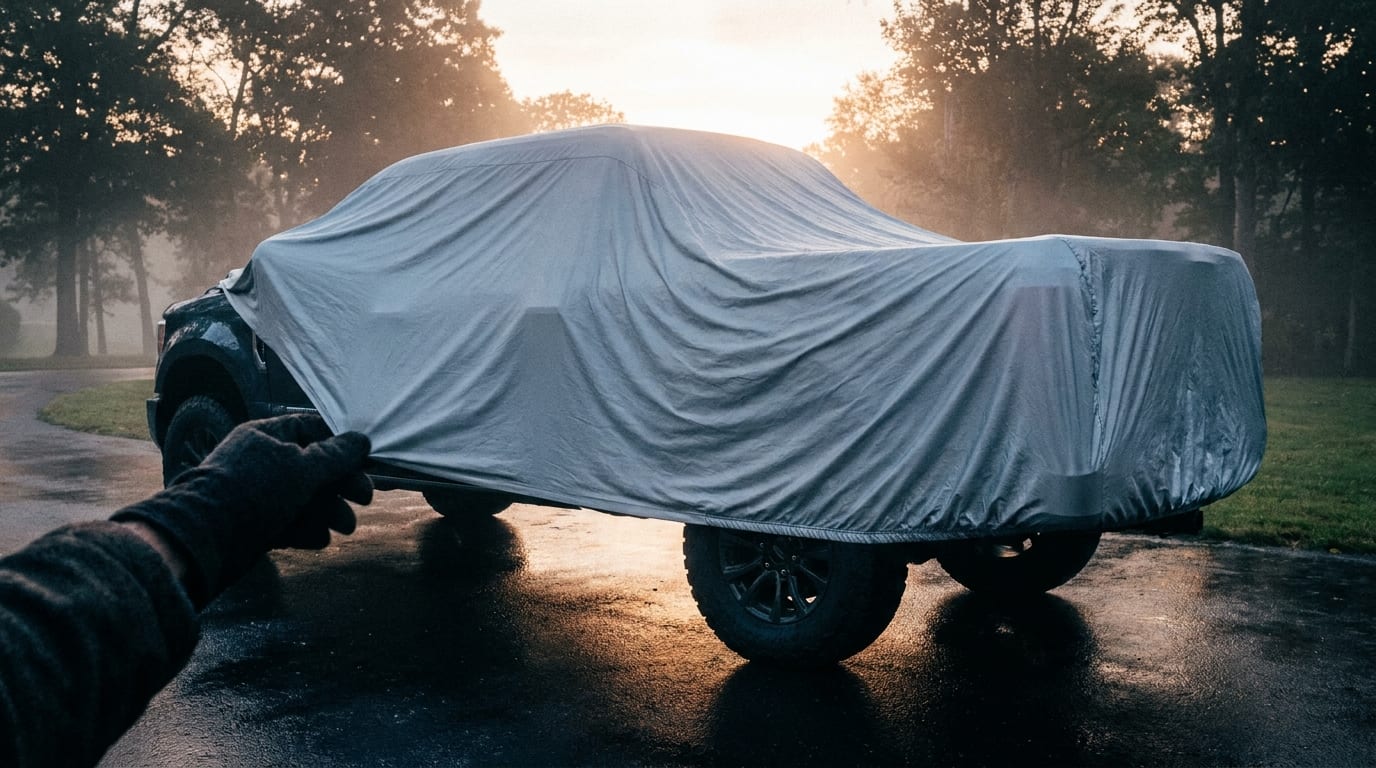
Cab style changes more than interior room. A Regular Cab and a SuperCrew with the identical bed length can differ by over a foot in total length, purely because of how much cab sits between the axles. If you're not sure which cab you have, check the door jamb sticker rather than guessing from memory.
Bed length is still the bigger variable overall. The jump from a 5.5-foot bed to an 8-foot bed adds real inches that a cover has to account for, and getting this wrong is the most common reason a "close enough" cover ends up with a gap at the tailgate. If you want the full breakdown of how bed lengths stack up across trucks in general, the pickup truck bed size guide is worth a look.
The F-150 Raptor and other lifted trims throw a wrench into standard sizing. Wider fenders, larger tires, and several extra inches of ground clearance mean a cover cut for a standard F-150 will sit oddly or not reach the ground at all. If you're covering a Raptor, check the dedicated F-150 Raptor cover page rather than assuming standard F-150 sizing applies. For any F-150 configuration, Ford's full truck cover lineup is a reasonable starting point to compare against.
Aftermarket add-ons deserve their own pass. Tonneau covers, bed racks, and running boards all change clearance at the cover's edges, and a cover that ignores them will strain against hard edges every time the wind picks up.
Common Measuring Mistakes to Avoid
The biggest one: measuring mirrors extended when your cover is designed to sit inside them, or the reverse. Check which the cover expects before you commit to one number.
Second: forgetting to measure over antennas, roof racks, or bed-mounted accessories. These get missed constantly because they're not part of the "truck" in your head, they're an add-on. But a cover doesn't know the difference.
Third: rounding. "About 79 inches" isn't a measurement, it's a guess with extra confidence. Record to the nearest half inch.
Fourth: assuming every F-150 model year shares dimensions. Ford has updated the F-150's body and bed options across generations, so a 2015 and a 2023 aren't interchangeable just because they're both F-150s. Check trim-specific specs every time.
What to Do With Your Measurements
Once you've got your six numbers written down, compare them against a sizing chart or run them through a find your car cover tool to see the closest match for your configuration.
A universal-fit cover is fine if the truck is mostly sitting in a garage or under a carport and just needs basic protection from dust. But if it's parked outside daily, exposed to sun and rain and wind, a custom-fit cover earns its higher price. Precise trim lines and mirror pockets stop a cover from working itself loose over months of exposure. The cover finder tool can help narrow that decision down by matching your exact year, trim, and bed length.
One more thing: remeasure if anything about the truck's shape changes. New tires, a lift kit, a bed rack. All of these shift the numbers enough that last year's cover might not sit right anymore.
Get the Right Fit for Your F-150
Accurate measurements are the single biggest factor in whether a cover actually fits, and whether it lasts more than one season outdoors. Everything else, material, price, color, matters less if the base dimensions are off.
If you've got your six numbers ready, take a few minutes to run them through a fitment tool and match them to your exact F-150 configuration. And if you want a refresher before you order, this diagram and the step-by-step above will still be here. Bookmark it, or subscribe to the blog for more guides like this one before your next purchase.
