Porsche unveiled the 944 at the Frankfurt Motor Show in September 1981 and slotted it between the entry-level 924 and the 911. Its wider, more muscular body drew on a wide-bodied 924 Carrera GT prototype from 1979, the pop-up headlights and hatchback stayed, and under the hood sat an engine Porsche made by essentially slicing the 928's V8 in half. No Porsche before it had sold as quickly. By 1988 the range-topping Turbo S made 250 PS and was the fastest four-cylinder production car in the world.
- The 944's 2.5-liter inline-four came from the 928's V8, which Porsche essentially sliced in half, though very few parts interchange. Two balance shafts, built to a Mitsubishi patent, keep the big four smooth.
- The first US cars made 143 hp (163 PS in Europe). By 1988 the Turbo S made 250 PS and reached 162 mph.
- Porsche built 163,302 944s from 1982 to 1991. After its first year of sales, the 944 was more than half of all Porsche production.
- In 1987 the US-spec 944 Turbo became one of the first cars in the world with driver and passenger airbags as standard equipment.
A Porsche with half a V8 under the hood
The 944 did not replace the 924. Porsche kept building the cheaper car and positioned the 944 above it, between the 924 and the 911. The new car looked the part of a step up: its flared fenders and more aggressive nose drew on a wide-bodied 924 Carrera GT prototype Porsche showed at Frankfurt in 1979, while the pop-up headlights and big rear hatch carried over. Underneath, the 944 kept the 924's front-engine, rear-transaxle layout, with the gearbox mounted at the rear axle. That gave it a nearly even weight split, about 50.7 percent front and 49.3 percent rear, in a sports car with a usable hatch and two small rear seats.
The engine is the best piece of trivia in the car. In Porsche's own telling, its engineers essentially sliced the 928's aluminum V8 in half to create a 2.5-liter inline-four, though very few parts actually interchange between the two. A four-cylinder that size shakes on its own, so Porsche fitted two counter-rotating balance shafts and paid Mitsubishi a royalty for the patented design, a refinement of an idea the British engineer Frederick Lanchester had patented in the early 1900s. European cars made 163 PS. US cars, with a catalytic converter and lower compression to meet American emissions rules, were rated at 143 hp. Porsche claimed 0 to 60 mph in under 9 seconds.
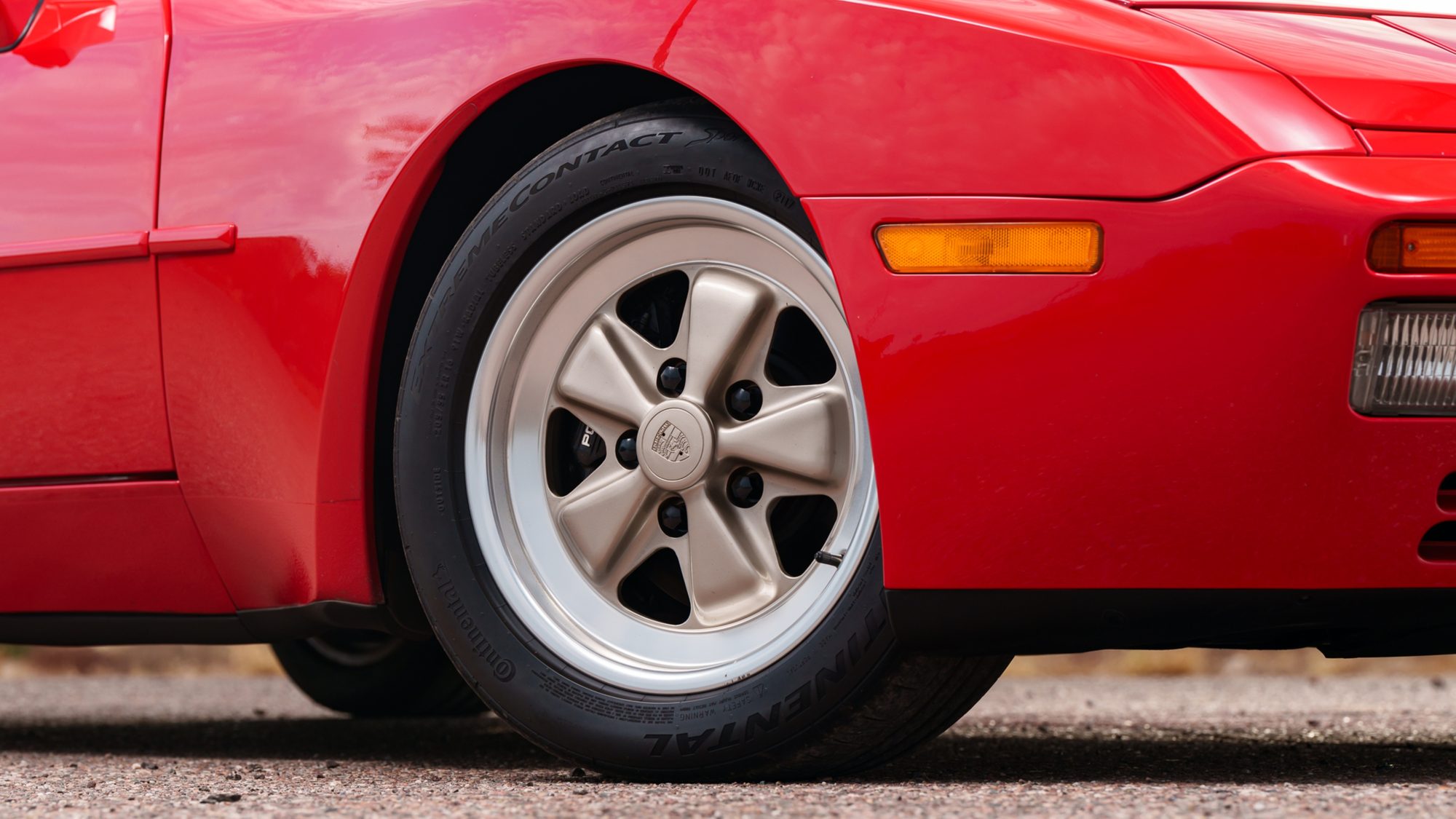
- Engine
- 2.5-liter (2,479 cc) inline-four, derived from the 928's V8
- Output
- 143 hp in the US; 163 PS in Europe
- 0 to 60 mph
- Under 9 seconds (factory claim)
- Layout
- Front engine, rear transaxle
- Base price
- $18,980 (US, 1983)
US cars were rated below European cars because they ran a catalytic converter and lower compression to meet US emissions rules.
How a four‑cylinder Porsche got to 250 PS
Porsche spent the rest of the decade building faster versions of the same basic car. A turbo came first, then a 16-valve head, then a bigger engine.
- 1981 to 1983
Unveiled, then on sale
Porsche showed the 944 at Frankfurt in September 1981. It went on sale in Europe in 1982 and reached the US as a 1983 model, priced from $18,980.
- 1985 to 1986
The Turbo, internally type 951
The 944 Turbo was a highlight of the Geneva Motor Show in March 1985, with a turbocharged, intercooled version of the 2.5-liter four making 220 PS. It reached the US for the 1986 model year, rated at 217 hp.
- 1987
944 S, and airbags as standard
A 16-valve cylinder head turned the base engine into the 944 S, with 190 PS and no turbo. The same year, the US-spec 944 Turbo became one of the first cars in the world with driver and passenger airbags as standard equipment.
- 1988
Turbo S, the high point
The Turbo S raised output to 250 PS and top speed to 162 mph, making it the fastest four-cylinder production car in the world at the time. Porsche built 1,635 of them.
- 1989 to 1991
944 S2 closes it out
The 944 S2 took the 16-valve four to 3.0 liters, one of the largest four-cylinder engines in production at the time, for 211 PS without a turbo. It was sold for the 1989 to 1991 model years, as a coupe and, from launch, a Cabriolet.
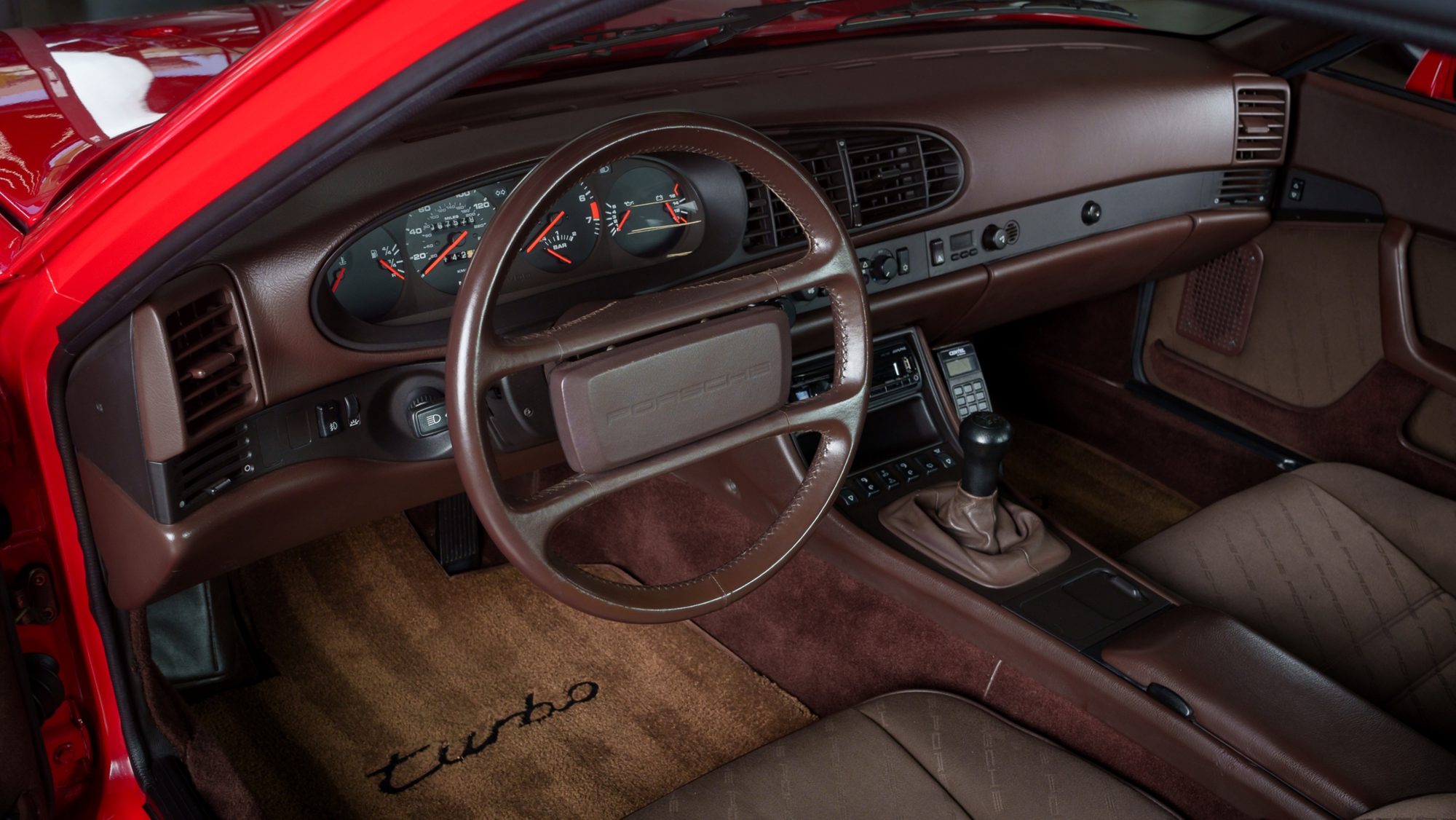 Cockpit
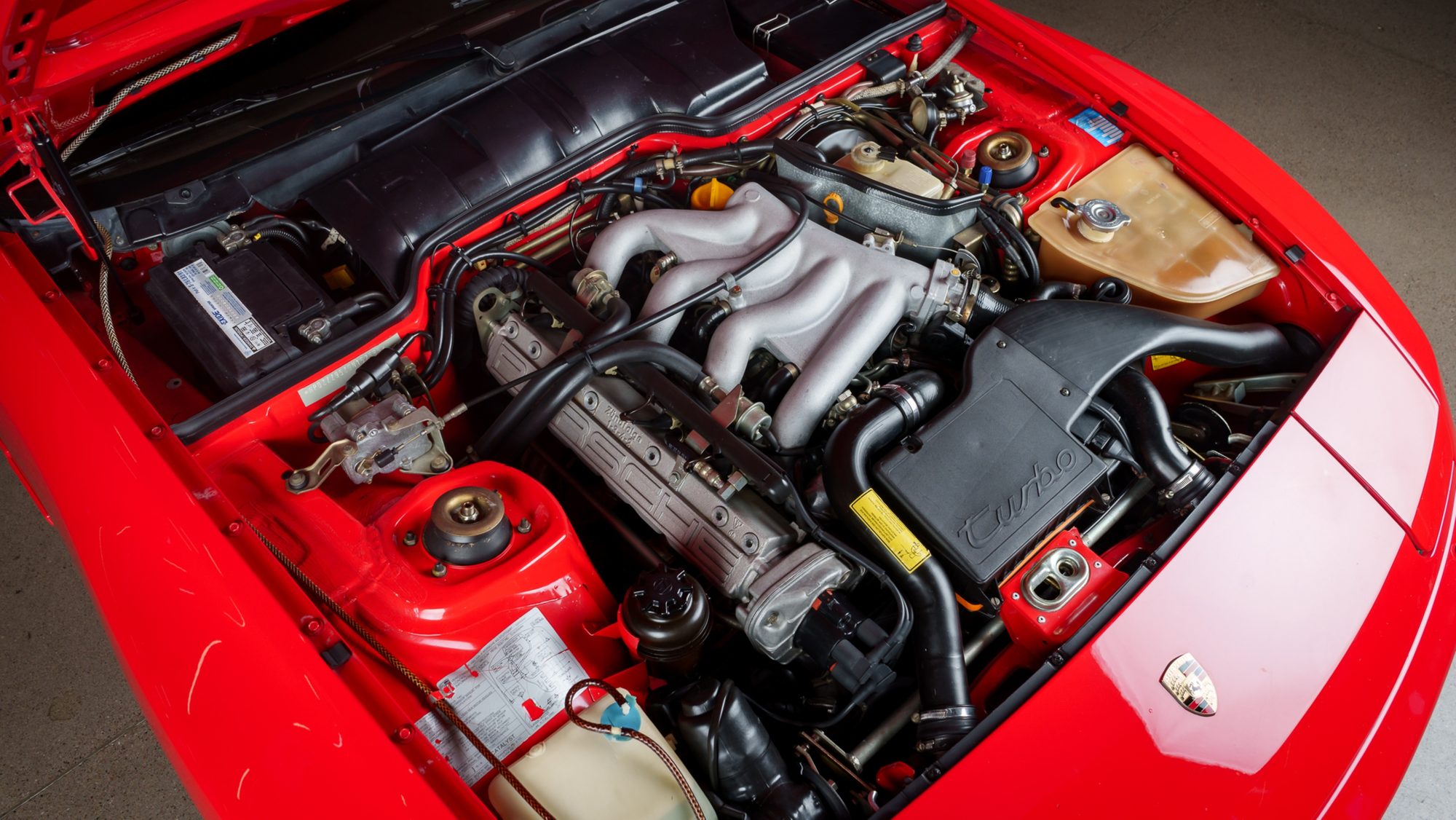 Turbo four
Whether a 944 is collectible now
A 1983 944 started at $18,980 in the US. Values today spread out a lot by variant and condition. A solid, driver-quality early base 944 can still be found for well under $15,000. The Turbo is where the money is: in mid-2024, Hagerty valued a 944 Turbo in excellent condition at about $54,000, up 54 percent since 2019, while well-sorted driver-quality Turbos were still in the mid-$20,000 range. Hagerty found S2 values running slightly behind the Turbo's, and the Turbo S, with just 1,635 built, is rarer still.
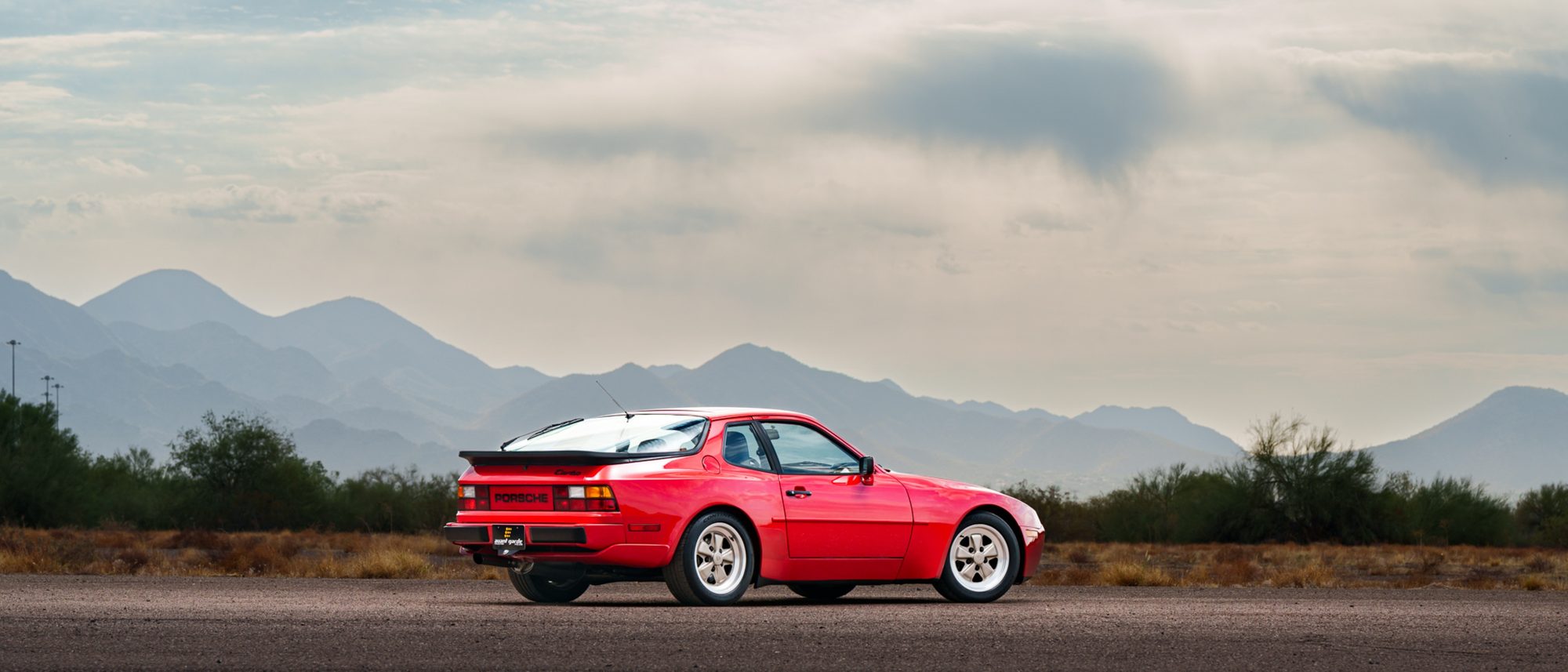
None of that requires a garage queen. The 944 was built to be driven, at a price that let more people actually do it. Whether it spends its nights in a garage or a driveway, a car with this much history under a fairly ordinary-looking hood is worth keeping the weather off of.
Keep it coveredCovers for the 944, matched to your exact car
Questions owners ask
What does 951 mean on a Porsche 944 Turbo?
951 is Porsche's internal factory designation for the 944 Turbo. The car was sold as the 944 Turbo, and enthusiasts use the number as shorthand for it.
Is the 944 S2 the same as the 944 Turbo?
No. The 944 S2 made 211 PS from a naturally aspirated 3.0-liter, 16-valve four. The 944 Turbo used a turbocharged, intercooled 2.5-liter four, which made 220 PS at launch and 250 PS in the 1988 Turbo S. The two were sold alongside each other from 1989 to 1991.
How rare is the 944 Turbo S?
Porsche built 1,635 Turbo S cars, all for 1988. For comparison, about 25,000 944 Turbos were built in all from 1985 to 1991.
Sources (18)
- Porsche unveiled the 944 at the Frankfurt Motor Show in September 1981; its exterior design was influenced by a wide-bodied 924 Carrera GT prototype from 1979; Porsche 'essentially decided to slice the V8 of the 928 in half to create a 2.5-litre, four-cylinder inline unit'. porsche.com
- The 944 was positioned between the 924 and the 911; it was priced at DM 38,900; 163,302 were built by the end of production in 1991; 'No other Porsche model had ever sold as quickly and as well as the 944.' newsroom.porsche.com
- After its first year of sales, the 944 accounted for more than 51 percent of total Porsche production. porsche.com
- The 924 Carrera GT styling prototype was shown at the Frankfurt show in 1979. stuttcars.com
- The 944 kept the 924's front-engine, rear-transaxle layout, with nearly even weight distribution of 50.7 percent front and 49.3 percent rear; the base engine displaced 2,479 cc; Porsche's factory 0 to 60 mph claim was under 9 seconds; the 944 was in essence half of the later 928's 5.0-liter V8, though very few parts interchange. en.wikipedia.org
- The 944's engine was a four-cylinder derivative of the 928's V8 with very few interchangeable parts; Porsche paid Mitsubishi a per-engine patent royalty for its twin counter-rotating balance shafts; the 944 made 163 PS DIN in Europe and 143 hp SAE in the US; the 1983 US price was $18,980; the 924 stayed in production after the 944 arrived. ateupwithmotor.com
- The catalytic-converter 944 ran 9.7:1 compression against 10.6:1 for the non-catalyst car, and made 110 kW instead of 120 kW. de.wikipedia.org
- The US 944's power was reduced from the European 120 kW because of catalytic converters and internal engine modifications; the Europe-spec car went on sale for 1982 and the US car arrived as a 1983 model; the 944 Turbo was announced at the Geneva Motor Show on March 7, 1985; the 944 S arrived as a 1987 model with a 16-valve head. stuttcars.com
- The balance shaft was invented and patented by the British engineer Frederick W. Lanchester in 1907, and the design was refined by Mitsubishi on its Astron 80 four-cylinder of 1975. en.wikipedia.org
- The 944 Turbo was a highlight of the 1985 Geneva Motor Show, with 220 PS. porsche.com
- The 944 Turbo, internal factory designation 951, debuted at Geneva in March 1985, reached the US for the 1986 model year at 217 hp, and the 1988 Turbo S made 247 hp (SAE); the 1987 US 944 Turbo had driver and passenger airbags as standard equipment. clarks-garage.com
- In 1987 the US version of the 944 Turbo became one of the first cars in the world fitted with both driver and passenger airbags as standard equipment. porsche.com
- The 944 S (MY 1987 to 1988) made 190 PS; the 944 S2 (MY 1989 to 1991) used a 3.0-liter four-valve engine making 211 PS and was offered as a Cabriolet from launch. porsche.com
- The 944 Turbo S made 250 PS with an official top speed of 261 km/h (162 mph), making it the world's fastest four-cylinder production car at that time. porsche.com
- The 944 S2's 3.0-liter four was the largest production four-cylinder engine of its time. en.wikipedia.org
- Porsche built 1,635 944 Turbo S cars; a 944 Turbo in #2 (excellent) condition was valued at $54,000, up 54 percent since 2019; driver-quality Turbos were in the mid-$20,000 range; Turbo values slightly outpace S2 values. hagerty.com
- A total of 25,245 944 Turbos were made in model years 1985 to 1991; the production table's 1988 figure includes the 1,635 Turbo S cars. en.wikipedia.org
- Good, driver-quality early base 944s (1982 to 1985) are generally available in the $7,500 to $12,000 range. stuttcars.com
Photos: Josh Bryan - stock.adobe.com