Three characters on an order form, Z06, have marked Chevrolet's track-ready Corvette, on and off, since 1963. The first one, in 1963, was not even a separate model. It was a box on the order form: a way to buy a Corvette with the suspension, brakes and engine a customer might actually race that weekend, no showroom polish required. Six decades on, the name has moved through four more generations of Corvette, each faster than the last, and landed on a mid-engine supercar that revs to 8,600 rpm and starts at about $120,000. The idea underneath it has held whenever the name has been on the order form: take the most track-ready Corvette of its day and put the Z06 badge on it.
- RPO Z06 started in 1963 as an $1,818 racing option on the Sting Ray: one engine choice, a 4-speed manual, and only 199 built.
- The name sat unused for 38 years, then returned in 2001 on a lighter, fixed-roof C5, and kept gaining power through the C6 and C7.
- The C8 Z06 is the first Z06 with its engine behind the driver, following the C8 Stingray's move to a mid-engine layout in 2020, and its 5.5-liter LT6 is the most powerful naturally aspirated V8 ever sold in a production car.
- At 670 hp it starts around $120,000, and it is not even the fastest Corvette anymore: the twin-turbo ZR1 took that title.
Five cars have worn the name
Every Z06 has been built to the same brief: take the Corvette that already exists and build the version with nothing held back. What that has meant has changed with every generation, from a bigger fuel tank and stiffer springs in 1963 to a mid-engine car with a race-derived engine six decades later.
- 1963
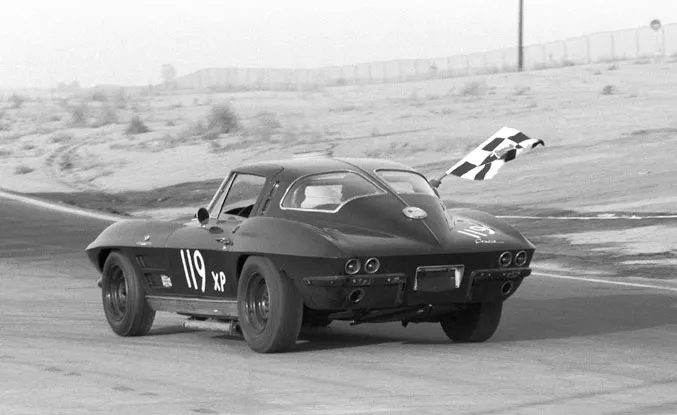
RPO Z06, the racing option
Zora Arkus-Duntov, the engineer who pushed Chevrolet to build a real sports car, created RPO Z06 for Corvette buyers who intended to race what they drove home. It paired the fuel-injected, 360 hp L84 V8 with stiffer springs, bigger shocks, a thicker front stabilizer bar and sintered-metallic brakes, and it required a 4-speed manual and a Positraction rear end. Chevrolet built 199 of them, and 63 of those also carried the optional 36.5-gallon fuel tank for long races.
- 2001 to 2004
The badge returns on the C5
After a 38-year gap, Z06 came back on a fixed-roof version of the C5, its rigid hardtop replacing the standard car's targa top for extra stiffness. The LS6 V8 made 385 hp at launch and 405 hp from 2002, and the whole package was built to be quicker than the ZR-1 it replaced, at a lower weight.
- 2006 to 2013
The C6 Z06 goes big-inch
The C6 Z06 introduced the LS7, a 7.0-liter, 427-cubic-inch V8 with dry-sump oiling so it would not starve for oil under hard cornering. At 505 hp and 470 lb-ft, it was the largest and most powerful small-block Chevrolet had ever built.
- 2015 to 2019
The C7 Z06 adds a supercharger
The C7 Z06 kept the small-block layout but bolted on a 1.7-liter supercharger, turning the 6.2-liter LT4 into a 650 hp engine, SAE-certified, the most powerful production engine GM had built at the time.
- 2023 to today
The C8 Z06 moves to the middle
The C8 generation put the Corvette's engine behind the driver for the first time in its history. The Z06 version paired that chassis with a purpose-built, naturally aspirated 5.5-liter LT6 and a flat-plane crank, the same basic architecture as Chevrolet's C8.R race engine, making it the most powerful naturally aspirated V8 ever offered in a production car.
What the C8 Z06 is like up close
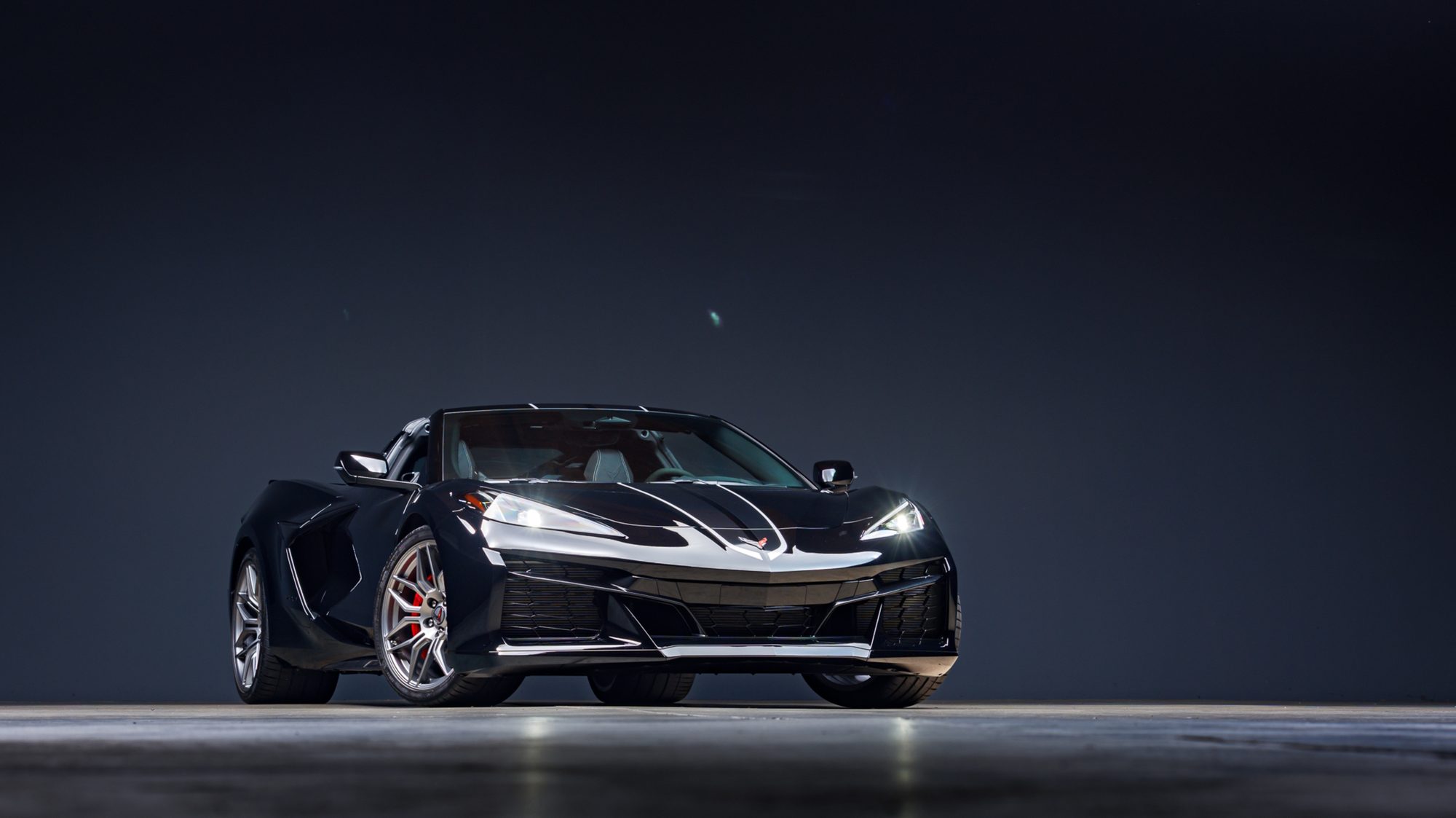
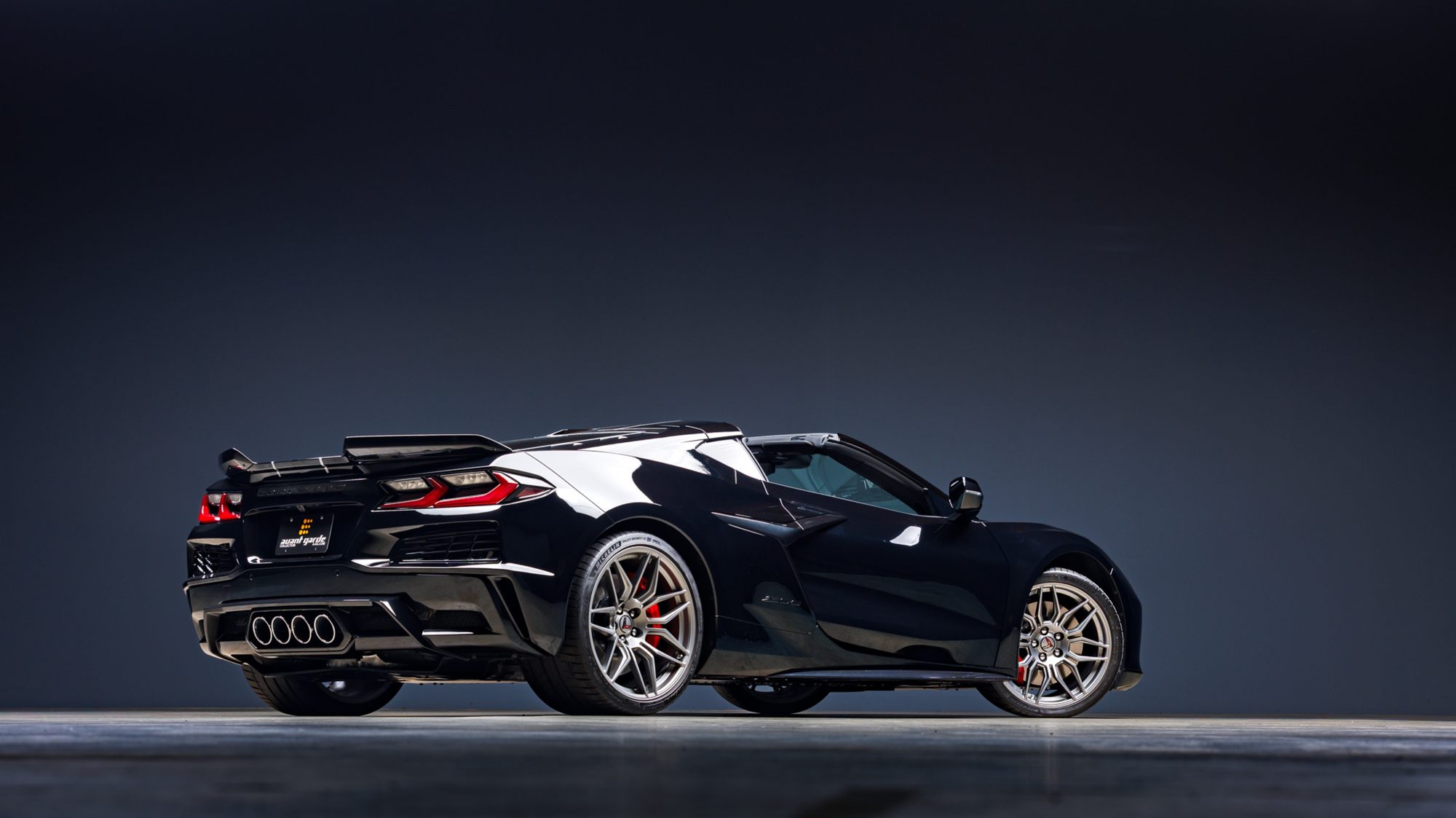
The rest of the photos on this page show a C8 Z06 convertible, and they show what six decades of the same brief looks like now. The proportions come from the C8 Stingray underneath it, but almost every panel is Z06-specific: wider fenders, a bigger front splitter and its own rear spoiler, all there to cool a much harder-working engine and put more rubber on the road.
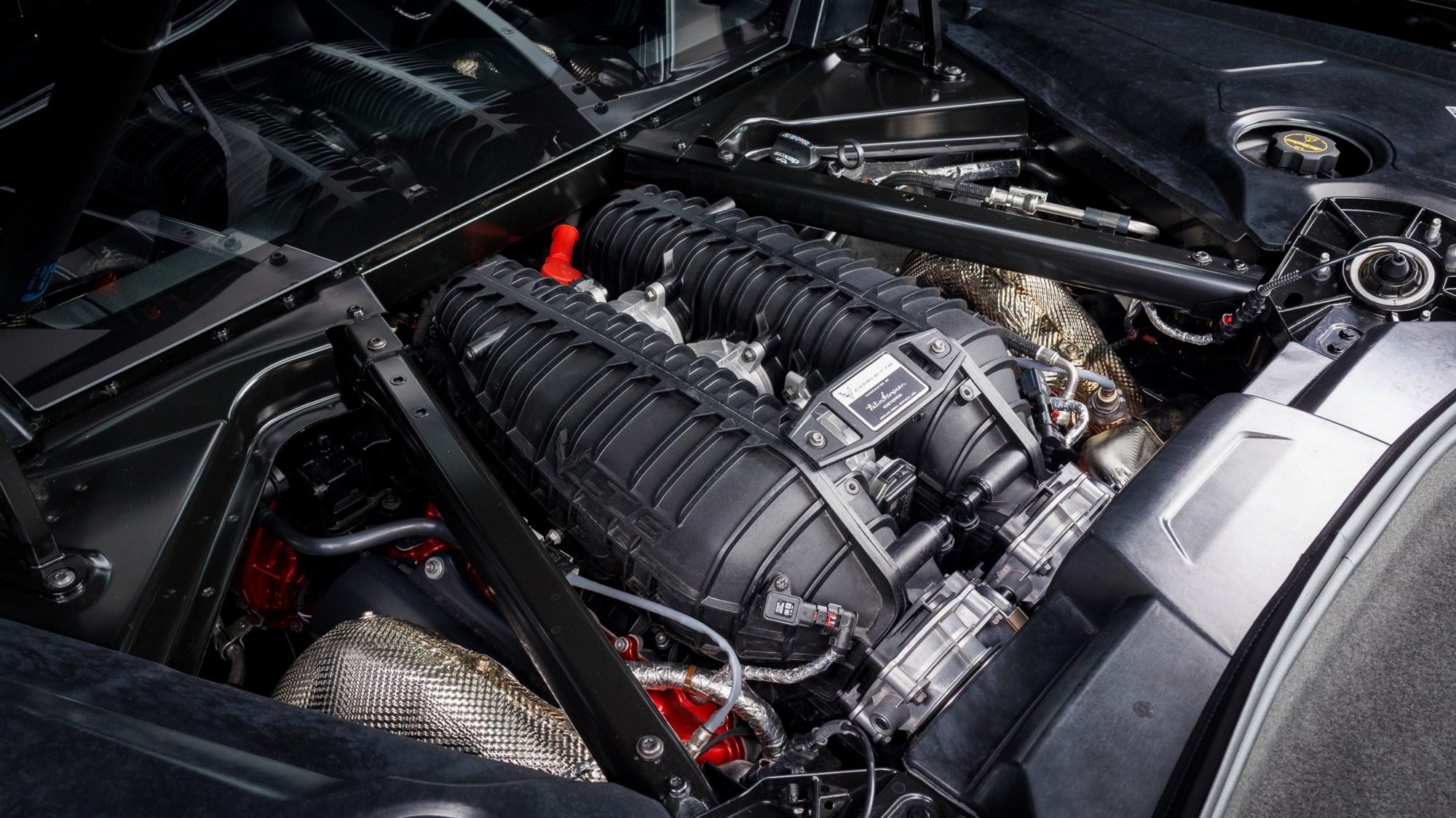
The number that matters most is 8,600 rpm. Most V8s in road cars stop pulling well before 7,000; the LT6's flat-plane crankshaft, a layout more common in Ferrari and race-car V8s than in American ones, lets it rev like a much smaller engine while still displacing 5.5 liters. Chevrolet rates it at 670 hp at 8,400 rpm and 460 lb-ft at 6,300 rpm, and none of it needs a turbocharger or a supercharger to get there.
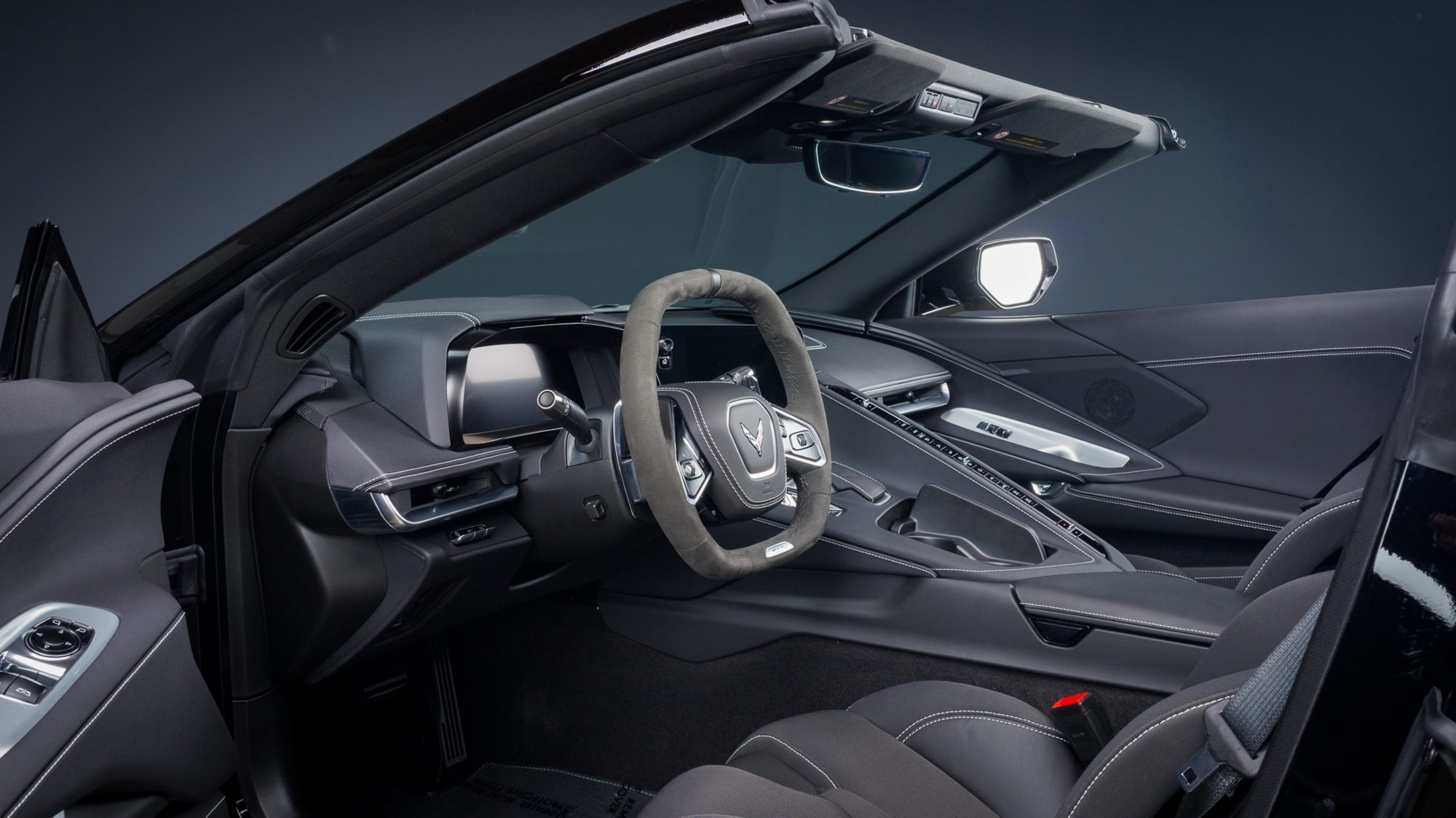 Cockpit
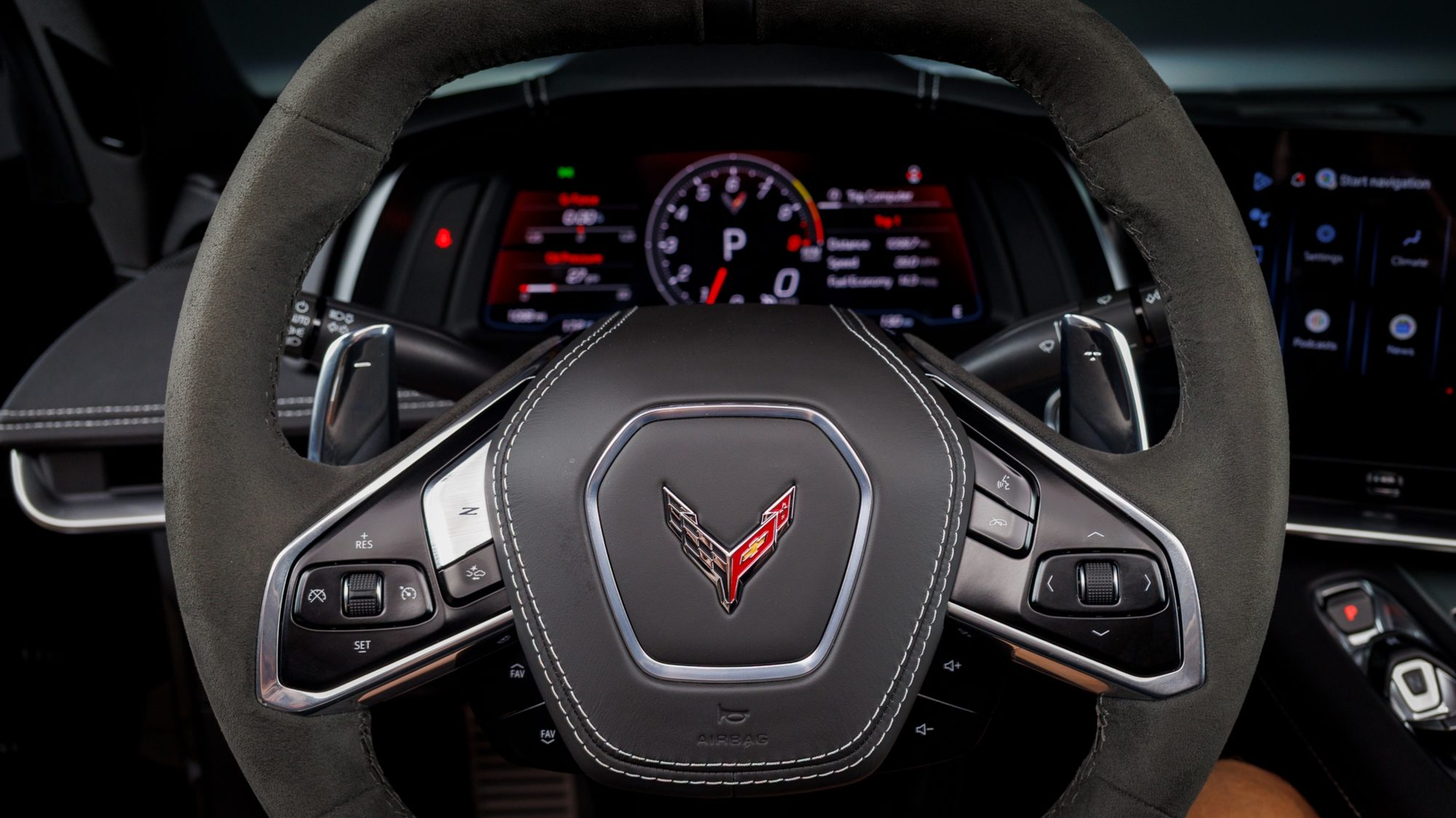 Redline
Underneath the styling, the Z06 carries wider wheels and Michelin Pilot Sport tires, available red-painted brake calipers, and, on cars with the optional Z07 Performance Package, carbon-ceramic rotors and more aggressive aero. That package is also what unlocks Chevrolet's quickest published numbers, below.
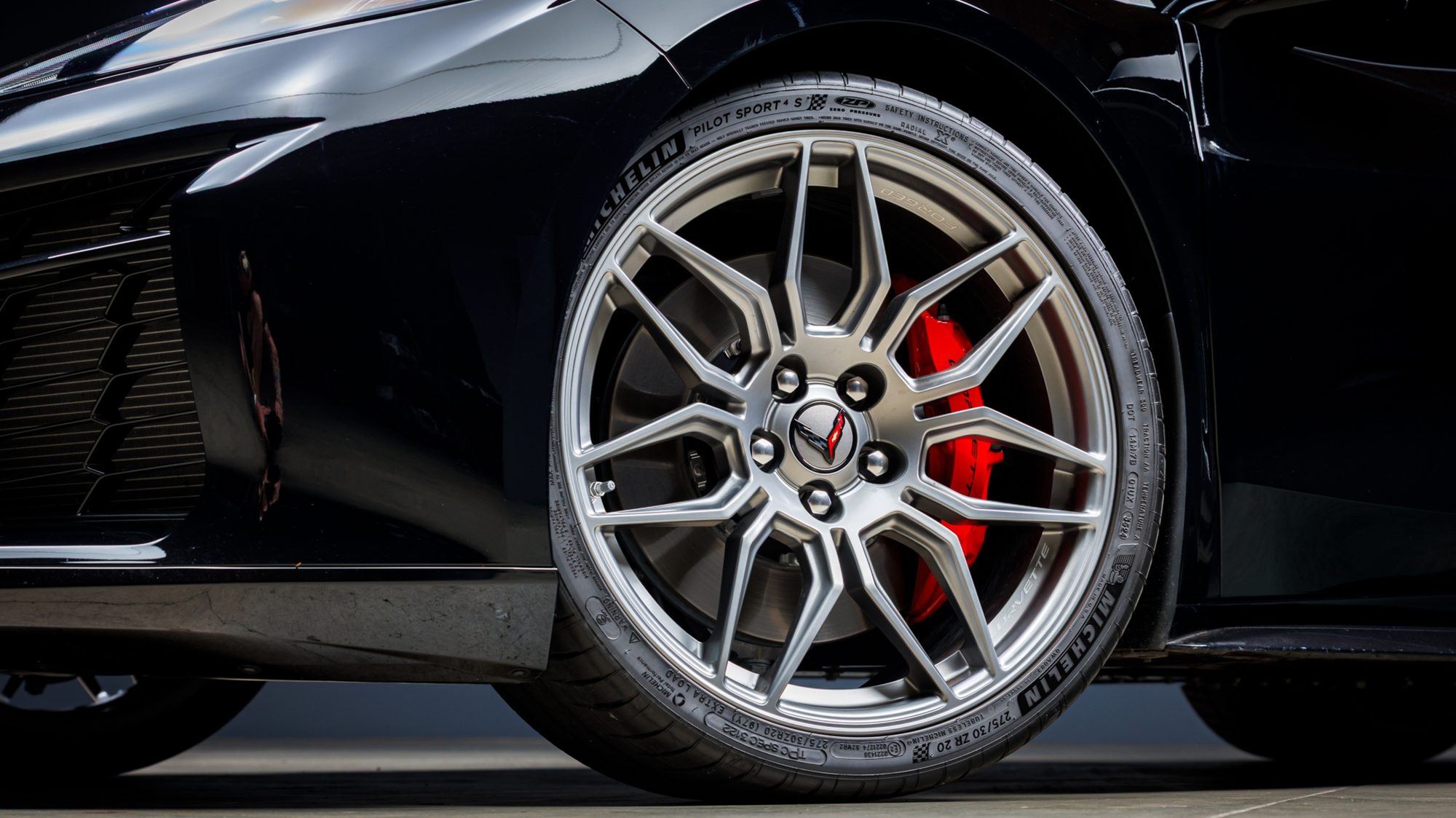 Brakes
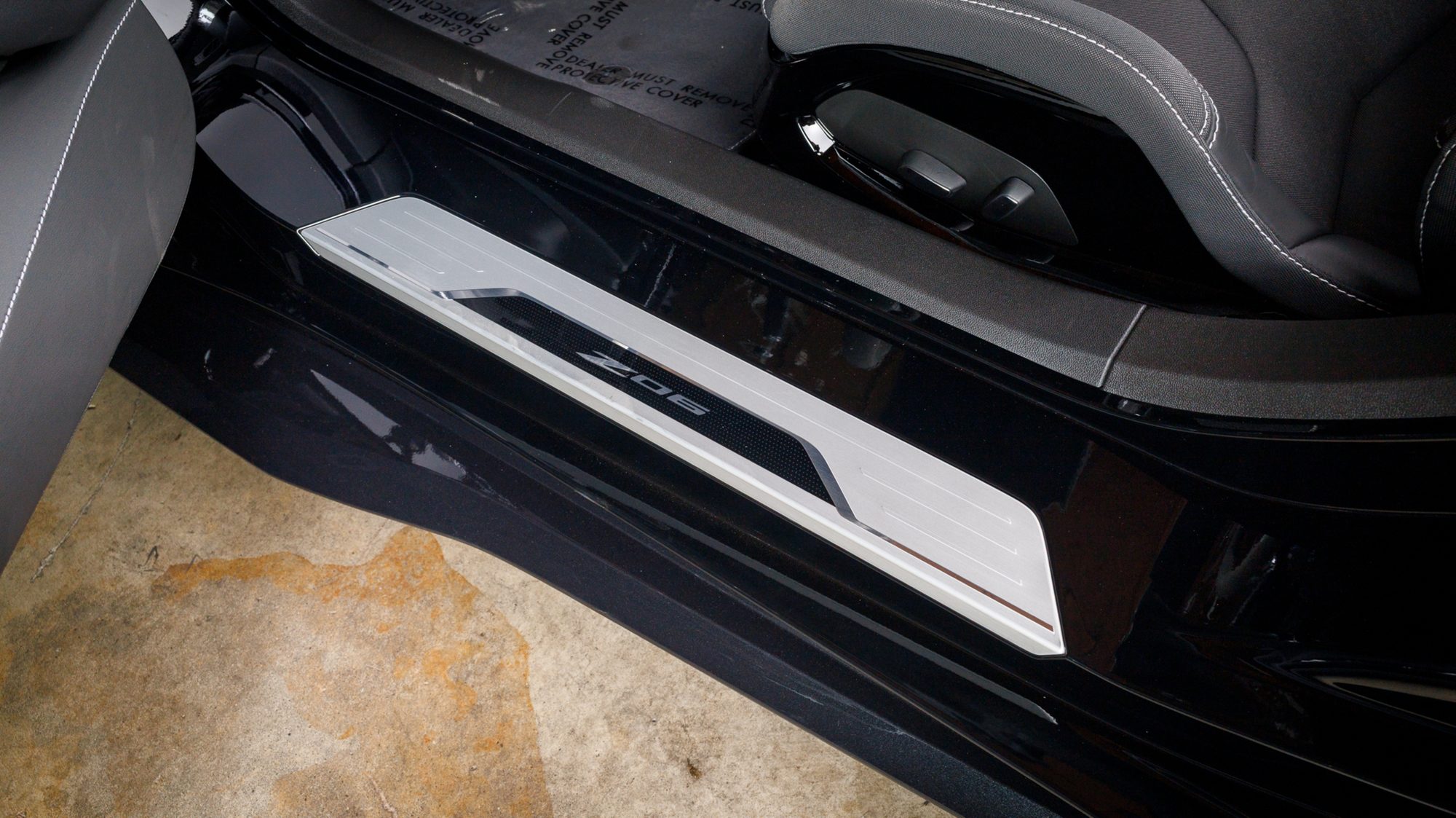 Badge
Badge- Engine
- 5.5-liter LT6 V8, flat-plane crank, naturally aspirated
- Redline
- 8,600 rpm
- Starting price
- About $120,195 for 2026, before options
Figures from Chevrolet's own testing and order guide. The quickest 0 to 60 and quarter-mile times, in the stat band above, require the optional Z07 Performance Package.
Whether the price makes sense
A car engineered like this does not come cheap, and the 2026 Z06 starts around $120,000 before options. That is real money, but it buys a naturally aspirated V8 that revs to 8,600 rpm and posts numbers usually reserved for far pricier exotics, without a turbocharger's help. Chevrolet has since built something even faster: the ZR1, which bolts twin turbochargers onto a version of the same engine, called the LT7, and pushes output to 1,064 hp. The Z06 is no longer the quickest Corvette money can buy. It is still the one built around the idea that a great engine should not need forced induction to get there.
Every Z06, from the 199 built in 1963 to the ones rolling out of Bowling Green this year, was built to be driven hard and rarely babied. When it is not on a track or a back road, though, it deserves the same care as anything else that lives in a garage or a driveway: something between it and the dust, the sun and the weather until the next drive.
Keep it coveredCovers for the Corvette, matched to your exact car
Questions owners ask
Does "Z06" stand for anything?
No. It is simply the Regular Production Option (RPO) code Chevrolet assigned to the 1963 racing package, an alphanumeric catalog code with no acronym behind it. The option became a legend, so Chevrolet reused its own code as a model name starting in 2001.
How many 1963 Corvettes had the Z06 option?
199. Sixty-three of those also carried the optional 36.5-gallon fuel tank, RPO N03, built for cars that needed to go a long way between pit stops.
Is the Z06 the fastest Corvette you can buy?
Not anymore. The ZR1 uses a twin-turbocharged version of the Z06's engine, called the LT7, and makes 1,064 hp to the Z06's 670. The Z06 stays naturally aspirated, which is the whole point of the LT6: built to rev, not to be boosted.
Was the C8 Z06 the first mid-engine Corvette?
The first mid-engine Z06, yes. It followed the C8 Stingray, the first mid-engine Corvette of any kind, which arrived for the 2020 model year. Every earlier Corvette, all seven generations before it, put the engine up front.
Sources (15)
- RPO Z06 debuted for the 1963 Corvette Sting Ray, developed by Zora Arkus-Duntov, paired only with the 360 hp L84 V8 and a 4-speed manual, initially priced at $1,818.45. corvsport.com
- 199 Corvettes were built with the RPO Z06 option in 1963; 63 of those also had the 36.5-gallon N03 fuel tank. corvsport.com
- The Z06 name returned in 2001 on the C5, a fixed-roof hardtop with the 385 hp LS6 V8, raised to 405 hp for the 2002 to 2004 model years, built to beat the outgoing ZR-1 at a lower weight. en.wikipedia.org
- The C6 Z06 (2006) used the 7.0-liter, 427-cubic-inch LS7 V8: 505 hp, 470 lb-ft, dry-sump lubrication, the largest small-block Chevrolet had built. corvetteactioncenter.com
- The C7 Z06 (2015) used the supercharged 6.2-liter LT4 V8, SAE-certified at 650 hp and 650 lb-ft, the most powerful production engine GM had built at the time. corvetteactioncenter.com
- The C8 Z06 is the first Z06 with its engine behind the driver, following the C8 Stingray's 2020 move to a mid-engine layout; its naturally aspirated, flat-plane-crank 5.5-liter LT6 makes 670 hp at 8,400 rpm with an 8,600 rpm redline, the most powerful naturally aspirated V8 ever offered in a production car. hagerty.com
- Each LT6 is hand-assembled by one builder at Chevrolet's Performance Build Center in Bowling Green, Kentucky, roughly three hours per engine, and carries a plaque on the intake naming the builder. corvetteforum.com
- The LT6's dry-sump oil tank fill cap and loop-handle dipstick sit near the intake, on the Z06 coupe's engine bay diagram (Engine Compartment Overview, LT6 5.5L V8, Z06 Coupe, callouts 3 and 4). cdn.dealereprocess.org
- Chevrolet's own published figures for the Z06 are a 2.6-second 0 to 60 mph time and a 10.6-second quarter mile at 131 mph, both with the optional Z07 Performance Package. chevrolet.com
- The 2026 Z06 1LZ coupe's launch MSRP was $119,695 including destination; a December 2025 destination increase brought it to about $120,195. gmauthority.com
- Black is the no-charge standard brake caliper color on the Z06; Bright Red, Accelerate Yellow and Edge Red are paid options. gmauthority.com
- The C8 Corvette's shift paddles are mounted on the steering wheel itself, not on the steering column. motor1.com
- The ZR1 uses a twin-turbocharged version of the Z06's engine, called the LT7, making 1,064 hp and 828 lb-ft. hagerty.com
- Z06 is a Regular Production Option (RPO) code, an alphanumeric catalog designation with no acronym meaning, reused as a model name from 2001 onward. corvsport.com
- The base C8 Z06 comes with its own front splitter and rear spoiler; the pedestal-mounted high wing is an extra-cost option, not standard equipment. en.wikipedia.org
Photos: Josh Bryan/stock.adobe.com