The NSX's point was never outright speed. It was a supercar you could live with. In February 1989, Honda's engineers asked Ayrton Senna, then the reigning Formula 1 world champion, to try a prototype at Suzuka and say what he thought. He thought it felt fragile. Honda spent more than eight months proving him right and fixing it, and the NSX reached showrooms in 1990 as the first mass-production car with an all-aluminum monocoque body, on the promise that none of that had to come at the cost of driving it every day.
- Ayrton Senna tried a prototype in February 1989 and said it felt "a little fragile." Honda raised its rigidity targets that April and, after more than eight months of work that included the Nürburgring, made the body 50 percent stiffer.
- The NSX went on sale in 1990 as the first mass-production car with an all-aluminum monocoque body, priced in the US from about $60,000.
- In 1997, manual cars moved to a 3.2-liter, 290 hp V6 and a new 6-speed manual. A facelift for 2002 traded the pop-up headlights for fixed xenon units, and production ended in November 2005.
- The name returned for the 2017 model year on a 573 hp twin-turbo hybrid with all-wheel drive, priced from $156,000 and built on a completely different formula.
Built with a Formula 1 driver's feedback
Honda R&D began basic research on a mid-engine, rear-drive layout in January 1984, a year after the company returned to Formula 1, and formal development of the NSX started in the fall of 1985. The engineers wanted a sports car that showed off Honda's racing spirit, and the team in America planning the new Acura brand wanted a flagship for its lineup. The chassis was designed to match the rigidity of a Porsche or a Ferrari. Then Honda asked a Formula 1 driver to check its work.
I'm not sure I can really give you appropriate advice on a mass-production car, but I feel it's a little fragile.
Ayrton Senna · after trying an NSX prototype, February 1989
Senna was not the NSX's development driver. That was Motoharu Kurosawa, who proposed the Nürburgring as the car's development base. But Senna's comment reset the target. Honda raised its rigidity goals in April 1989 and took the car to the Nürburgring, where the circuit exposed the body flexing just as he had described. After more than eight months of work, the body was 50 percent stiffer, and the car that went on sale wrapped it around a mid-mounted, naturally aspirated V6 with VTEC.
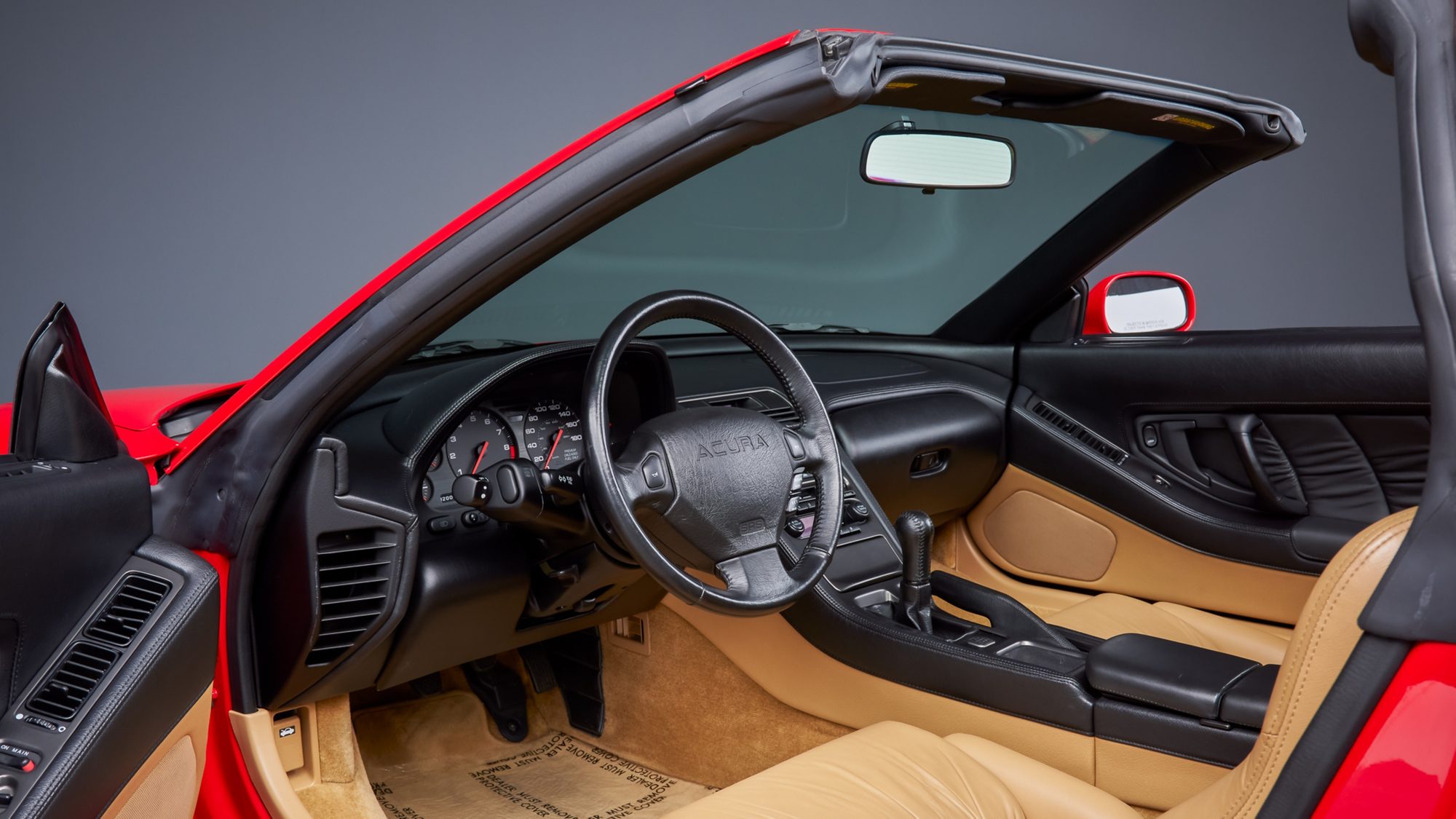 Cockpit
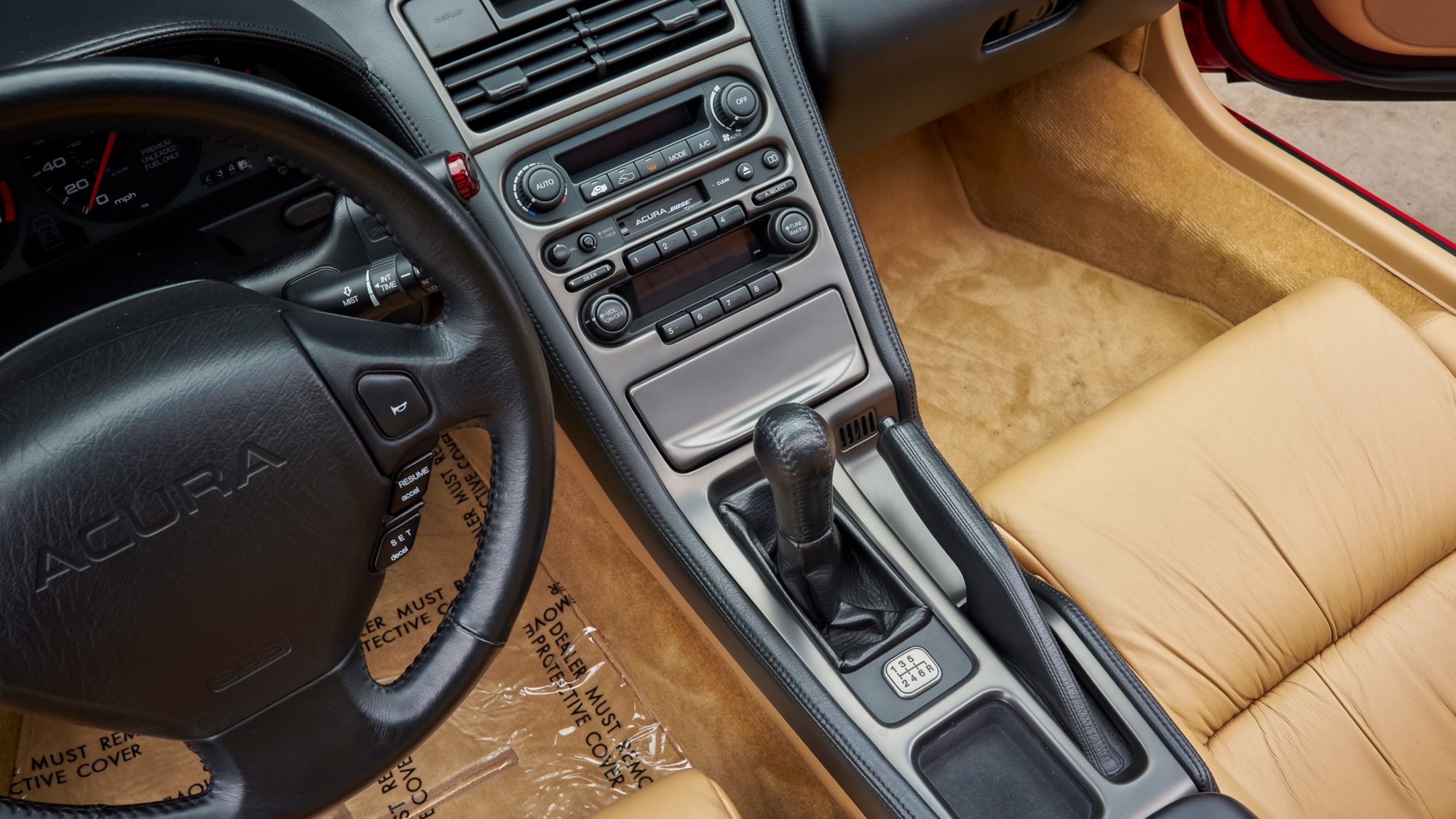 Cabin
CabinNone of that was meant to make the NSX harder to live with. Acura's own history of the car credits it with "levels of quality and daily driving comfort unheard of in sports cars of the time," and says its comfortable cockpit and gentle road manners "ran sharply counter to contemporary European exotics." Acura's general manager, Jon Ikeda, put it this way in 2019: "Before NSX, it was always assumed that supercar performance came at the price of a comfortable interior and everyday drivability."
The first generation, year by year
- 1989
A concept in Chicago, a verdict from Senna
Honda showed the NS-X concept at the Chicago Auto Show on February 9, 1989. That same month Senna tried a prototype and called it fragile, and Honda spent more than eight months making the body 50 percent stiffer.
- 1990 to 1991
The NSX goes on sale
Sales began in the US in August 1990, with the NSX sold as an Acura and badged a 1991 model, and in Japan that September. It paired a 3.0-liter, 270 hp C30A V6 with a 5-speed manual (or a 4-speed automatic at 252 hp) in the world's first mass-production all-aluminum monocoque body, from about $60,000.
- 1995
A targa top arrives: the NSX-T
The NSX-T added a removable roof panel and reached North America that March. It largely replaced the fixed-roof coupe there: from then on, North American hardtops were limited to a handful of special orders and the 1999 Zanardi Edition.
- 1997
A bigger engine and a sixth gear
Manual-transmission cars moved to a 3.2-liter C32B V6 with 290 hp and 224 lb-ft, paired with a new close-ratio 6-speed manual. Automatic cars kept the 3.0-liter, 252 hp engine and a 4-speed automatic.
- 2002
The pop-up headlights disappear
A facelift introduced in December 2001 replaced the pop-up headlights with fixed xenon HID units, added slightly wider rear tires and stiffer springs, and revised the tail lights and rear bodywork. The fixed-roof coupe was no longer offered in North America.
- 2005
Production ends
The last first-generation NSX was built on November 30, 2005, after a run of just over 15 years. The name stayed off the market for about a decade.
What made it different up close
The aluminum was the point. Building the body from aluminum instead of steel saved about 140 kg, roughly 310 lb, and using aluminum for the suspension and other parts too brought the saving to nearly 200 kg, about 440 lb, across the whole car, by Honda's count. The V6 sits crosswise behind the seats, ahead of the rear axle, a layout the second-generation car would give up for a lengthwise twin-turbo engine.
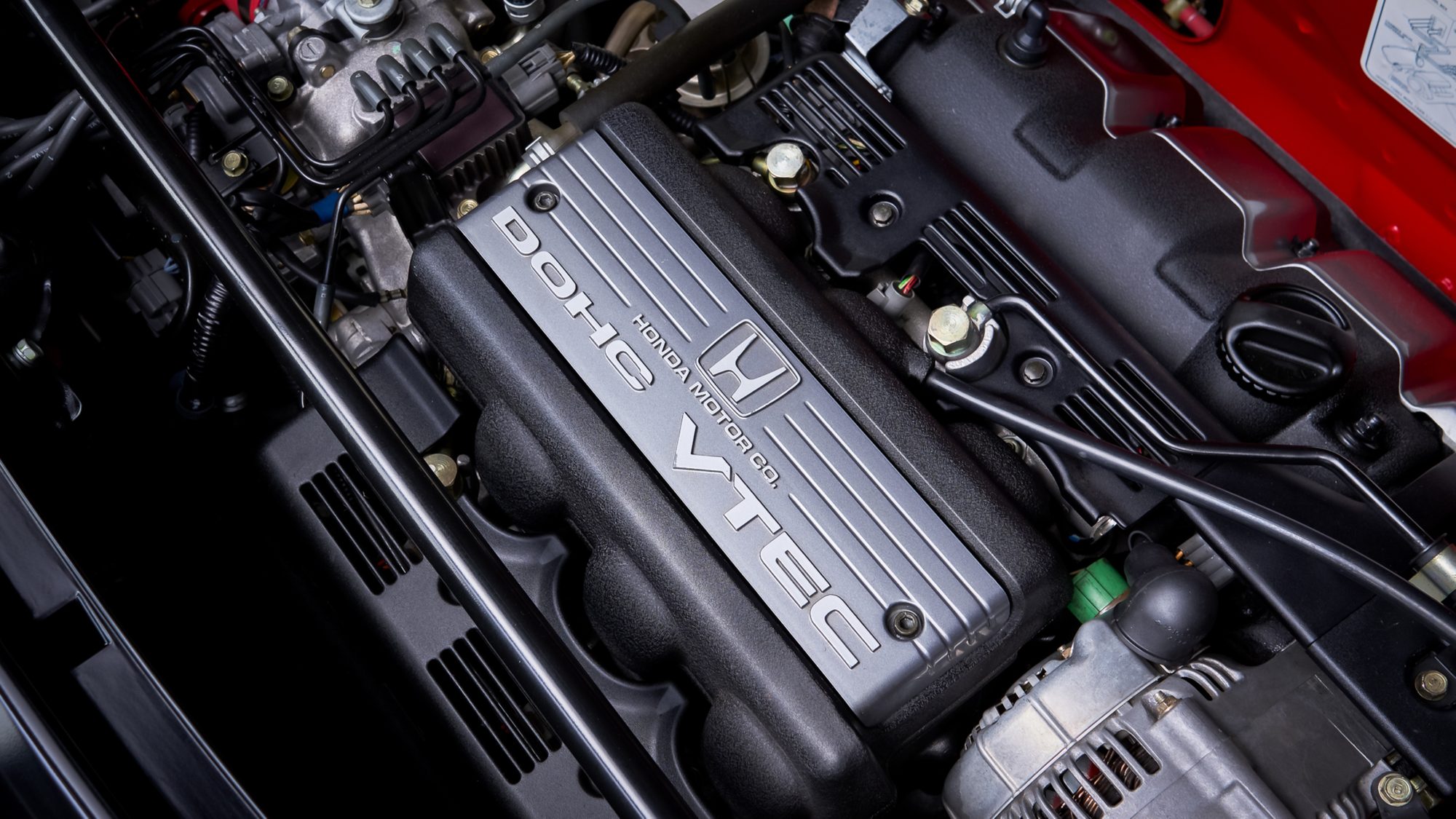
VTEC was a late addition. The NS-X concept shown in Chicago used a single-cam V6 shared with the Legend sedan, and Honda's president, Tadashi Kume, asked why the flagship lacked the VTEC system R&D had just developed for four-cylinder engines. The redesigned C30A became the second Honda engine with VTEC, after the four-cylinder B16A, and the company's first V6 to use it. Titanium connecting rods, which Acura lists as a first for a production engine, helped raise its redline to 8,000 rpm.
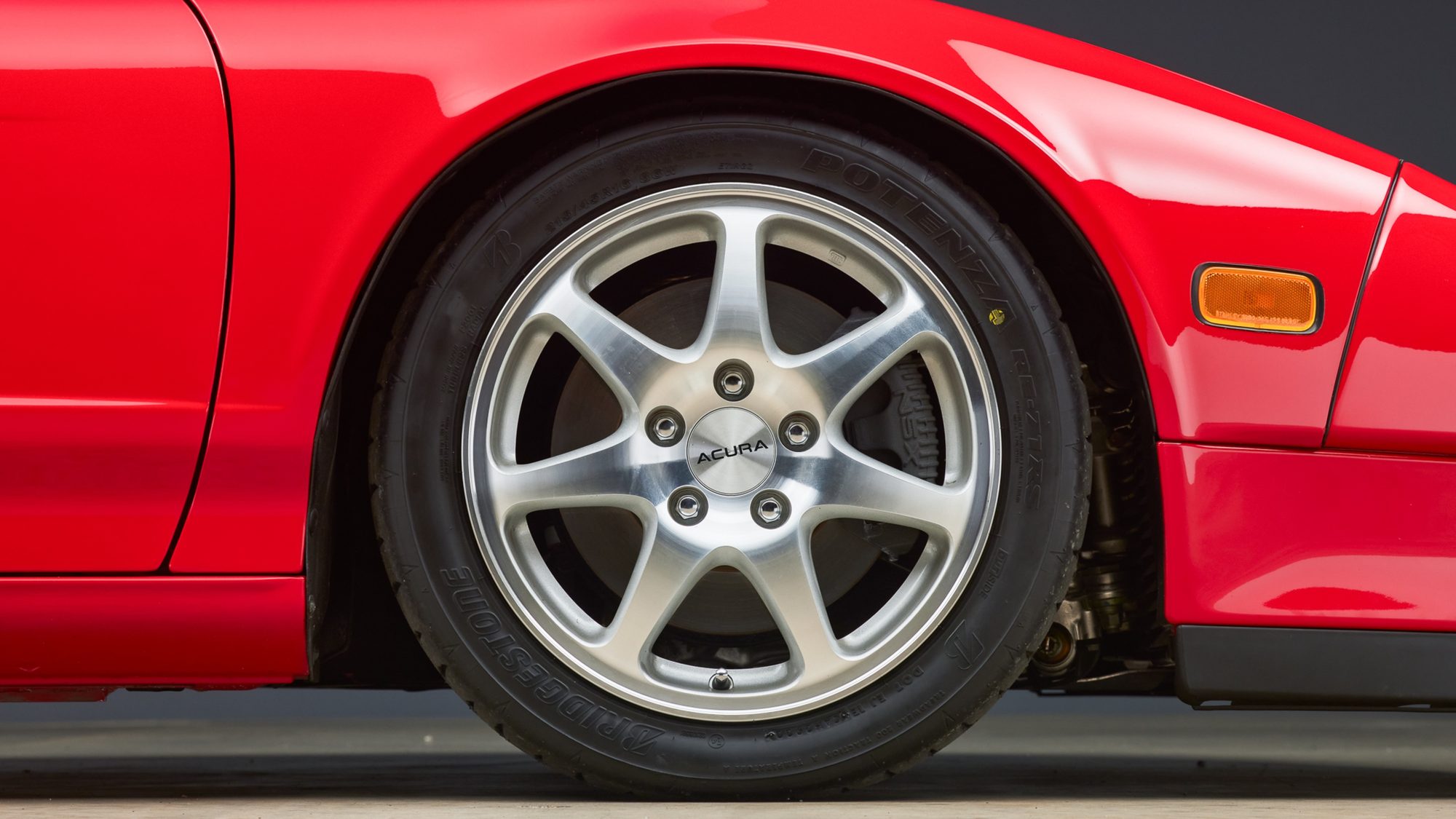
- Engine
- 3.0-liter C30A V6, DOHC VTEC, mid-mounted crosswise
- Output
- 270 hp, 210 lb-ft (252 hp with the automatic)
- Transmission
- 5-speed manual or 4-speed automatic
- Starting price
- About $60,000
Honda and Acura figures. From 1997, manual cars used a 3.2-liter V6 with 290 hp, 224 lb-ft and a 6-speed manual; automatics kept the 3.0-liter at 252 hp.
A different car wears the name today
Honda revived the NSX name for the 2017 model year on a car that shares almost nothing mechanical with the original: a twin-turbo, 3.5-liter V6 mounted lengthwise, working with three electric motors to drive all four wheels, for a combined 573 hp and a top speed Honda put at about 191 mph. It was priced from $156,000 and built in Marysville, Ohio, through the 2022 model year. It does not feel like the same idea. The original earned its reputation by being usable, approachable and honest about what it was; the second-generation car is a different kind of statement.
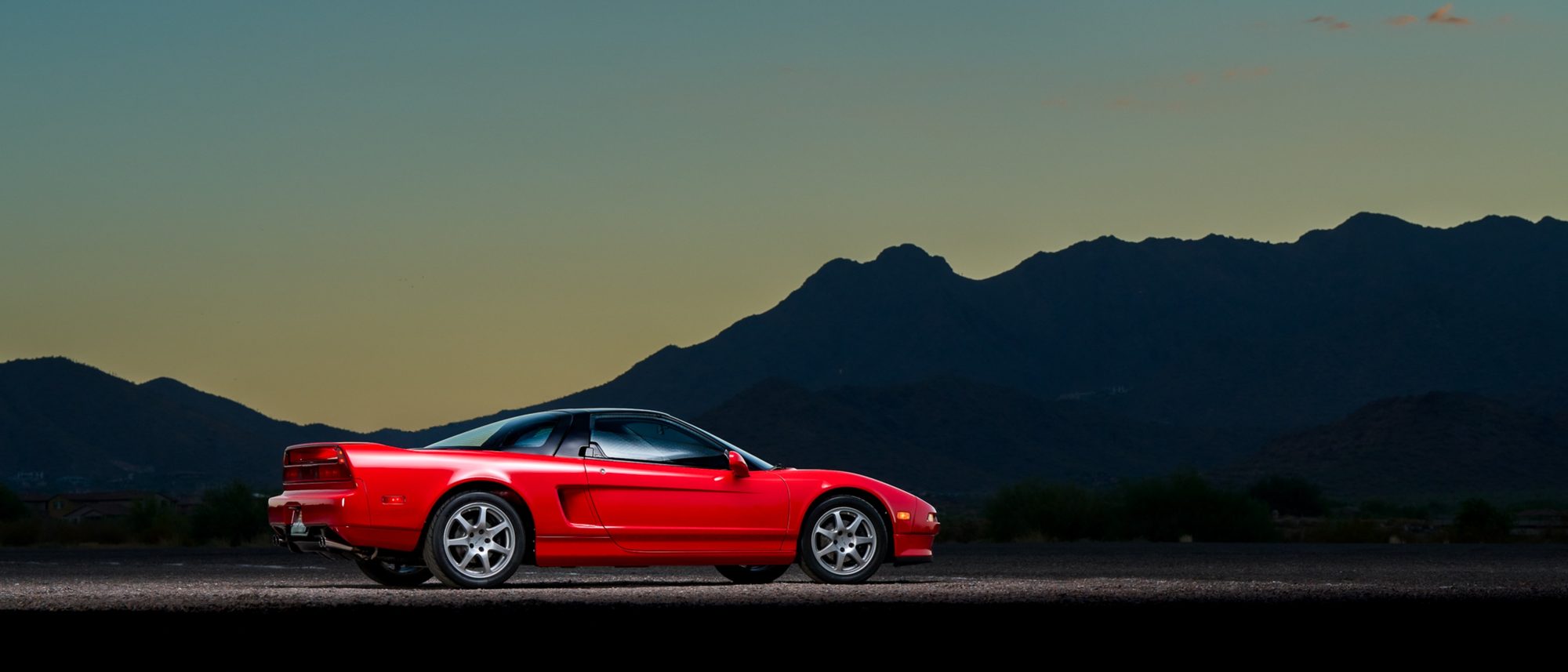
First-generation values have climbed. In 2020, Hagerty reported that NSX values had risen an average of 84 percent over the previous five years, and SlashGear's 2025 look at auction results put most cars between roughly $80,000 and $120,000, depending on condition, year and options. The standout is the Zanardi Edition: 51 US-only 1999-model cars built to mark Alex Zanardi's back-to-back CART championships for Honda in 1997 and 1998, with a lighter fixed roof, no power steering, a lighter battery and forged BBS wheels that together cut about 149 lb. In 2020, the last of the 51 sold on Bring a Trailer for $282,017, double the previous Zanardi record. Whatever the number, it is still a car Honda built to be driven.
Keep it coveredCovers for the NSX, matched to your exact car
Questions owners ask
Does NSX stand for anything?
Loosely. Honda's engineers built the development name NS-X from "new," "sportscar" and X, the mathematical symbol for an unknown. American Honda chose it from a list of candidate names and expressed it as "New Sports eXperimental." The concept drew so much attention that the name stuck, and the hyphen was dropped for the production car.
Did Ayrton Senna help design the NSX?
Not as a designer. Senna tried an NSX prototype in February 1989 and told Honda's engineers it felt "a little fragile." Honda used that comment to raise its rigidity targets, and the development driver, Motoharu Kurosawa, carried the testing that followed at the Nürburgring. Senna gave advice; he did not develop the car.
What is the Zanardi Edition?
A US-only 1999-model special edition built to mark Alex Zanardi's back-to-back CART championships for Honda in 1997 and 1998. Only 51 were built, all in Formula Red, with a lighter fixed roof, manual steering in place of power assist, a lighter battery, single-pane rear glass and lightweight BBS wheels, together about 149 lb lighter than an NSX-T.
Is the new NSX the same car as the original?
No. The second-generation NSX, sold for the 2017 to 2022 model years, replaced the naturally aspirated V6 with a twin-turbo 3.5-liter V6 and three electric motors driving all four wheels, 573 hp combined at launch, from $156,000. It is a much more powerful car built on a completely different formula.
Sources (13)
- In February 1989 Senna evaluated an NSX prototype and said "I'm not sure I can really give you appropriate advice on a mass-production car, but I feel it's a little fragile"; the team raised its rigidity targets in April 1989, tested at the Nürburgring, which exposed the flexing body, and after over eight months raised rigidity 50 percent. Also: NS-X concept shown in Chicago on February 9, 1989; research began January 1984, a year after Honda returned to F1; formal development fall 1985; American Honda wanted a flagship for Acura; rigidity targeted Porsche and Ferrari; the concept's SOHC Legend V6 and Tadashi Kume's push for a VTEC V6; NS-X naming ('New,' 'Sportscar,' X as an unknown; American Honda's 'New Sports eXperimental'; hyphen dropped); the 'daily driving comfort' and 'ran sharply counter to contemporary European exotics' lines and Jon Ikeda's 2019 quote. acuranews.com
- The NSX was the world's first mass-production car with an all-aluminum monocoque body; Senna's February 1989 comment, the April 1989 rigidity target change, eight months of work and the 50 percent rigidity gain; Japanese sales began September 1990; the rigidity target equaled a Porsche or Ferrari; the aluminum body saved 140 kg over a steel-bodied equivalent and nearly 200 kg for the entire car. global.honda
- Senna tested the prototype at Suzuka; he was not the development driver (Motoharu Kurosawa was, and proposed the Nürburgring as the base); transverse rear-mid engine; C30A 270 hp and 210 lb-ft, automatic 252 hp; titanium rods raised maximum rpm by 700 to an 8,000 rpm redline; NSX-T in North America March 1995, largely replacing the coupe there, with the 1999 Zanardi Edition and a handful of special-order cars as the hardtop exceptions; December 2001 facelift with fixed xenon HID headlamps, slightly wider rear tires, stiffer springs and revised tail lights and rear bodywork; no North American hardtop from 2002; production ended November 30, 2005 (began August 1990); Zanardi Edition US-only, a 1999 model, 51 built, Formula Red, fixed roof, single-pane rear glass, manual steering, lighter battery, BBS wheels, 149 lb lighter. en.wikipedia.org
- Acura NSX went on sale in the US in August 1990 and in Japan in September 1990. global.honda
- From 1997 the standard engine with the new close-ratio 6-speed manual is a 3.2-liter V6 making 290 hp and 224 lb-ft; the optional 4-speed automatic keeps a 3.0-liter V6 at 252 hp; the titanium connecting rods were the first application of titanium in a production car. acuranews.com
- The C30A was the second Honda engine to use VTEC, after the four-cylinder B16A (so Honda's first VTEC V6); its titanium connecting rods were a first in a mass-production vehicle. en.wikipedia.org
- Acura lists the NSX (1990) as the first production engine with titanium connecting rods. acuranews.com
- Senna won the Formula 1 world championship in 1988, 1990 and 1991, so in February 1989 he was the reigning champion. en.wikipedia.org
- The first NSX was sold as a 1991 model with a starting price of around $60,000; SlashGear's August 2025 market piece puts most NSXs at roughly $80,000 to $120,000 depending on condition, options and year. slashgear.com
- The 2017 NSX: twin-turbocharged DOHC V6 of 3,493 cc, longitudinally mid-mounted, two front motors plus one direct drive motor, 573 hp total system power, approximately 191 mph top speed. hondanews.com
- The second-generation NSX's North American starting price was announced in December 2015 at US$156,000; model years 2017 to 2022; built at the Performance Manufacturing Center in Marysville, Ohio. For its final model year, 2022, only the limited-production Type S was offered, with system output raised to 602 hp (610 PS). en.wikipedia.org
- Acura unveiled the 1999 Alex Zanardi Edition NSX in November 1998 at the Miami International Auto Show. acuranews.com
- NSX values rose an average of 84 percent over the five years to 2020; the Zanardi Edition marked Zanardi's 1997 and 1998 CART titles, 51 built, lighter fixed roof, no power steering, lighter battery, forged BBS wheels, about 149 lb lighter; chassis 51 of 51 sold on Bring a Trailer for $282,017, doubling the previous $140,000 Zanardi record. hagerty.com
Photos: Josh Bryan - stock.adobe.com