In early 1963, Ford came close to buying Ferrari. It reportedly spent several million dollars on audits and legal negotiations, and then Enzo Ferrari cut off the talks, unwilling to give up control of his racing program. Henry Ford II, enraged, told Ford's racing division to find a way to beat Ferrari in endurance racing, where Le Mans was the race that mattered most. What came out of that grudge, the GT40, won the 24 Hours of Le Mans four years in a row. Ford revived the idea as the Ford GT for 2005, and again for 2017 with a carbon-fiber supercar built about one a day, whose first buyers Ford picked itself.
- The GT40 exists because Ford's 1963 attempt to buy Ferrari collapsed, and Henry Ford II ordered his racing division to beat Ferrari in endurance racing instead.
- It won the 24 Hours of Le Mans four years straight, 1966 through 1969, starting with a controversial 1-2-3 finish.
- The modern Ford GT was built from December 2016 to December 2022 at about one car a day, and Ford chose its first buyers through an application process, not a dealer lot.
- Its twin-turbo 3.5-liter V6 made 647 hp at launch and 660 hp from the 2020 model year on. It is the first Ford GT not powered by a V8.
Why Ford built a car just to beat Ferrari
The short version of the story is almost too tidy to be true, but it holds up. Ford wanted to buy Ferrari in 1963 and reportedly spent several million dollars getting close, before Enzo Ferrari cut off the talks late in the process over who would direct his racing, in particular whether Ferrari could still race at the Indianapolis 500, where Ford was racing Lotus cars powered by its own engines. Henry Ford II's response was to order Ford's racing division to find a way to beat Ferrari in endurance racing, and the showcase was the 24 Hours of Le Mans, a race Ferrari had won six years running.
The car that resulted got its name from a measurement, not a boast. Ford started from Lola's Mk6, a mid-engined car designed by Eric Broadley that already used a Ford V8, and the finished car stood 40 inches tall at the top of the windshield, the minimum the rules allowed. GT40 was a literal description before it was a legend. Early results were dismal enough that Ford handed the program to Carroll Shelby's team after the 1964 season. Shelby's chief test driver, the English-born racer and engineer Ken Miles, played a major role in developing the car.
A new GT wins its class at Le Mans before the first road car is built
The modern Ford GT did not simply borrow the old name. In June 2016, on the 50th anniversary of that first overall win, the No. 68 Ford GT race car took the GTE Pro class at Le Mans, finishing 10.2 seconds ahead of the closest Ferrari after post-race penalties. The road car followed that December, when production began.
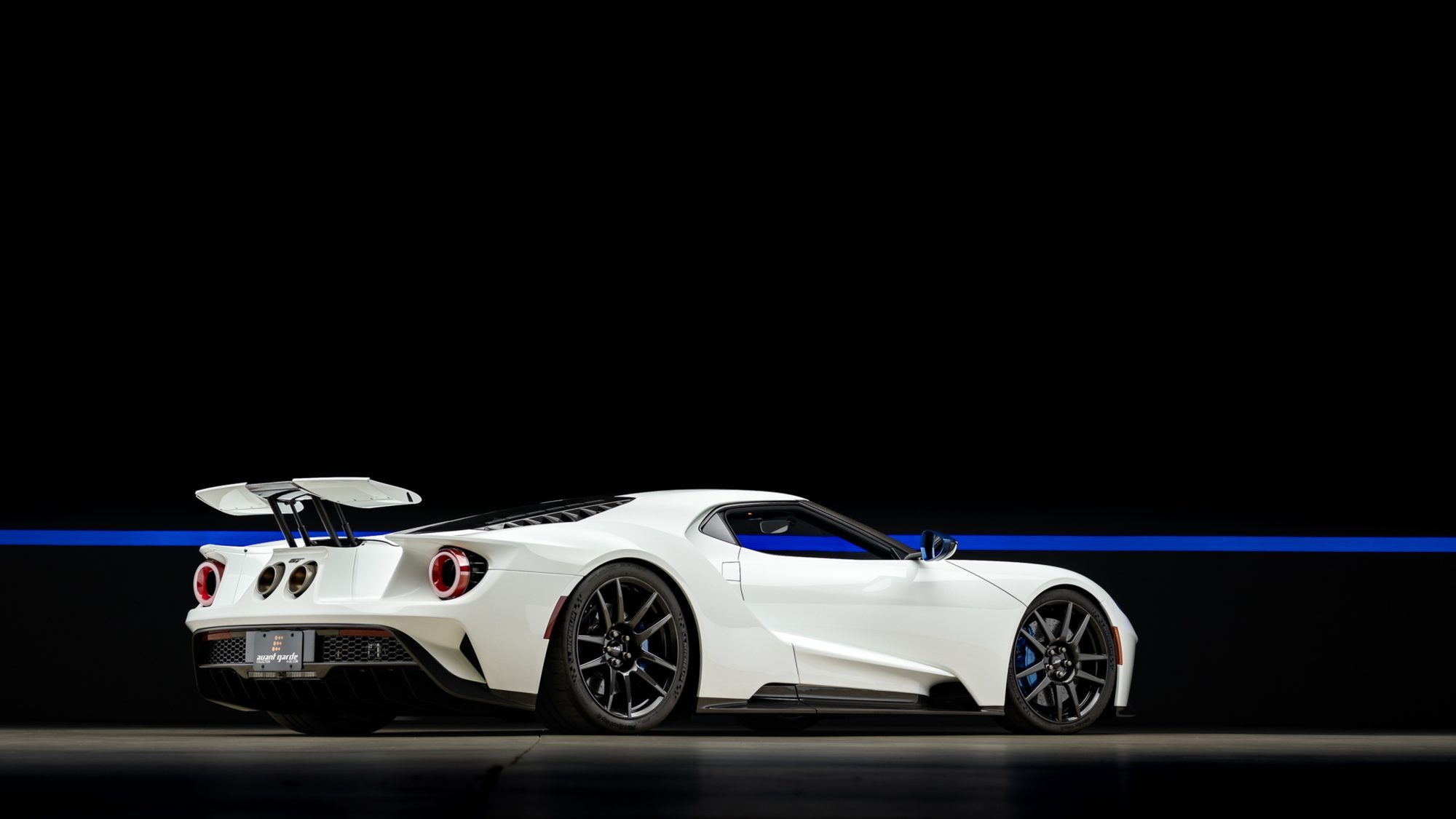
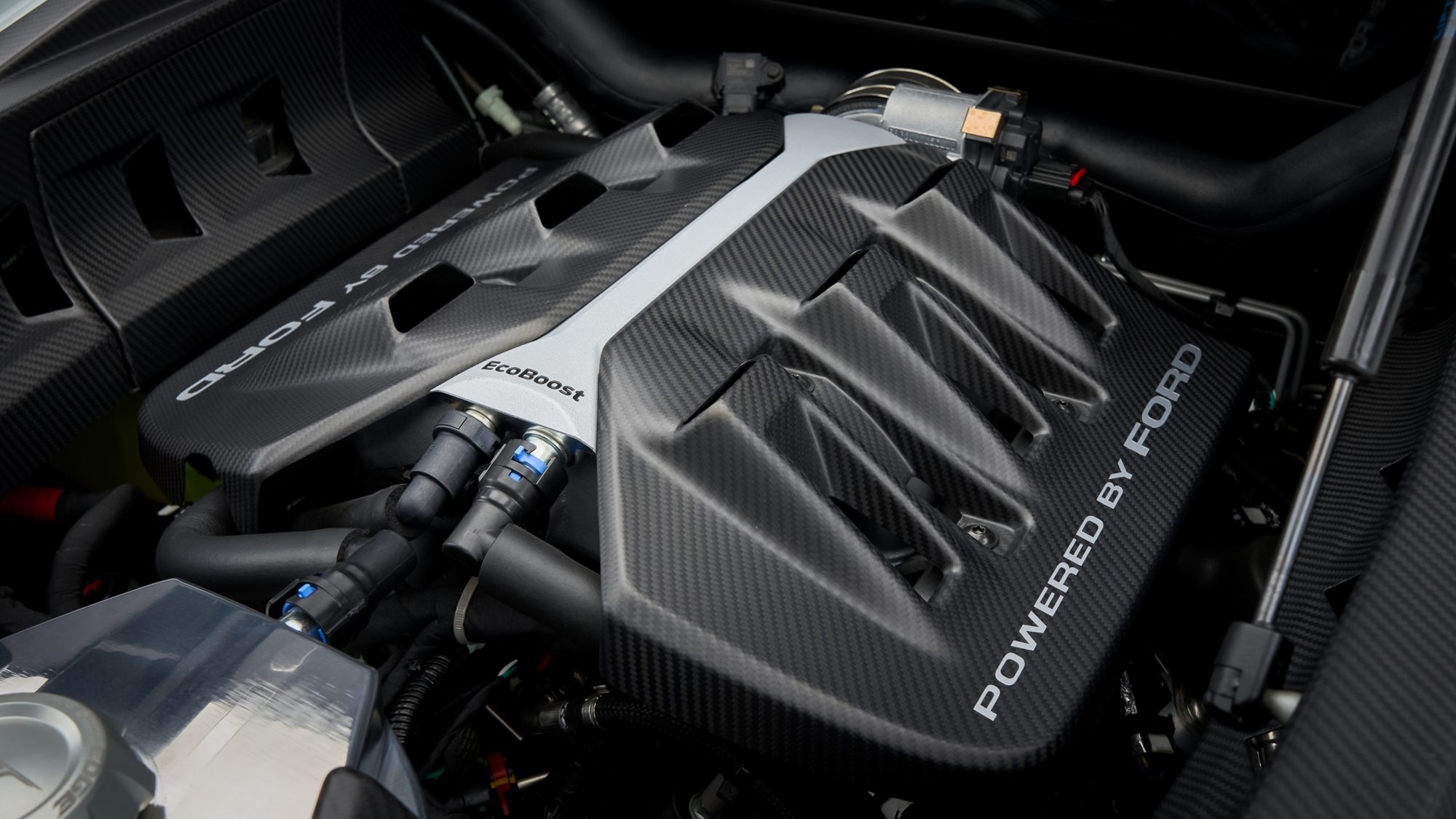
The engine is the part that still surprises people: not a V8, V10 or V12, but a twin-turbocharged 3.5-liter EcoBoost V6 that shares its block, cylinder heads and dual fuel system with the F-150's 3.5-liter V6. The compact V6 is also what made room for the flying buttresses, which channel air around the cockpit and over the active rear wing for downforce. At launch it made 647 hp and 550 lb-ft; Ford raised that to 660 hp starting with the 2020 model year. Car and Driver's testing clocked 0 to 60 mph in 3.0 seconds, and the top speed is 216 mph. Underneath is a carbon-fiber monocoque bolted to aluminum front and rear subframes.
- Engine
- 3.5-liter twin-turbocharged EcoBoost V6
- Output
- 647 hp / 550 lb-ft at launch; 660 hp from the 2020 model year
- 0 to 60 mph
- 3.0 seconds
- Top speed
- 216 mph
- Original price
- $453,750 (2017 base)
- Built
- December 2016 to December 2022
0 to 60 mph is Car and Driver's instrumented test. Curb weight is about 3,354 lb.
 Engine
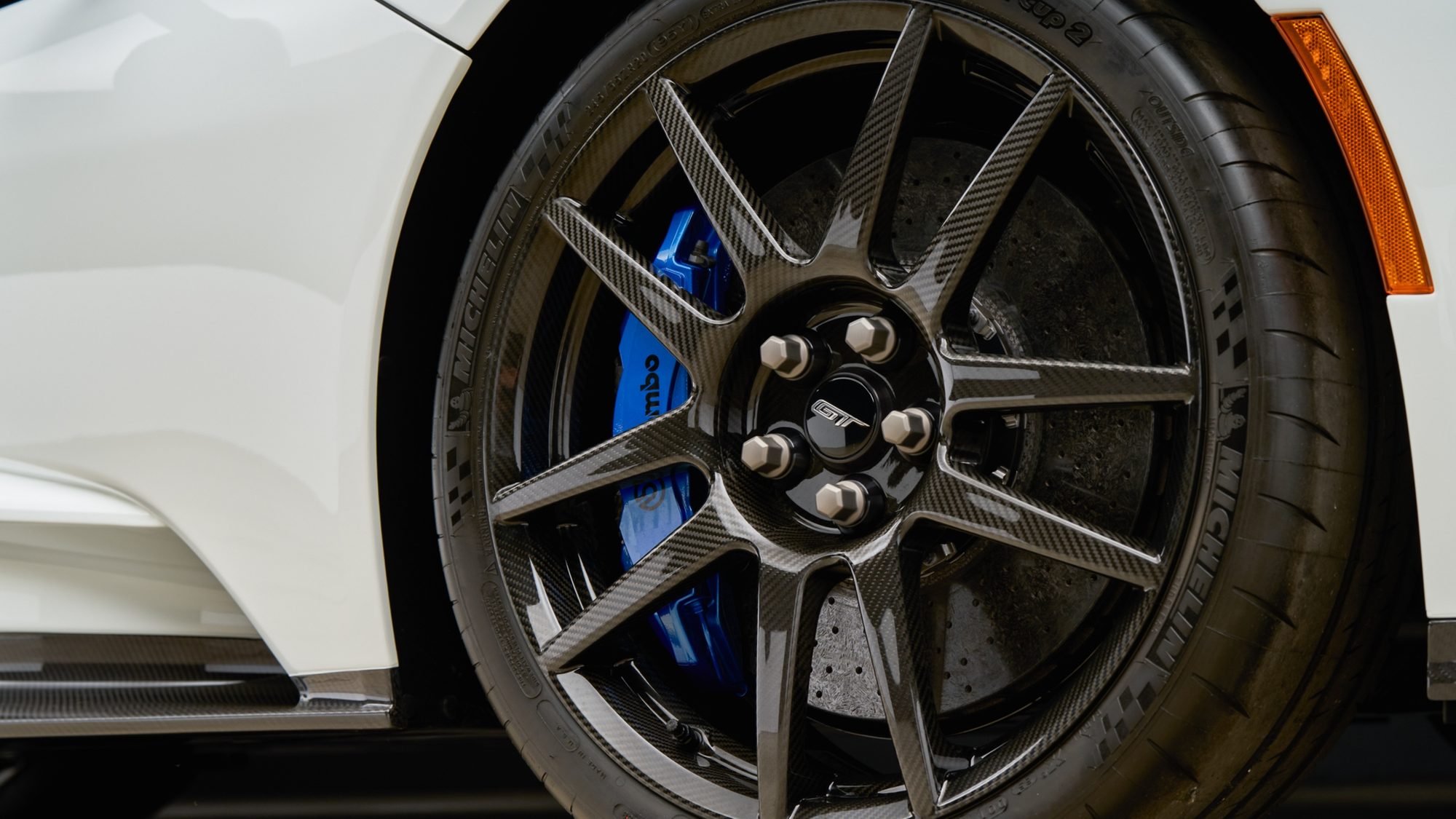 Brakes
One a day, and you had to apply
Ford did not build the modern GT in its own plants. Multimatic assembled it at a low-volume facility in Markham, Ontario, at a rate of about one car a day, with 1,350 cars planned across the whole run. It started at $453,750 for 2017, and Ford limited production to 250 cars a year, with the first round of applications covering 500 cars across the first two years. In the end only 138 were built as 2017 models. Buyers could not simply walk into a dealership, either: the 2017 and 2018 model years were allocated through Ford Performance's application process, the 2019 cars went mainly to applicants who had missed out the first time, and Ford opened the 2020 model year to new customers.
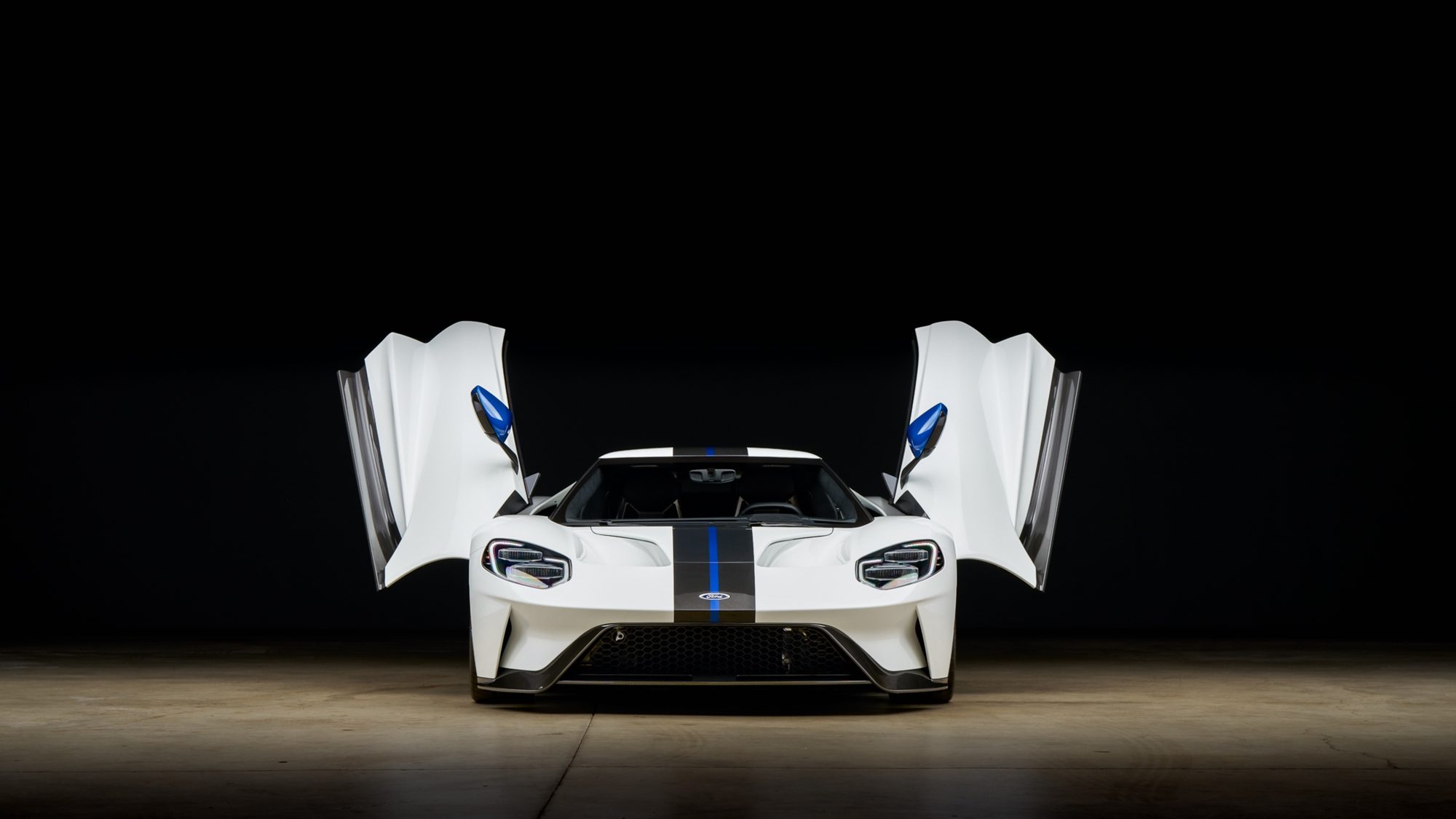 Doors
Doors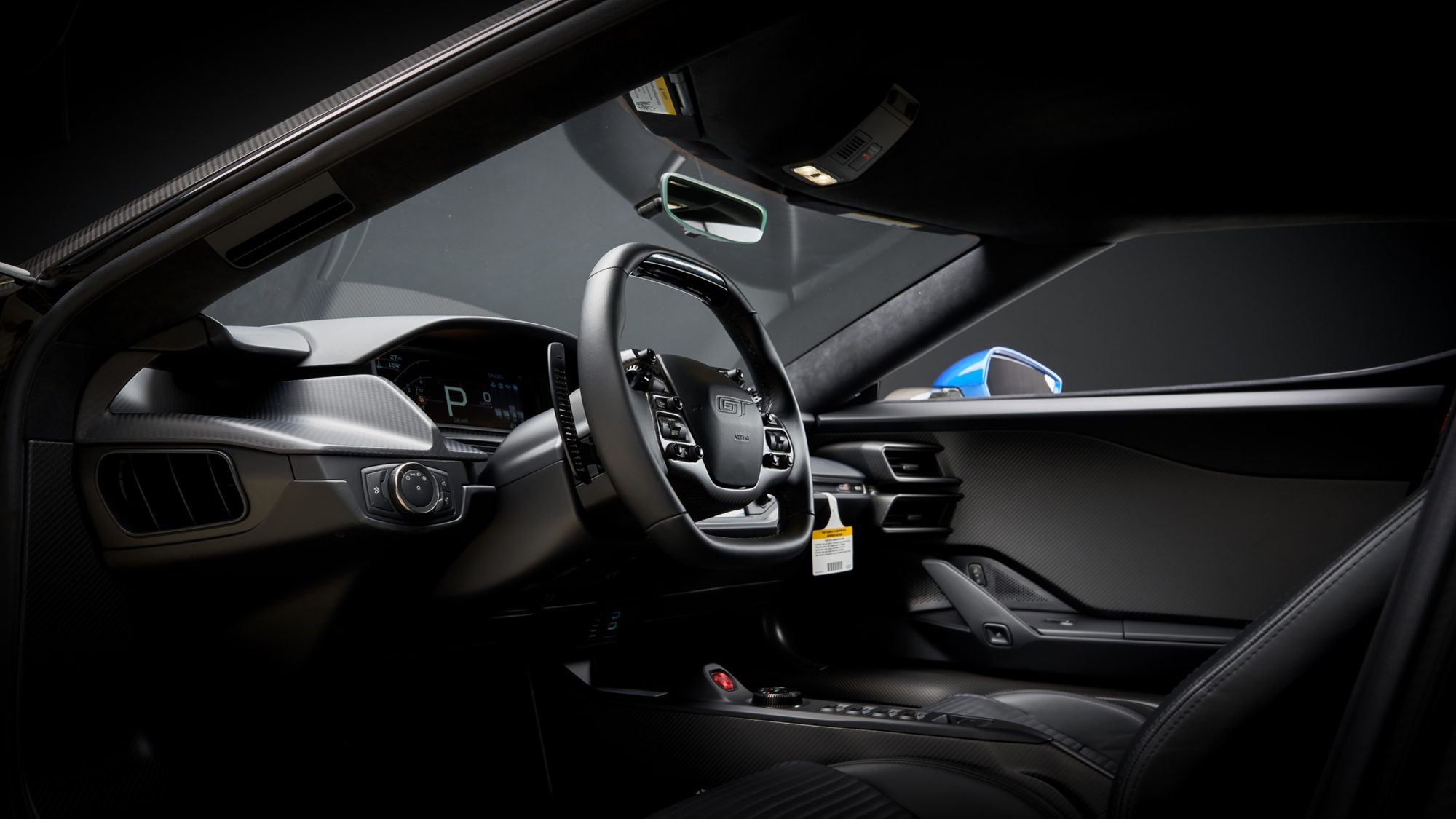 Cockpit
A car built to settle a grudge six decades ago still spends most of its life the way any other car does: parked. Whether it is a GT40 in a private collection or a modern GT between drives, it deserves a cover matched to the exact car, not a generic one pulled off a shelf.
Keep it coveredCovers for the GT, matched to your exact car
Questions owners ask
Did Ford really try to buy Ferrari before building the GT40?
Yes. In 1963 Ford pursued a purchase of Ferrari and reportedly spent several million dollars on audits and legal negotiations before Enzo Ferrari cut off the talks over control of his racing, including whether Ferrari could still race at the Indianapolis 500. Henry Ford II then directed Ford's racing division to find a way to beat Ferrari in endurance racing.
Why is it called the GT40?
GT stands for grand touring. The 40 is the car's height in inches, 40 inches (1.02 m) at the top of the windshield, which was the minimum allowed.
Who actually won the controversial 1966 Le Mans finish, McLaren or Miles?
Officially, Bruce McLaren and Chris Amon. Ken Miles and Denny Hulme, in the leading GT40, were told to slow so the two cars could finish together, but officials awarded the win to McLaren and Amon: their car had started about 47 feet (14 meters) further back on the grid, so it had covered slightly more ground over the 24 hours.
Is the modern Ford GT the same car as the 1960s GT40?
No. They share a name and a Le Mans mission, not a chassis. Ford revived the idea as the Ford GT for the 2005 and 2006 model years, without the 40 because it could not secure the GT40 trademark, and again with the current carbon-fiber GT from the 2017 model year.
Sources (18)
- In 1963 Ford reportedly spent several million dollars on an audit of Ferrari and legal negotiations before Enzo Ferrari cut off talks over the ability to direct his racing, including racing at Indianapolis; Henry Ford II, enraged, directed his racing division to find a company that could build a Ferrari-beater in endurance racing. en.wikipedia.org
- Ferrari won the 24 Hours of Le Mans six years running, 1960 to 1965. en.wikipedia.org
- GT stands for grand touring and 40 is the car's height in inches (1.02 m) measured at the top of the windscreen, the minimum allowed; Ford chose Lola's proposal because the Lola Mk6 already used a Ford V8, and Lola's Eric Broadley contributed. en.wikipedia.org
- After dismal results in 1964 the GT40 program was handed to Carroll Shelby after the 1964 Nassau race. en.wikipedia.org
- Ken Miles was an English racing engineer and driver, chief test driver of Shelby American from 1963, with a major role in developing the racing GT40; he died on 17 August 1966 testing the Ford J-car at Riverside International Raceway. en.wikipedia.org
- At the 1966 24 Hours of Le Mans (18 and 19 June), three Ford GT40 Mk IIs finished 1-2-3: McLaren/Amon, Miles/Hulme, Bucknum/Hutcherson. Miles was told to slow for a dead-heat finish; McLaren's #2 had started fourth on the grid, about 47 feet (14.28 meters) behind Miles's #1 in second, and was declared the winner because the rules for same-lap cars finishing together took starting position into account. en.wikipedia.org
- McLaren's #2 started fourth on the grid, 14.28 meters behind Miles's #1, which started second; with a further 6 meters gap at the finish line, the total margin was just over 20 meters, the closest finish in Le Mans history to that point. 24h-lemans.com
- The GT40 won Le Mans four consecutive times, 1966 through 1969: Mk II in 1966, Mk IV in 1967, Mk I in 1968 and 1969. en.wikipedia.org
- Ford could not agree terms for the GT40 trademark, so the 2005 production car was named Ford GT without the 40. en.wikipedia.org
- On the day of the 50th anniversary of its first overall Le Mans win, Ford won LMGTE Pro at the 2016 24 Hours of Le Mans with the No. 68 Ford GT (Joey Hand, Sebastien Bourdais, Dirk Muller), 10.2 seconds ahead of the second-place Risi Competizione Ferrari after post-race penalties. en.wikipedia.org
- The first-generation Ford GT covered the 2005 and 2006 model years; the second generation was built December 2016 to December 2022, about one car per day, at Multimatic's low-volume assembly facility in Markham, Ontario, with 1,350 units planned. en.wikipedia.org
- The second-generation GT's 3.5-liter twin-turbo EcoBoost V6 shares its cylinder heads, block and dual fuel system with the F-150's 3.5-liter V6; it made 647 hp and 550 lb-ft at launch and 660 hp from the 2020 model year; the flying buttresses, enabled by the compact V6, channel air over the active rear spoiler; the chassis is a carbon fiber monocoque bolted to aluminum subframes; curb weight 3,354 lb; top speed 216 mph. en.wikipedia.org
- 2017 Ford GT: original base MSRP $453,750; 647 hp, the most powerful EcoBoost Ford had built; first Ford GT not powered by a V8. caranddriver.com
- Car and Driver's full instrumented test of the 2017 Ford GT recorded 0 to 60 mph in 3.0 seconds, 0 to 100 mph in 6.2 seconds, the standing quarter-mile in 10.8 seconds at 134 mph, and a manufacturer-claimed drag-limited top speed of 216 mph. caranddriver.com
- Ford GT production was limited to 250 units per year; the initial ordering period covered the first two years of production, 500 vehicles. media.ford.com
- Only 138 Ford GTs were built as 2017 models, short of the 250 a year Ford had promised. motorauthority.com
- The 2017 and 2018 model years were allocated through Ford Performance's vehicle allocation process; 2019 went primarily to buyers unsuccessful in the initial selection; 2020 and later were for new customers. en.wikipedia.org
- The track-only GT Mk II launched on 4 July 2019, is not street legal, and was limited to 45 cars at a unit price of US$1.2 million. en.wikipedia.org
Photos: Josh Bryan/stock.adobe.com