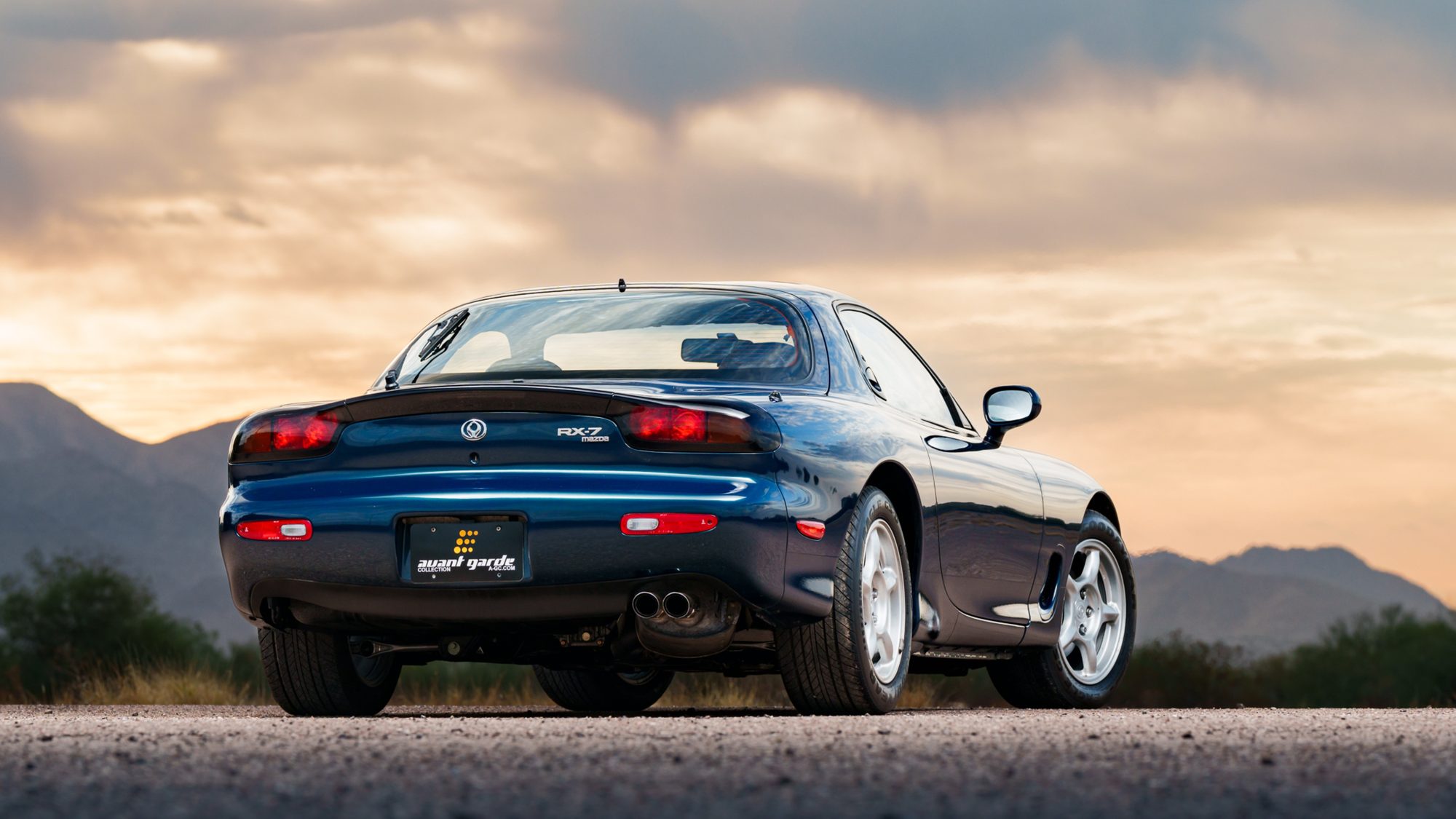
Most sports cars get their speed from a bigger engine. The third-generation Mazda RX-7, sold in North America only for the 1993 to 1995 model years, took a different route: a 1.3-liter twin-rotor Wankel with no pistons at all, fed by the first mass-produced sequential twin-turbo system ever exported from Japan. It made 255 horsepower from an engine compact enough to sit behind the front axle line, in a car that weighed about 2,800 lb, and Mazda claimed 0 to 60 mph in 4.9 seconds. Enthusiasts know this generation by its chassis code, FD, and Japan kept building it until 2002. In the United States it was gone after three model years and fewer than 14,000 cars.
- The FD was the RX-7's third generation, built in Japan from 1991 to 2002 but sold new in the US and Canada only for the 1993 to 1995 model years, fewer than 14,000 of them for the US.
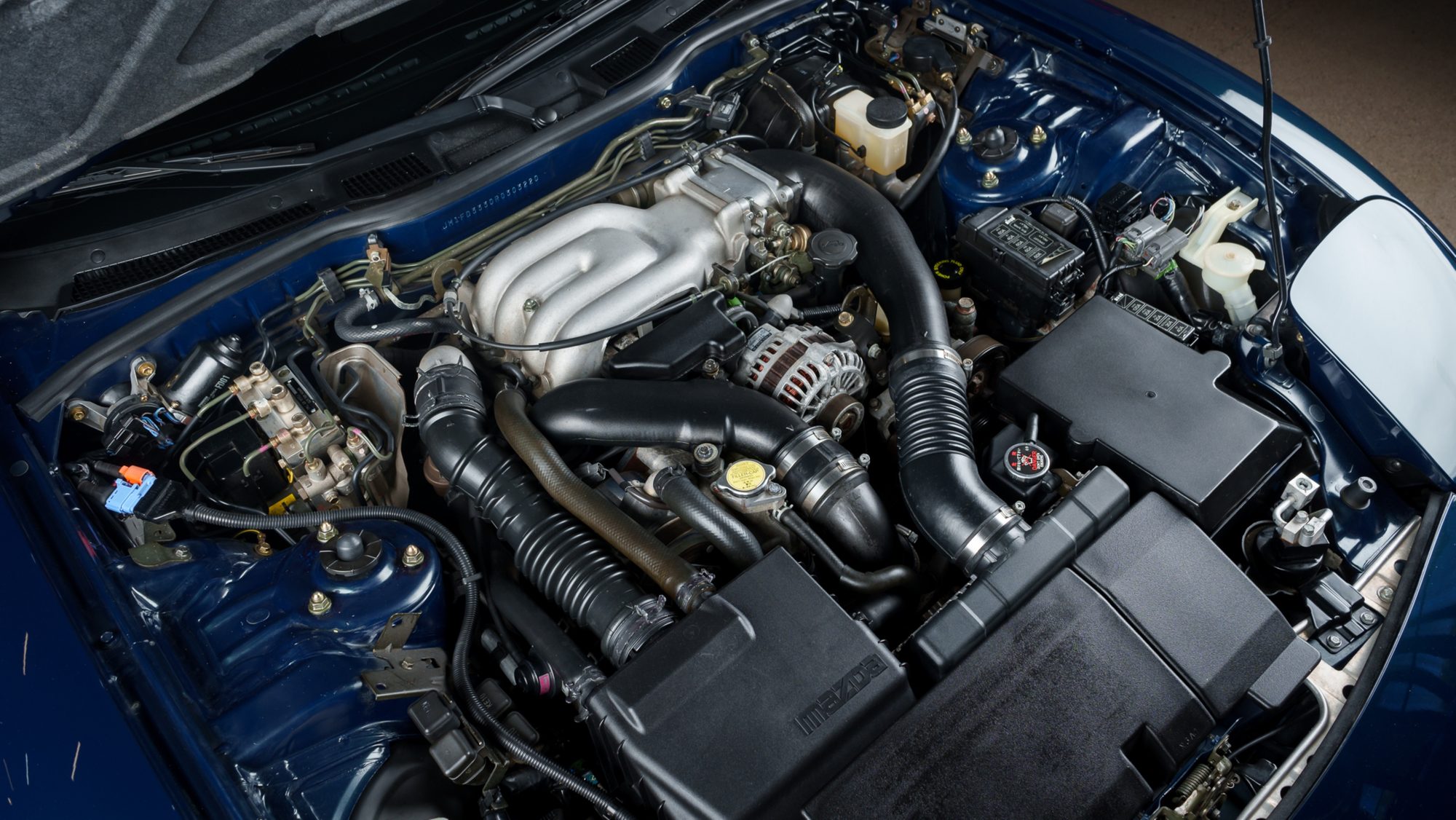
- Its 13B-REW engine is a 1.3-liter twin-rotor Wankel with sequential twin turbos, the first mass-produced sequential twin-turbo system exported from Japan. US cars made 255 hp and 217 lb-ft, with no pistons anywhere in the engine.
- Rotary engines use a little oil by design: a metering pump feeds a small amount of engine oil in to lubricate the rotor seals, and it burns off with the fuel.
- New, it started at about $32,500. On Bring a Trailer in 2023, a low-mile 1993 R1 sold for $80,500 and a silver 1994 R2 for $148,000, then the site's record for the FD.
The third RX‑7, and the last one Americans could buy new
The RX-7 nameplate goes back to 1978, and the FD was its third generation, following the original SA22C and the second-generation FC of 1985 to 1992. Mazda announced the new car in October 1991: a lower, more rounded body, two seats for North America, and the rotary engine packaged behind the front axle line and low in the chassis for a 50:50 weight distribution. It went on sale in Japan that December and reached the United States and Canada as a 1993 model. It lasted three model years there. The price climbed from about $32,500 at launch to about $36,500 for a base car by 1995, sales slowed, and Mazda ended North American sales after the 1995 model year, when an estimated 500 cars were built. Japan kept building the FD through two more rounds of updates, known as Series 7 and Series 8, until August 2002.
An engine that spins instead of pumps
A normal engine burns fuel in cylinders and turns that push into rotation through pistons, rods and a crankshaft. The Wankel rotary Mazda used skips that translation step: a rounded, triangular rotor turns inside a housing shaped roughly like a fat figure eight, and the spaces between the two do the job a piston and cylinder do, without anything ever stopping and changing direction. The result is an engine with far more power for its weight than a piston engine, and easier to package in a small engine bay. With two turbochargers added, the FD's engine, at 1.3 liters across its two rotors, made 255 horsepower and revved smoothly to redline with none of the reciprocating mass a piston engine has to manage.
- Engine
- 1.3-liter 13B-REW twin-rotor Wankel, sequential twin turbos
- Output
- 255 hp at 6,500 rpm, 217 lb-ft at 5,000 rpm
- Transmission
- 5-speed manual standard, 4-speed automatic optional
- Starting price
- About $32,500 (1993)
US-market figures. Japan kept the same basic engine through 2002 and raised output to 280 PS by the end of production.
A cockpit built around the driver
The FD's cabin put its two seats low and close together, around a dashboard that wraps toward the driver, with the shifter and climate controls stacked tightly on a narrow center console. At launch, the base car came with a 5-speed manual, rear-wheel drive, a limited-slip differential, anti-lock brakes and a driver's airbag, with cloth seats and a cassette stereo. The Touring package added a glass sunroof, leather seats, fog lights, a rear wiper and a Bose Acoustic Wave stereo with a CD player.
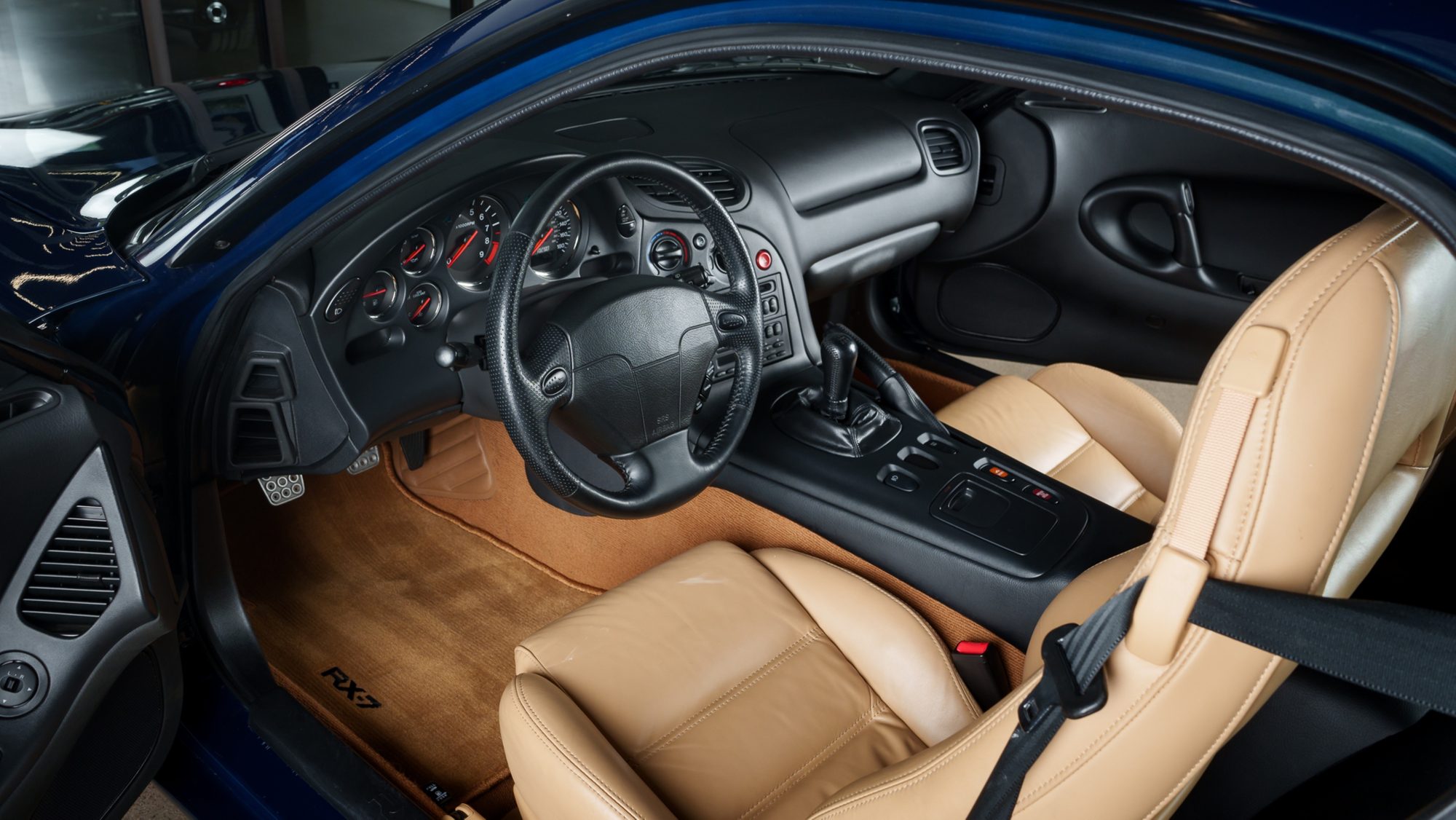 Cockpit
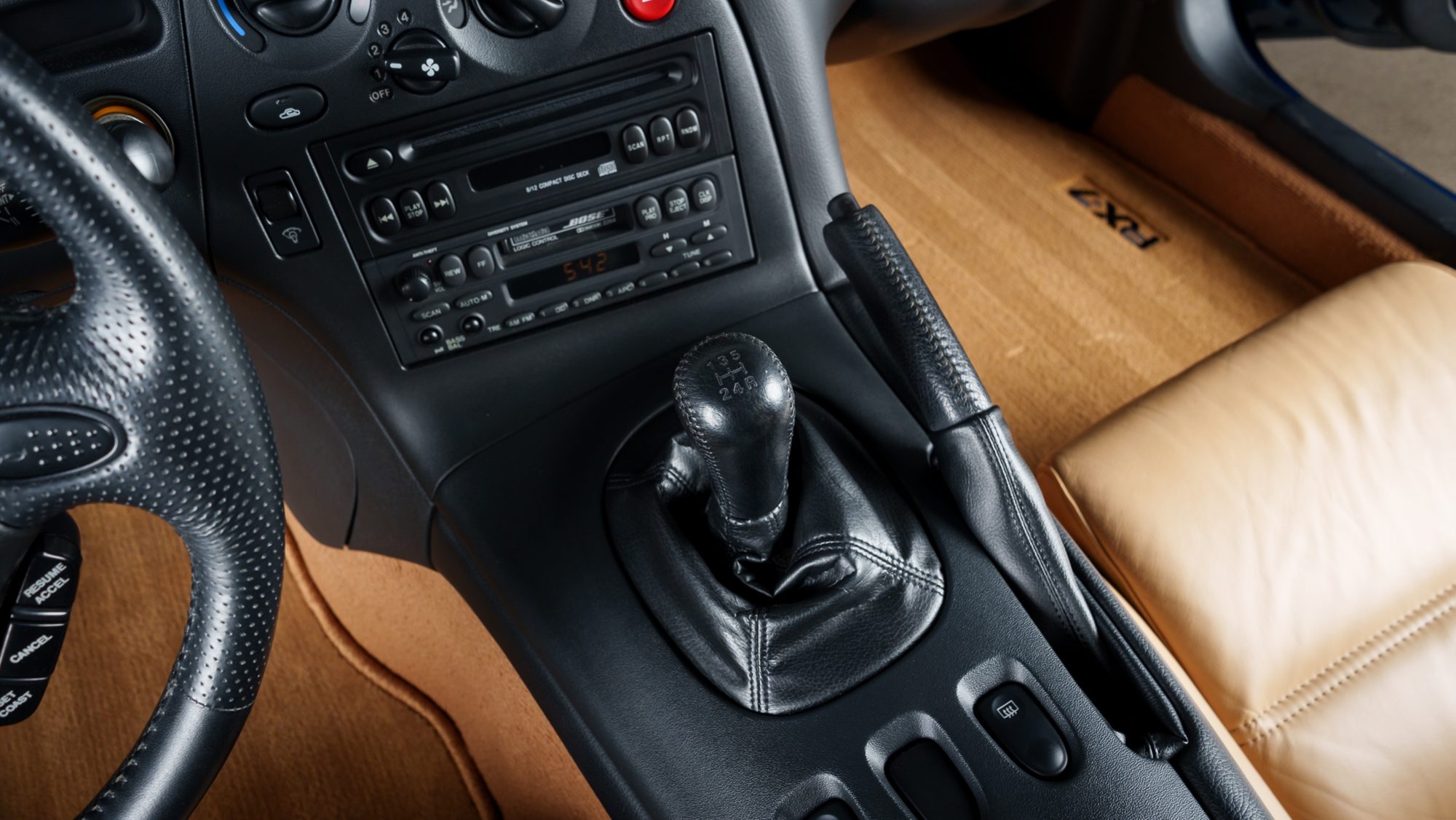 Shifter
At the top of the US lineup sat the R1 package for 1993, renamed R2 for 1994 and 1995, when it got slightly softer suspension. It was built for drivers who wanted grip over comfort: upgraded springs, Bilstein shocks, an extra engine oil cooler, a front strut brace, a front lip and rear wing, faux suede seats and Z-rated Pirelli tires, and the R1 did without cruise control. Some color and year combinations are genuinely rare: Mazda USA sold just 138 Brilliant Black R1s for 1993 and 83 Silverstone Metallic R2s for 1994.
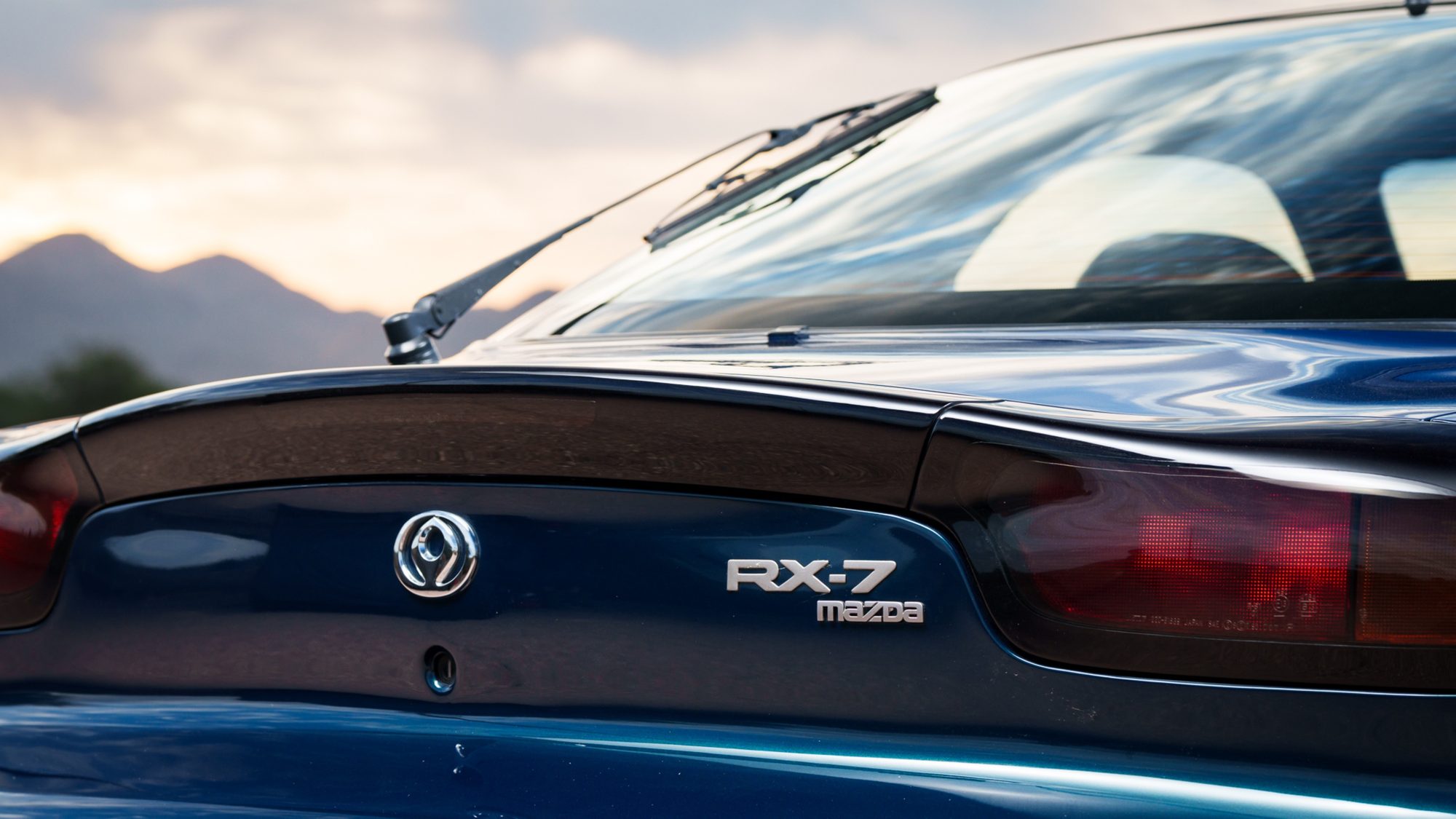
Worth a lot more than it cost new
A new RX-7 started at about $32,500 in 1993. The best surviving cars have since sold for far more. In June 2023, a silver 1994 R2 with under 7,000 miles sold on Bring a Trailer for $148,000, the site's record for the FD at the time, and later that year a 1993 R1 with about 8,000 miles sold there for $80,500. Those are the top of the market, not the norm: The Autopian noted that FD values had been trending down since the second quarter of 2022, and mileage, condition and originality decide what any one car is worth.
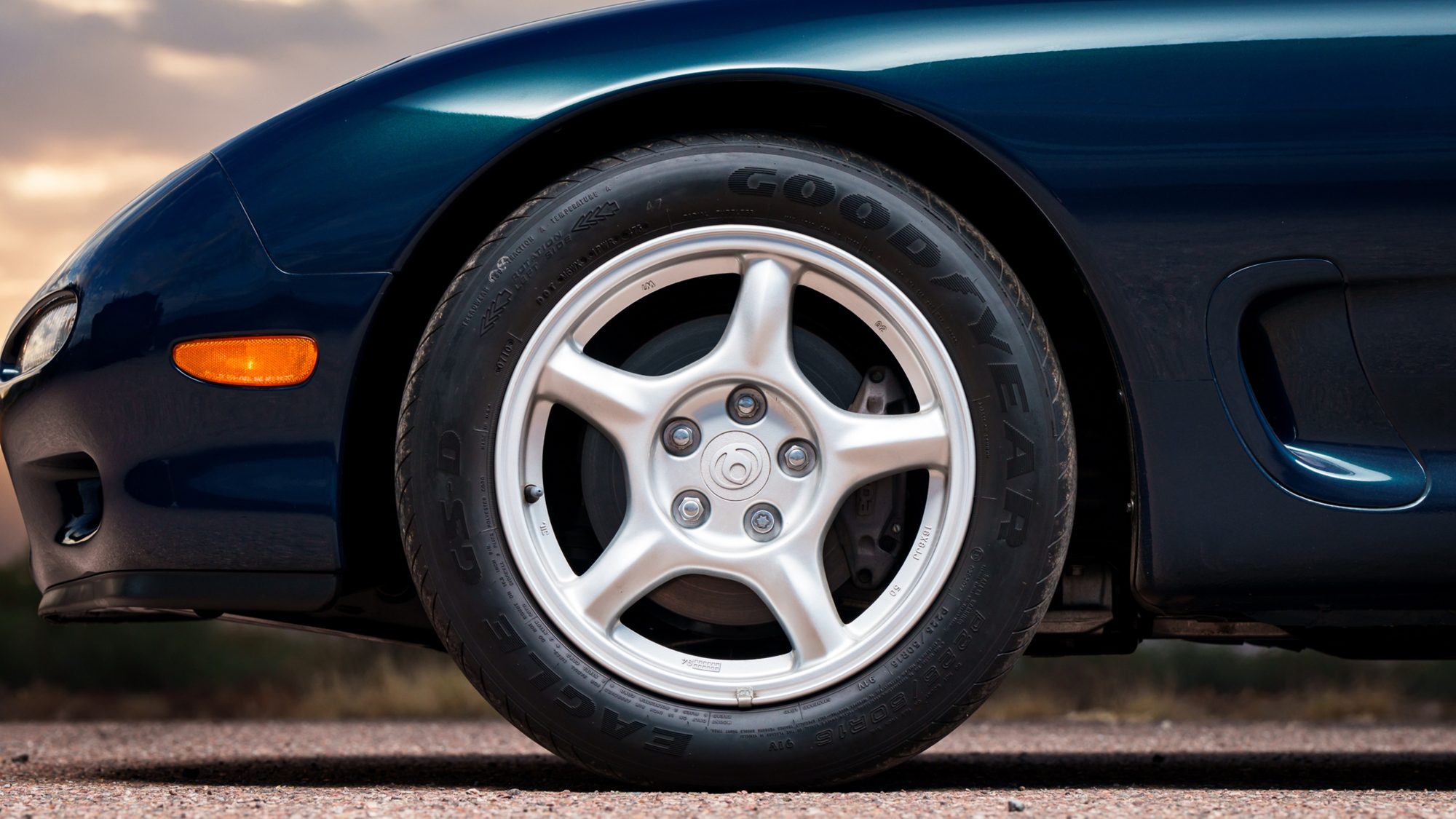
None of that is really about horsepower. Plenty of cars from the 1990s made more of it. What the FD RX-7 has that most of them do not is an engine unlike almost anything else on the road, a US sales run short enough to make every surviving car feel a little rarer than it is, and a shape that still looks like it is moving when it is parked at the curb.
Keep it coveredCovers for the RX-7, matched to your exact car
Questions owners ask
Why did the Mazda RX-7 only sell in the US for three years?
Sales slowed as the price rose, from about $32,500 in 1993 to about $36,500 for a base car by 1995, and Mazda ended RX-7 sales in the US and Canada after the 1995 model year, when an estimated 500 cars were built. Japan kept building the FD until August 2002.
Does a rotary engine have pistons?
No. A Wankel rotary engine, the type Mazda used in every RX-7, replaces pistons and rods with a rounded, triangular rotor that turns inside a housing shaped roughly like a figure eight, driving an eccentric output shaft. The RX-7 FD's 13B-REW paired two of those rotors with sequential twin turbochargers.
Is it normal for a rotary engine to burn oil?
A small amount, yes, by design. Mazda's rotaries use a metering oil pump to feed a measured amount of engine oil in to lubricate the rotor seals, and that oil burns off with the fuel. Check the level regularly, and have a rotary specialist inspect an engine that uses much more than normal.
What were the RX-7 R1 and R2 packages?
The performance package at the top of the US lineup: R1 for 1993, renamed R2 for 1994 and 1995 with slightly softer suspension. It added upgraded springs, Bilstein shocks, an extra engine oil cooler, a front strut brace, a front lip and rear wing, faux suede seats and Z-rated Pirelli tires, and the R1 did without cruise control. Some colors are very rare, such as the 83 Silverstone Metallic R2s sold in the US for 1994.
Sources (12)
- FD production October 1991 to August 2002, on sale in Japan from December 1991; sold in the US and Canada for 1993 to 1995; North American cars were two-seaters; Series 6 (1992 to 1995), Series 7 (1996 to 1998), Series 8 (1998 to 2002); the 13B-REW was the first-ever mass-produced sequential twin-turbocharger system exported from Japan, 255 PS in 1992 rising to 280 PS by 2002; the system was developed with the aid of Hitachi and previously used on the Japan-only Cosmo JC; primary turbo boost from 1,800 rpm, changeover at 4,500 rpm; base/Touring/R1 (renamed R2 in 1994); 5-speed manual standard, 4-speed automatic on base and Touring; driver airbag and ABS standard; Touring had a glass moonroof, fog lights, leather, rear wiper and Bose Acoustic Wave system with CD; R1/R2 had upgraded springs, Bilstein shocks, an additional oil cooler, front lip and rear wing, faux suede seats and Pirelli Z-rated tires; cruise control deleted on the R1; R2 had slightly softer suspension; an estimated 500 built for 1995, discontinued in North America due to slow sales. en.wikipedia.org
- The engine's compact size and light weight let it be packaged behind the front axle line and low in the chassis for a 50:50 weight distribution; the original RX-7 debuted in 1978 and the FC ran 1985 to 1992; the second turbo joins at around 4,500 rpm. evo.co.uk
- The JC Cosmo's 13B-RE and 20B-RE engines were the first Japanese-built, series-production sequential twin-turbo systems offered on any car; the Cosmo was sold in Japan only. en.wikipedia.org
- 255 hp and 217 lb-ft; 5-speed manual or 4-speed automatic; a driver's airbag, all-disc anti-lock brakes and a limited-slip differential standard at launch; for 1994, dual airbags, a power steel sunroof instead of glass on the Touring, a softer suspension setting especially on base and Touring cars, and the performance package renamed R-2; base price had reached $36,500 by the 1995 model year. consumerguide.com
- US-spec output of 255 hp at 6,500 rpm and 217 lb-ft at 5,000 rpm; 1993 base price of $32,550; 2,800 lb curb weight. conceptcarz.com
- Mazda claimed 0 to 60 mph in 4.9 seconds for the 1993 RX-7; it weighed less than 2,800 lb; 255 hp and 217 lb-ft from the 1.3-liter two-rotor engine. autoguide.com
- US-market total of roughly 13,879 cars across 1993 to 1995; launch price of $32,500. jdmbuysell.com
- Base cars had cloth seats, a limited-slip differential and a tape player; the Touring package had leather, sunroof, Bose Wave stereo, fog lights and rear wiper; the R1 dropped the sunroof, cruise control and CD player and added suede seats, stiffer springs, Bilstein shocks, a front strut bar, an additional oil cooler and front and rear spoilers; approximately 13,879 cars were produced for the US. lbilimited.com
- 0 to 60 mph of about 4.9 seconds, 2,800 lb curb weight, $31,000 price, and a production total of 13,879 for the 1993 to 1995 North American cars. supercars.net
- A silver 1994 R2 with 6,743 miles sold on Bring a Trailer for $148,000 in June 2023, the record for the FD there at the time; a 1993 R1 with 8,253 miles sold for $80,500; Mazda USA sold 138 Brilliant Black R1 cars for 1993 and 83 Silverstone Metallic R2s for 1994; R1/R2 cars had twin oil coolers, brake ducts, a front tower brace, retuned suspension and aero add-ons; the FD market had been trending downward since the second quarter of 2022. theautopian.com
- A Wankel rotor, shaped like a Reuleaux triangle, spins inside a figure-eight-like epitrochoidal housing while its midpoint circles the output shaft; Wankels have a far higher power-to-weight ratio than piston engines and are easier to package in small engine bays; they tend to run relatively high oil consumption, burning oil in the combustion areas. en.wikipedia.org
- Mazda's rotary engines use a metering oil pump feeding oil injection ports in the rotor housings to lubricate the rotor faces and seals. en.wikipedia.org
Photos: Josh Bryan - stock.adobe.com