In August 1964, Ford gave Carroll Shelby the go-ahead to turn its new Mustang fastback into something that could win on a racetrack, not just look fast in a driveway. Shelby American pulled the back seat, reworked the engine, suspension and brakes, and put a new name on the rocker stripes: GT350. The car won its SCCA class three years running, spawned a rental-car legend, and started a nameplate Shelby American still puts on Mustangs today.
- In 1964, Ford asked Carroll Shelby to turn the new Mustang fastback into an SCCA road racer that could take on the Corvette.
- Shelby's shop reworked the K-code 289 to 306 hp and pulled the rear seat so the car would qualify as a two-seat sports car. Just 562 were built for 1965, all Wimbledon White with Guardsman Blue rocker stripes.
- Shelby built 34 GT350R race cars, and GT350s won the SCCA B-Production national championship three years straight, 1965 through 1967.
- For 1966 the car gained an optional rear seat, an optional automatic and new colors, and production jumped to 2,378, about 1,000 of them GT350H cars for Hertz's rental fleet.
Ford handed Shelby a Mustang and one job
The Mustang sold more than 400,000 copies in its first year. In August 1964, Ford gave Carroll Shelby the go-ahead to turn the new fastback into a car that could race in Sports Car Club of America (SCCA) road racing and take on the Corvette there. Shelby American took delivery of fastbacks built with the 271 hp "K-code" high-performance 289 and converted them in Los Angeles, first at its Venice shop and later at a facility at Los Angeles International Airport.
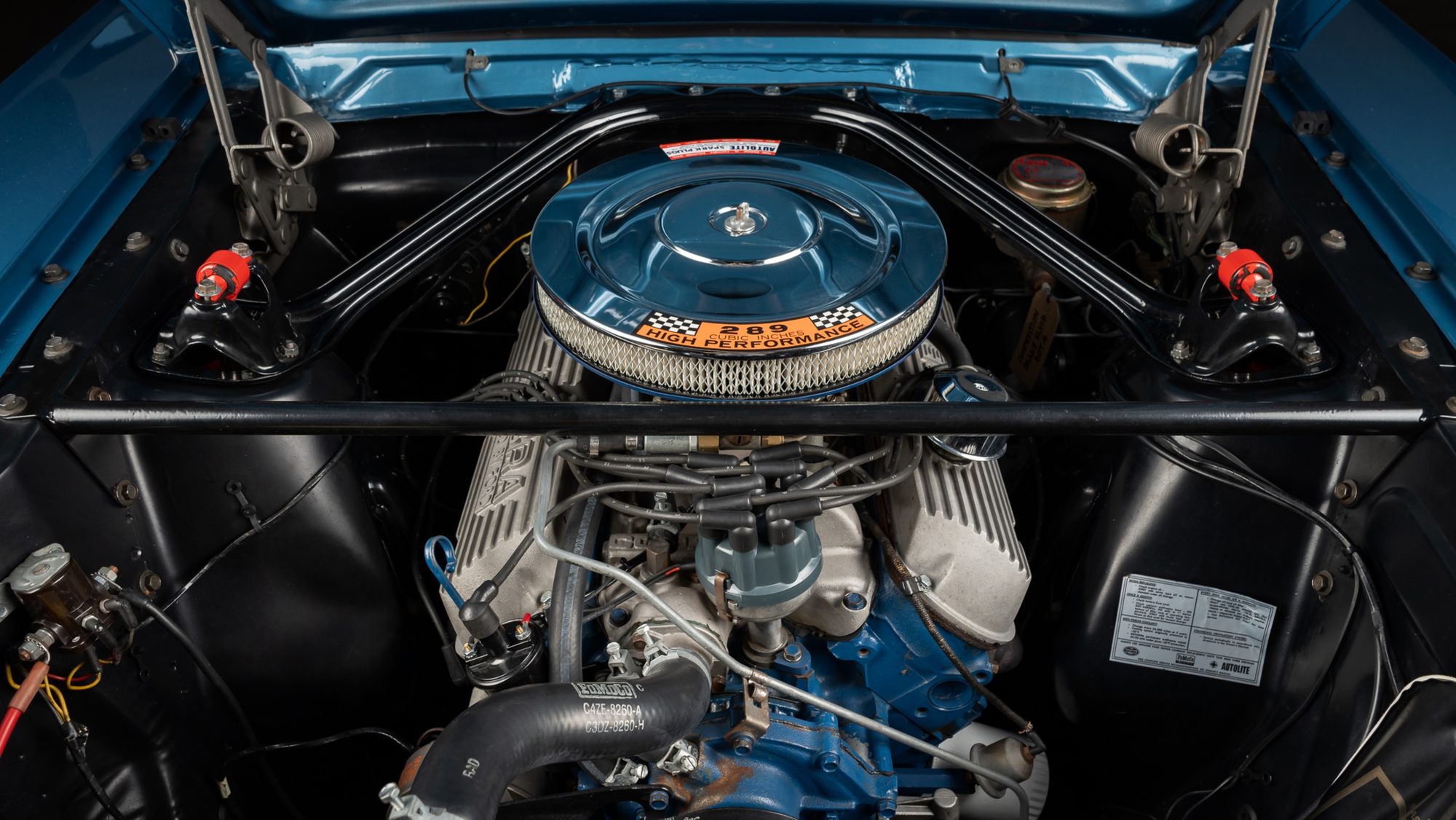
Under the hood, Shelby's crew added an aluminum high-rise intake manifold, a large Holley four-barrel carburetor, tubular Tri-Y headers and a larger radiator from the full-size Galaxie. The front upper control arms were relocated to lower the car about an inch, adjustable Koni shocks and a one-inch front sway bar went on, and the brakes grew to Kelsey-Hayes front discs and larger rear drums with metallic linings. The result was rated at 306 hp at 6,000 rpm and 329 lb-ft of torque at 4,200 rpm, in a car that weighed about 2,800 lbs.
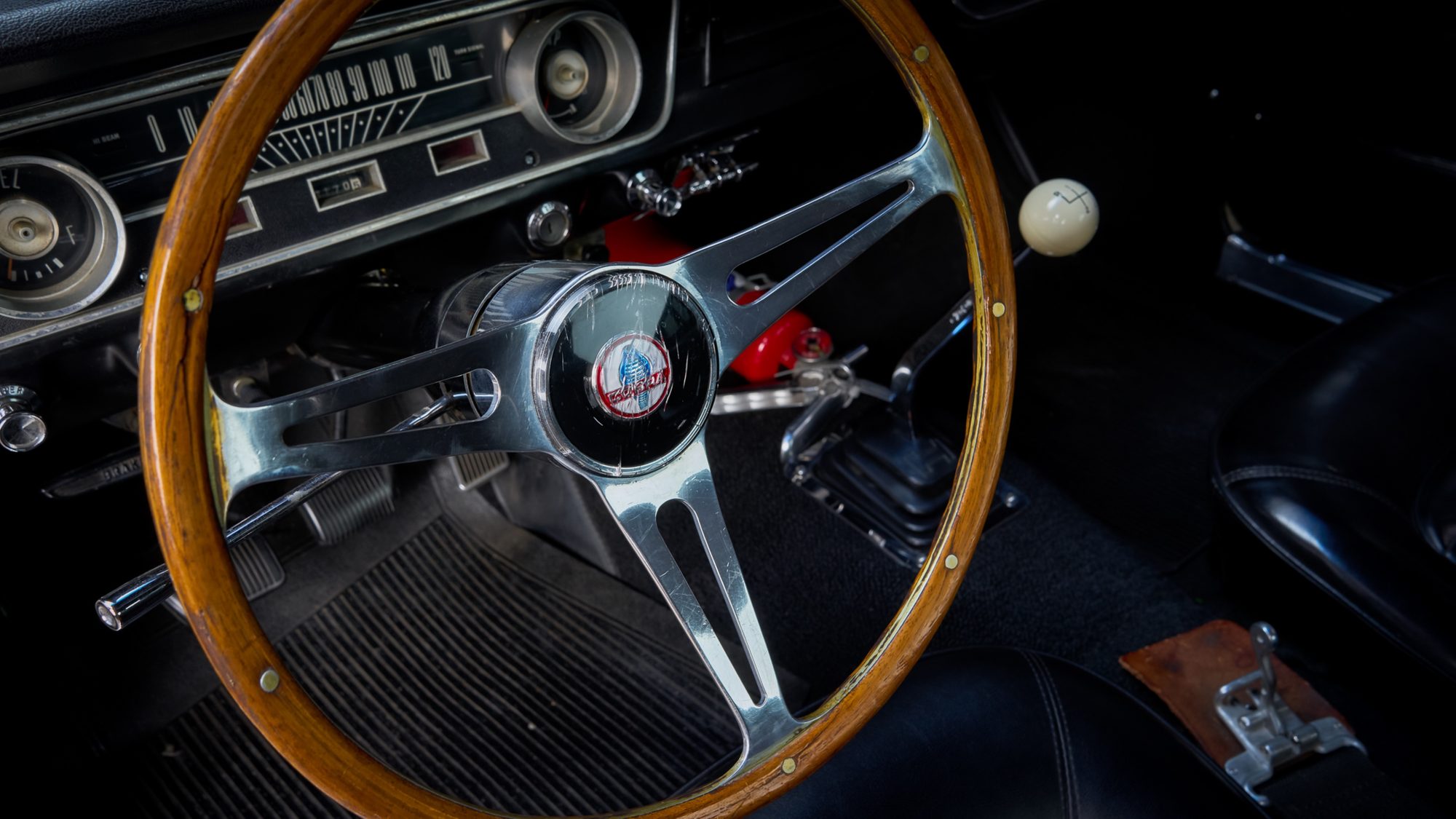 Cockpit
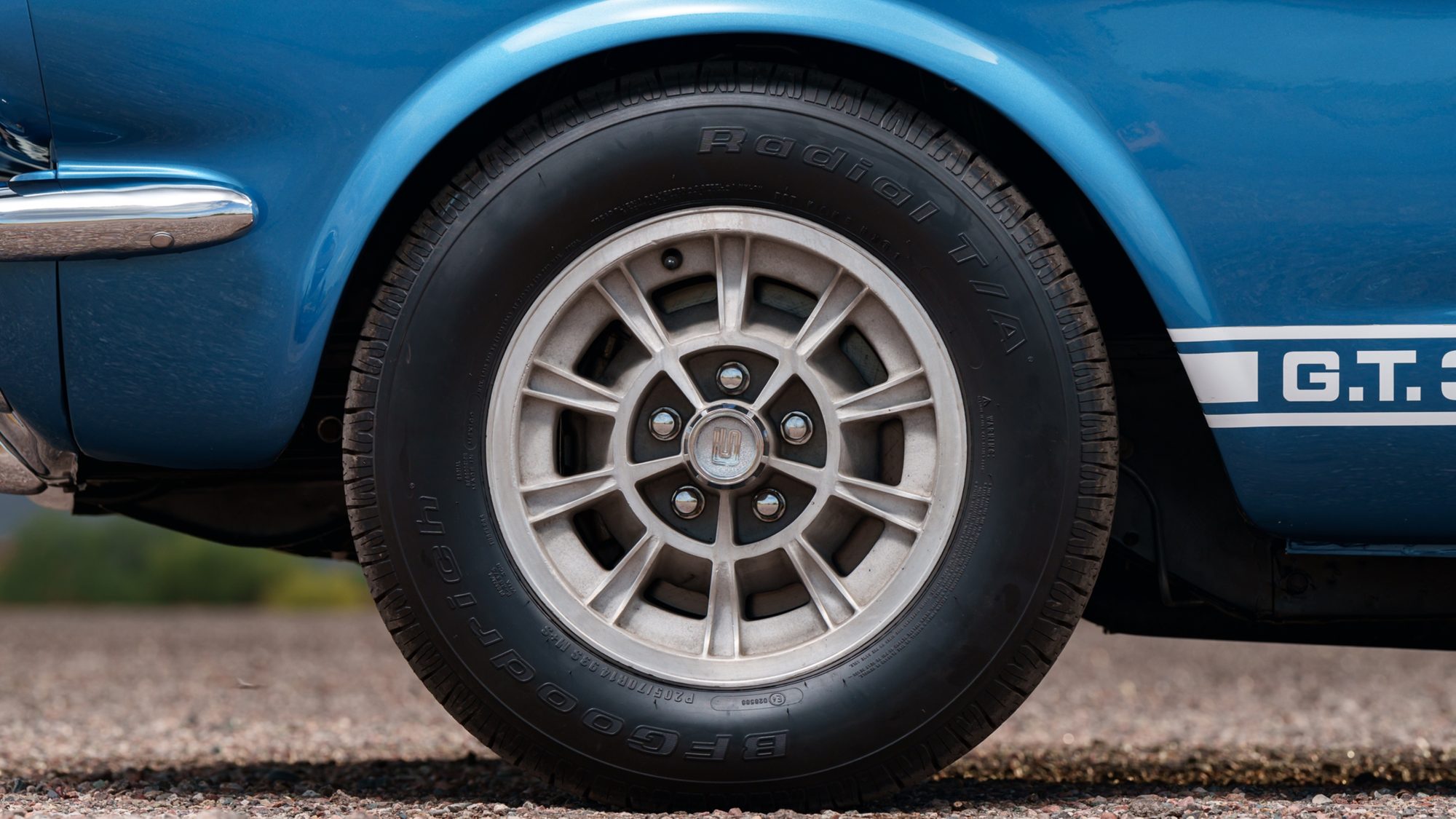 Rocker stripe
Two model years, one recipe
The 1965 and 1966 cars are the original GT350s, Shelby American's own conversions of Mustang fastbacks. What changed between the two years shows what each one was for.
- 1965
The racer, uncompromised
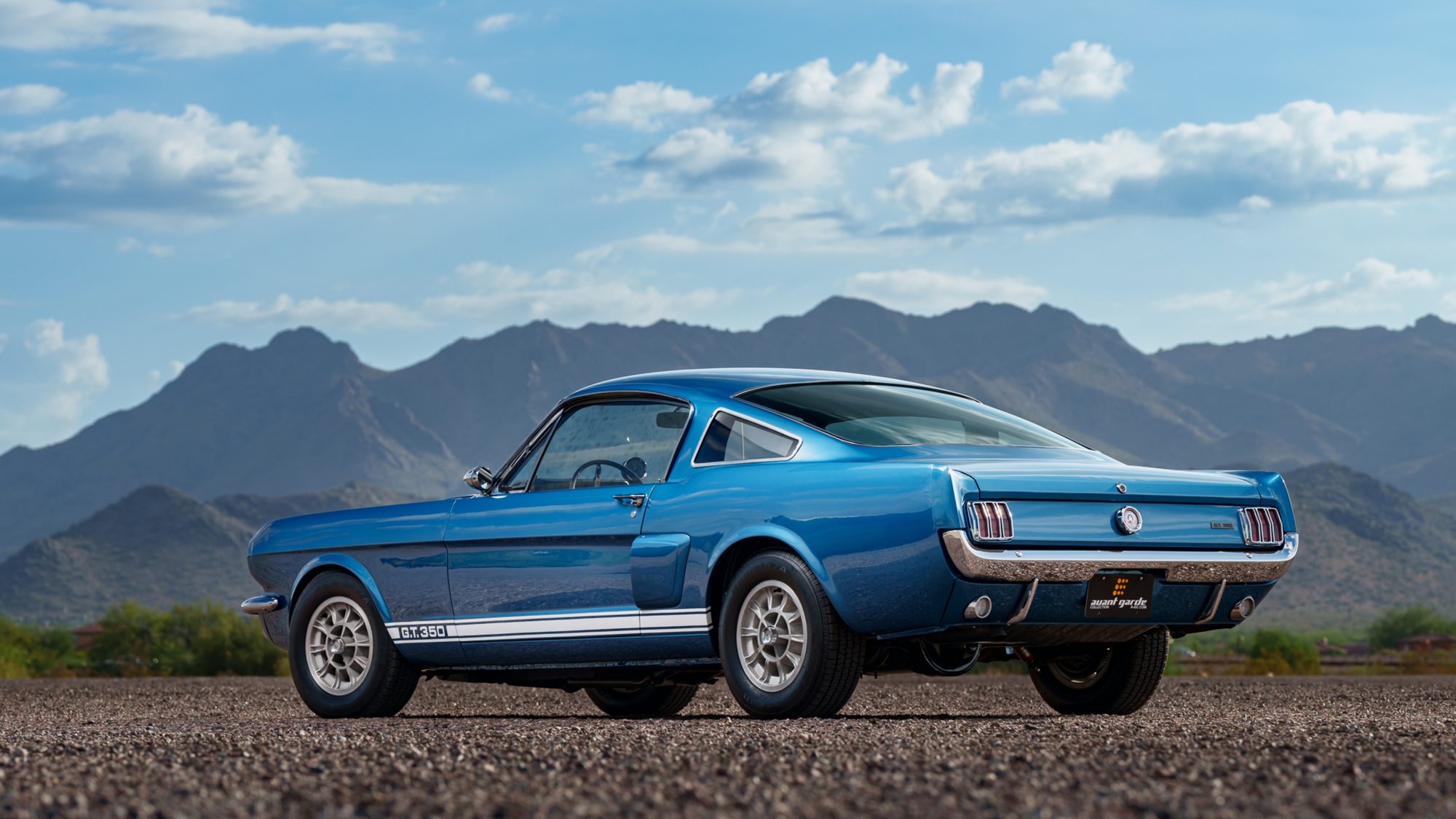
The launch car had no back seat and side-exit exhausts that ended just ahead of the rear wheels. Every one was painted Wimbledon White with Guardsman Blue rocker stripes; the over-the-top Le Mans stripes were an extra-cost option.
- 1966
Shelby civilizes the car
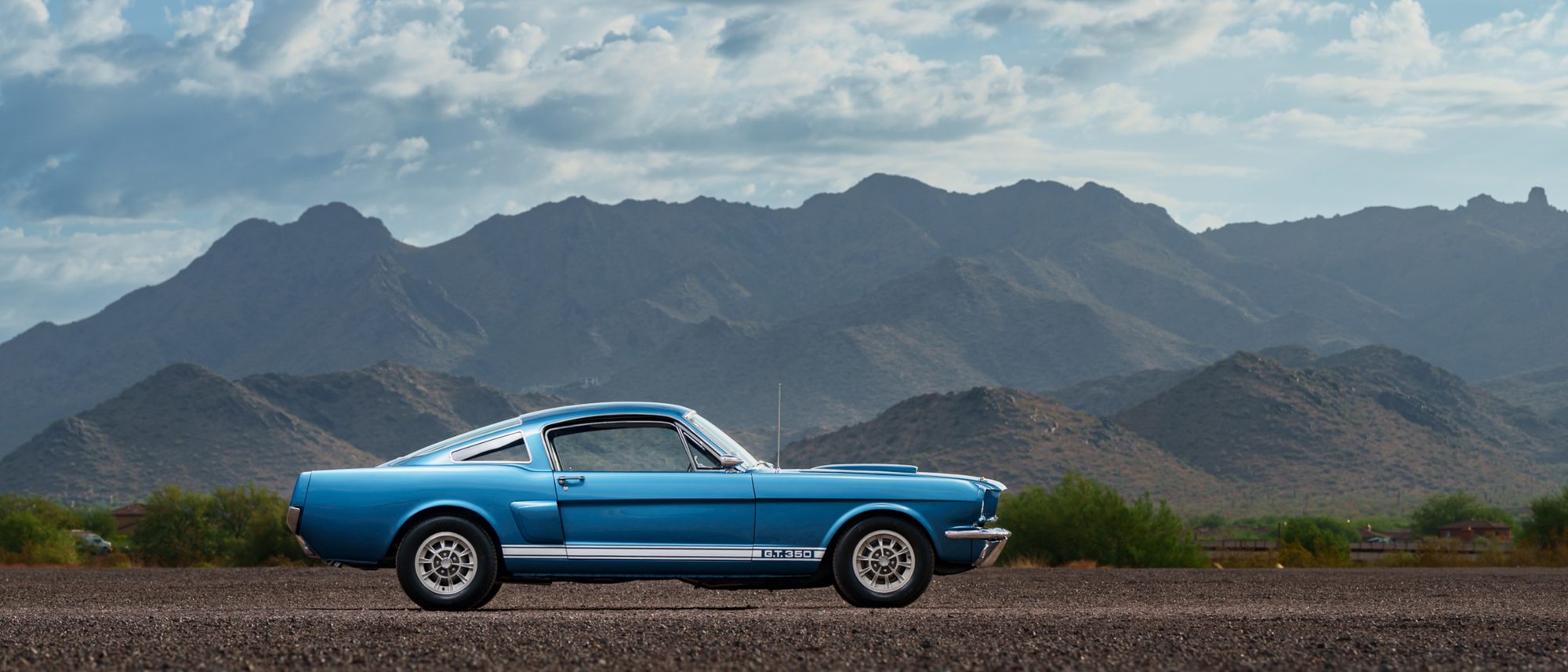
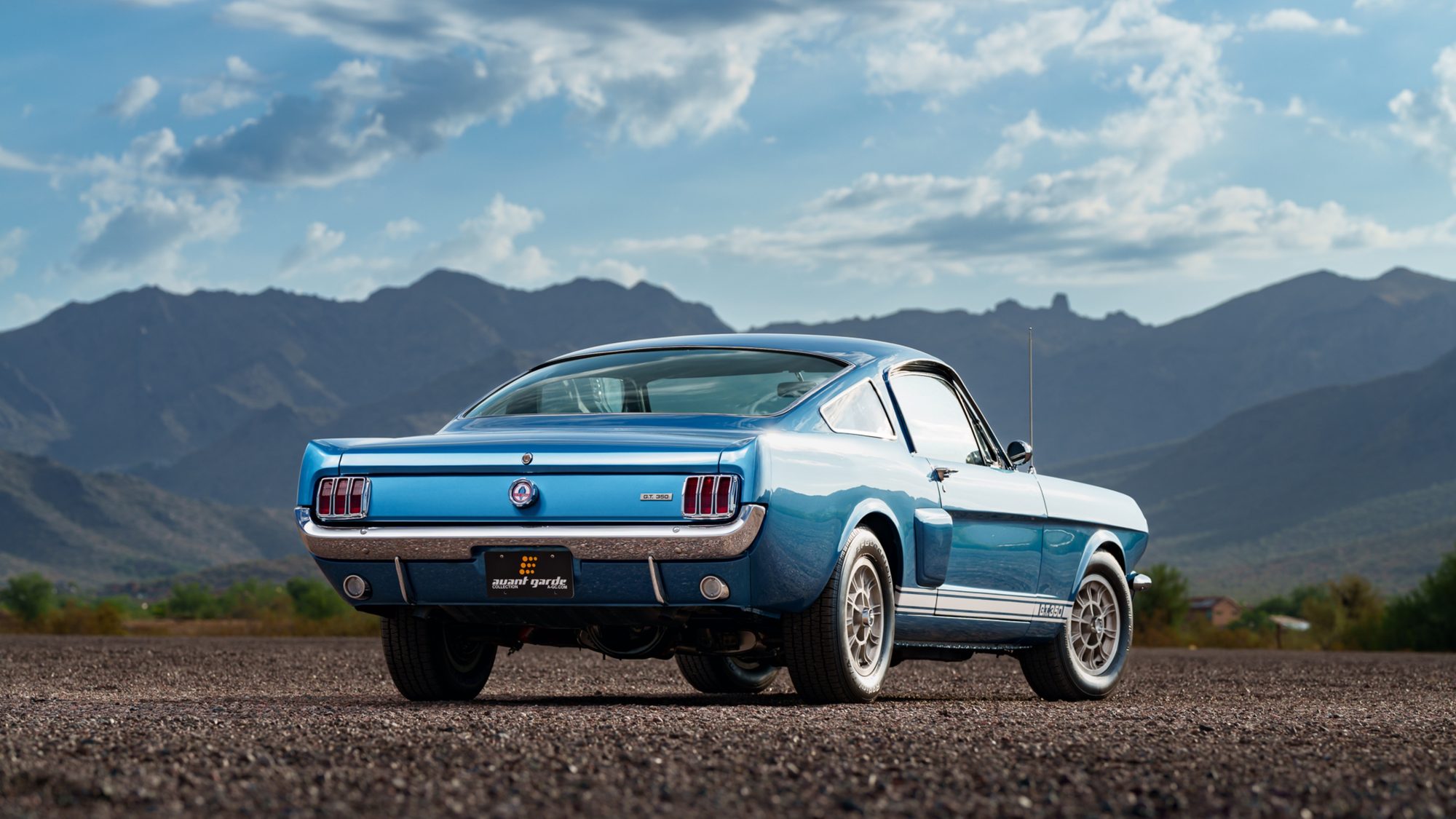
The rear seat returned as a fold-down option, a three-speed automatic joined the options list, and colors beyond Wimbledon White arrived, including blue, red, green and black. Rear-quarter windows replaced the 1965 car's extractor vents, functional brake-cooling scoops appeared ahead of the rear wheels, and the exhaust moved to the rear, which quieted the cabin. The blue car in these photos wears those windows and scoops. Production jumped to 2,378, more than four times the 1965 total, in large part because of one customer: Hertz.
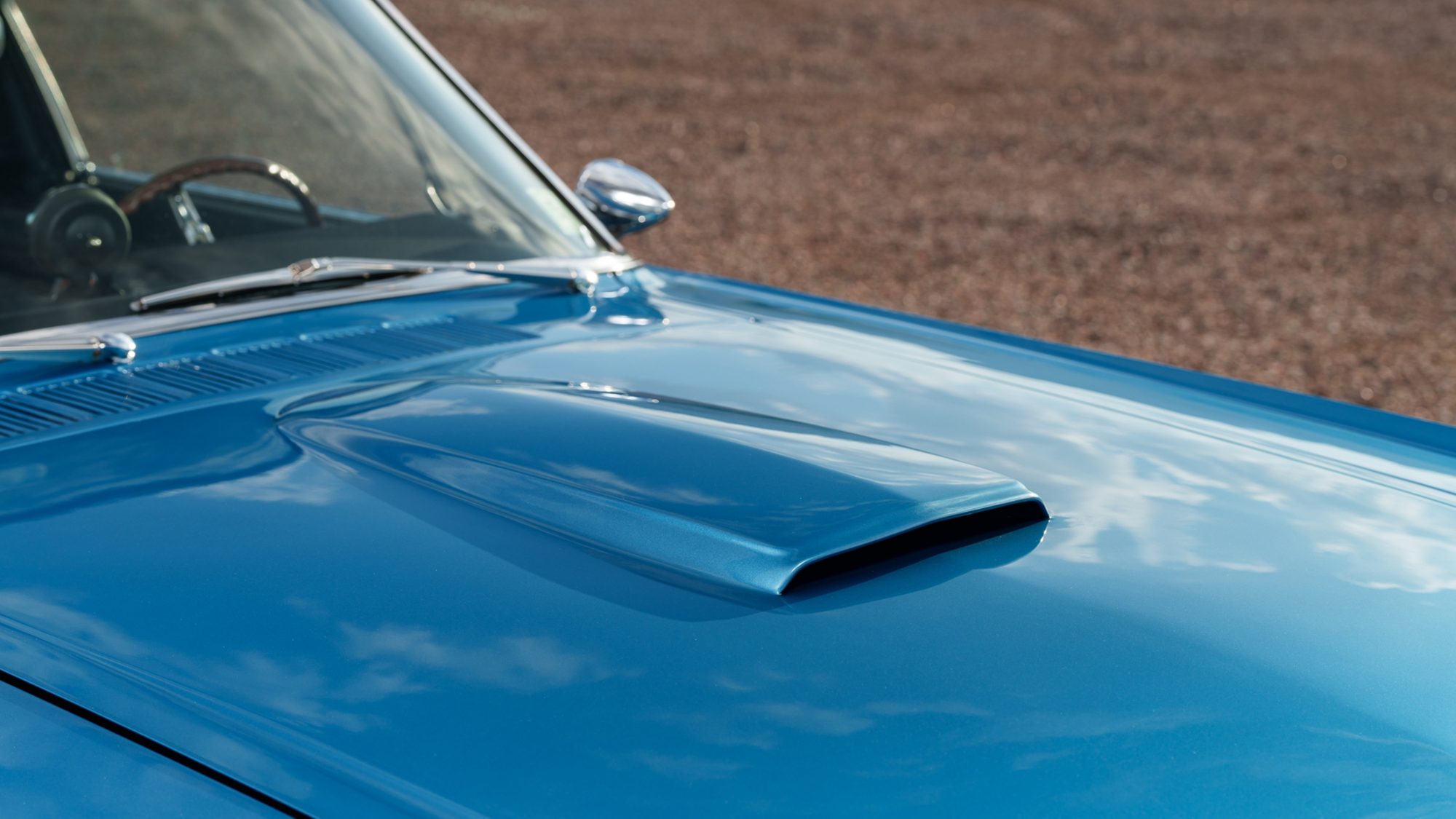
- Engine
- 289 cubic-inch V8, aluminum high-rise intake, Holley 4-barrel
- Output
- 306 hp at 6,000 rpm, 329 lb-ft at 4,200 rpm
- Weight
- About 2,800 lbs
- Transmission
- 4-speed manual only in 1965; automatic optional in 1966
- Price when new
- $4,547
1965 figures. Shelby American built 562 GT350s for 1965, 34 of them the R-model competition version, and 2,378 for 1966.
The racetrack, and the rental counter
Shelby also built 34 GT350R race cars for 1965, stripped further for competition. Ken Miles, Shelby's development driver, helped sort them, and the GT350R won its first race at Green Valley Raceway in Texas on Valentine's Day 1965. Jerry Titus won that year's SCCA B-Production national championship in a GT350, and GT350s took the class again in 1966 and 1967, beating the Corvettes they were built to take on.
What a real one costs today
Today a 1965 GT350 can bring half a million dollars. A 1965 car, chassis SFM 5S137, whose engine block carries the car's own Ford serial number, sold for $500,000 at RM Sotheby's Monterey sale in 2025. Another 1965 car, now running a replacement 302 V8 and a five-speed manual, still brought $460,100 on Hagerty's online marketplace in June 2026. A new one cost $4,547 in 1965.
A car this scarce and this valuable should not sit outside unprotected between drives, and neither should a modern Mustang. Whatever year is in your garage, cover it when it is not moving.
Keep it coveredCovers for the Mustang, matched to your exact car
Questions owners ask
Where did the name GT350 come from?
Not from the engine or its output. The most repeated account has Carroll Shelby, tired of naming debates, asking engineer Phil Remington how far it was between the company's race shop and its production shop. Remington said about 350 feet, and the car had its name. Another telling counts the paces from the shop to the edge of Los Angeles International Airport. Shelby's own view, as Jalopnik quotes it: "The name wouldn't make the car, and if it is a bad car, the name won't save it."
Did the original GT350 really have no back seat?
The 1965 model did not. SCCA's B-Production class was for two-seat sports cars, so Shelby's shop removed the rear seat and fitted a fiberglass shelf over the spare tire. A fold-down rear seat became optional in 1966.
How many 1965 Shelby GT350s were built?
562, including 34 GT350R race cars. Production rose to 2,378 for 1966, in large part because Hertz alone ordered about 1,000 of them for its rental fleet.
Was the GT350H really a rental car?
Yes. Hertz bought about 1,000 GT350H cars for 1966 and rented them to members of its Hertz Sports Car Club for $17 a day plus 17 cents a mile. Most were black with gold stripes, and after the first 85 four-speed cars, most came with an automatic. When their rental days were over, the cars went back to Ford to be refurbished and sold to the public.
Sources (19)
- In August 1964, Ford gave Shelby the go-ahead for the GT350; Shelby had to build at least 100 street-legal examples in time for the 1965 season; the street GT350 was priced at $4,547; early work was done at Shelby's Venice shop. shelbyamericancollection.org
- Ford shipped K-code (271 hp) fastbacks to Shelby; Shelby added a Cobra high-rise intake, a Holley four-barrel, Tri-Y headers and a radiator borrowed from the Galaxie 500, lowered the A-arms for about a one-inch drop, fitted adjustable Koni shocks and larger brakes; 306 hp at 6,000 rpm and 329 lb-ft at 4,200 rpm; 562 built for 1965. mustangspecs.com
- The 1965 GT350 had relocated front upper control arm mounting points, Koni adjustable shocks, a one-inch front sway bar, a larger radiator, and exhaust outlets just ahead of the rear wheels; it weighed 2,789 lbs. conceptcarz.com
- 1965 Shelby GT350: 306 hp at 6,000 rpm, 329 lb-ft at 4,200 rpm, 2,790 lbs, 0 to 60 mph in 7 seconds. audrainautomuseum.org
- The Mustang sold over 400,000 units in its first year. en.wikipedia.org
- The Mustang's 2+2 layout put it outside the two-seat sports car B-Production category; SCCA executive director John Bishop's answer was to remove the rear seat; Shelby fitted a fiberglass shelf over the spare tire and moved the battery to the trunk for weight distribution; 100 street-legal examples were needed by January 1, 1965, and on that day 100 Wimbledon White fastbacks were lined up outside Shelby's Venice facility for SCCA inspection; the GT350 won three consecutive SCCA B-Production championships, 1965 through 1967. jalopnik.com
- 1965 and 1966 GT350s were converted by Shelby, first in Venice and later at Los Angeles International Airport; all 1965 GT350s were Wimbledon White with Guardsman Blue rocker stripes; 1965 cars had Kelsey-Hayes front discs and larger rear drums with metallic linings; 34 GT350R race cars were built and the model was B-Production champion three straight years; for 1966 non-white colors (blue, red, green, black) arrived, the fold-down rear seat was optional, rear-quarter windows replaced the extractor vents, functional brake scoops were added, a three-speed automatic was optional and the exhaust exited at the rear; 1966 production was 2,378; the first 85 Hertz cars had four-speed manuals and were advertised as 'Rent-a-Racer' cars, and about 800 more were black with gold stripes and automatics; after rental the Hertz cars went back to Ford to be refurbished and sold to the public. en.wikipedia.org
- Wimbledon White with Guardsman Blue rocker stripes was the only factory scheme for the 1965 GT350; the over-the-top Le Mans stripes were optional. news.classicindustries.com
- Ken Miles and Chuck Cantwell did much of the development driving on the GT350R prototype, the first Shelby Mustang to win a race, at Green Valley Raceway near Dallas on Valentine's Day 1965; Jerry Titus won the 1965 B-Production National Championship; 34 GT350Rs were built. motoringresearch.com
- Ken Miles worked on developing the GT350R's suspension; Jerry Titus won the 1965 B-Production championship and the run-offs at Daytona; GT350Rs often beat their Corvette rivals. conceptcarz.com
- The GT350 won the SCCA B-Production Championship in 1965, 1966 and 1967. streetmusclemag.com
- In August 1964 Ford commissioned Shelby to build an uprated Mustang that could rival the Corvette; in September 1965 Shelby made Hertz a proposition for a special edition GT350, a contract that grew to 1,000 cars. supercarnostalgia.com
- Hertz agreed to buy 1,000 GT350 fastbacks and rented them to Hertz Sports Car Club members aged 25 or older for $17 a day plus 17 cents a mile; most were black and gold; stories of track use and welded-in roll bars are unconfirmed. mustangspecs.com
- For 1966 the GT350 offered fold-down rear seating and an optional three-speed automatic; rear-quarter windows replaced the extractor vents; functional brake scoops were added ahead of the rear wheels; rear-exit dual exhaust became standard and reduced cabin noise; 1966 production totaled 2,378. mustangspecs.com
- The name GT350 came from a distance: Shelby asked Phil Remington how far it was between the race shop and the production shop, and Remington said about 350 feet; Shelby: 'The name wouldn't make the car, and if it is a bad car, the name won't save it.' jalopnik.com
- A second account says the number was a count of paces from the corner of Shelby's Los Angeles shop to the property line of Los Angeles International Airport. slashgear.com
- Shelby American builds the 2026 Shelby GT350 on the Mustang GT, sold through select Ford dealers. shelby.com
- A 1965 Shelby GT350, chassis SFM 5S137, whose engine block carries the car's confidential Ford serial number, sold for $500,000 at RM Sotheby's Monterey 2025. rmsothebys.com
- A 1965 Shelby GT350, chassis 5S561, fitted with a replacement 302ci V8 and a Tremec 5-speed manual, sold for $460,100 on Hagerty Marketplace, closing June 2, 2026. hagerty.com
Photos: Josh Bryan - stock.adobe.com