Ask a room of racing fans who the greatest driver of all time is and you get an argument, not an answer. Formula 1 dominates that conversation, but the five names that keep coming up earned their place in different ways: championships won, records that have stood for decades, and in one case, greatness across categories that had almost nothing in common with each other. Here is what each one actually did.
- Michael Schumacher and Lewis Hamilton are tied for the most Formula 1 titles ever, seven each.
- Juan Manuel Fangio won five championships in seven full seasons. His career win rate, just over 46%, is still the highest in F1 history.
- Ayrton Senna won the Monaco Grand Prix six times between 1987 and 1993, a record that still stands more than three decades later.
- Mario Andretti is the only driver ever to win the Indianapolis 500, the Daytona 500 and a Formula 1 World Championship.
Michael Schumacher: seven titles, and a Ferrari revival
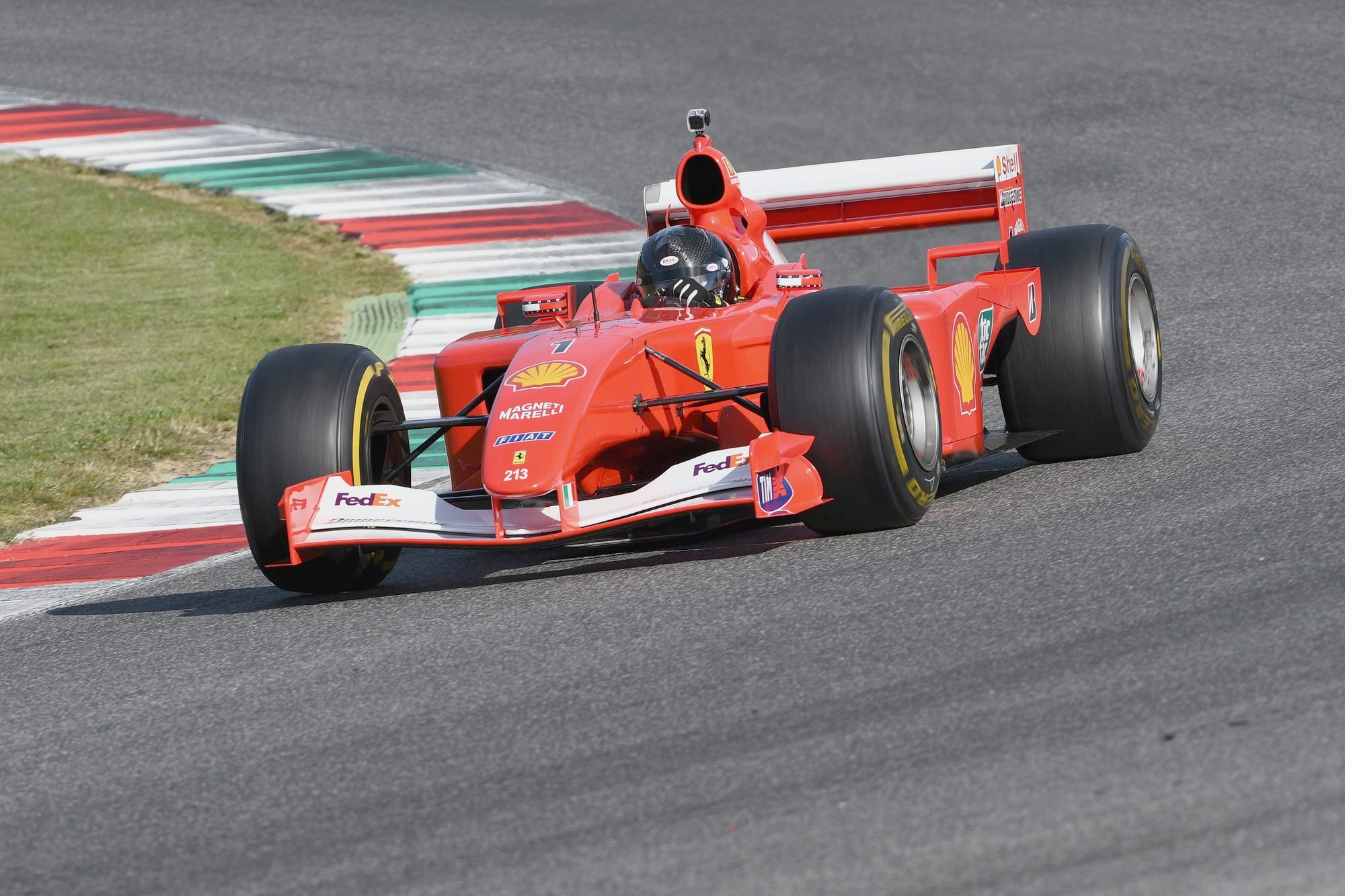
Michael Schumacher won two of his seven Formula 1 championships with Benetton, in 1994 and 1995, then joined Ferrari in 1996 and won five in a row from 2000 to 2004, turning a team that had not won a drivers' title since 1979 into the sport's dominant force. His wins came everywhere, including five at the Monaco Grand Prix, six at the Belgian Grand Prix (still the most any driver has won there) and five at the Italian Grand Prix.
His two most dominant seasons were 2002 and 2004. In 2002 he won a then-record 11 of 17 races, finished on the podium in every one of them, and clinched the title with six races still to run, a margin no driver has beaten since. In 2004 he broke his own wins record, taking 13 of 18 races. Sebastian Vettel matched that total in 2013, and Max Verstappen finally beat it in 2022 with 15 wins, then 19 in 2023. Schumacher's career total of 91 wins was the all-time record until Hamilton passed it in 2020.
Lewis Hamilton: matching Schumacher, then passing him
Lewis Hamilton passed Schumacher's career wins record in 2020 and matched his seven championships the same year, his fourteenth season in Formula 1, with titles won at McLaren and Mercedes. As of September 2026 he has 106 wins, the most of any driver, and nine of them came at the British Grand Prix at Silverstone, the most any driver has won at a single Grand Prix.
The ninth of those Silverstone wins, in July 2024, ended a 945-day winless run, the longest of his career. It came in mixed wet and dry conditions, after he pitted for slick tires one lap before Lando Norris. He also has three Monaco wins, in 2008, 2016 and 2019, and eight at the Hungaroring. Monaco is one record he has not come close to: Ayrton Senna's, covered next.
Ayrton Senna: three titles, and a Monaco record nobody has matched
Ayrton Senna won three Formula 1 championships with McLaren, in 1988, 1990 and 1991, before he was killed in a crash at the 1994 San Marino Grand Prix in Imola, Italy, at age 34. His first win came in the rain at the 1985 Portuguese Grand Prix, driving for Lotus, and he clinched his first title by winning the 1988 Japanese Grand Prix after stalling on the grid and dropping to 14th. His six wins at the Monaco Grand Prix, in 1987, 1989, 1990, 1991, 1992 and 1993, are still the record more than three decades later. Lewis Hamilton, the closest active challenger, has three.
If you no longer go for a gap that exists, you are no longer a racing driver.
Ayrton Senna, to Jackie Stewart in 1990
One of his most famous wins came at his home race, the Brazilian Grand Prix, which he had failed to win in seven previous tries. In 1991 his gearbox lost gear after gear in the closing laps until only sixth was left, and he nursed the car through the slow corners, nearly stalling, to hold the lead to the finish. He was so exhausted he needed help getting out of the car, and only just found the strength to lift the winner's trophy.
Juan Manuel Fangio: five titles, and the best win rate in F1 history
Juan Manuel Fangio, born in Argentina in 1911, won five Formula 1 championships, in 1951, 1954, 1955, 1956 and 1957, with four different constructors: Alfa Romeo, Maserati, Mercedes-Benz and Ferrari. He did it in seven full seasons. He started no championship race in 1952: a crash in a non-championship race at Monza that June broke his neck and kept him out for the rest of the year. He retired after the 1958 French Grand Prix.
His career win rate, 24 victories from 52 championship races entered, works out to just over 46%, still the highest of any driver in Formula 1 history. He won his home Argentine Grand Prix four times and the Italian Grand Prix three times. His third German Grand Prix win, in 1957, is often cited as one of the greatest drives in racing history: a pit stop left him about 50 seconds behind the two leading Ferraris, and he broke the lap record again and again to catch and pass them. It was the last of his 24 wins. Fangio died in 1995, at 84.
Mario Andretti: the only driver to win all three
Mario Andretti, born in 1940, is the only driver ever to win the Indianapolis 500 (1969), the Daytona 500 (1967, driving a NASCAR entry for Holman-Moody) and a Formula 1 World Championship (1978, with Team Lotus).
That barely covers it. He also won the 12 Hours of Sebring three times, in 1967, 1970 and 1972, took four IndyCar titles (1965, 1966 and 1969 in USAC, 1984 in CART), and in 1993, at 53, became the first driver to win races in four different decades. It all started on dirt tracks, in a 1948 Hudson he raced at 19.
- Michael Schumacher
- 7 (1994, 1995, 2000 to 2004)
- Lewis Hamilton
- 7 (2008, 2014, 2015, 2017 to 2020)
- Juan Manuel Fangio
- 5 (1951, 1954 to 1957)
- Ayrton Senna
- 3 (1988, 1990, 1991)
- Mario Andretti
- 1 (1978)
Schumacher and Hamilton are tied for the most titles ever. Andretti's single Formula 1 title undersells him: his Indianapolis 500 and Daytona 500 wins came outside Formula 1.
Still worth covering, whichever era you follow
Few of us will ever sit in a championship-winning race car. Whatever is sitting in your garage, it deserves basic protection from sun, dust and weather until the next drive.
Keep it coveredA cover for whatever is in your garage, matched to your exact car
Questions owners ask
Who has won the most Formula 1 world championships?
Michael Schumacher and Lewis Hamilton are tied at the top with seven titles each, Schumacher's coming in 1994, 1995 and 2000 to 2004, Hamilton's in 2008, 2014, 2015 and 2017 to 2020. Hamilton has also passed Schumacher's career wins record: as of September 2026 he has 106 to Schumacher's 91.
How did Fangio win five championships in only seven full seasons?
He raced full seasons in 1950 and 1951, sat out the 1952 championship, breaking his neck that June in a crash in a non-championship race at Monza, then returned from 1953 through 1957 and won four more titles in that stretch. He retired after the 1958 French Grand Prix. His career win rate, just over 46%, is still the highest of any Formula 1 driver.
Has anyone broken Ayrton Senna's Monaco Grand Prix record?
Not yet. Senna won at Monaco six times, in 1987, 1989, 1990, 1991, 1992 and 1993. More than three decades later, the closest anyone has come is five wins, by Graham Hill and Michael Schumacher.
Why is Mario Andretti considered the most versatile driver in racing history?
He is the only driver ever to win the Indianapolis 500, the Daytona 500 and a Formula 1 World Championship. He also won the 12 Hours of Sebring three times and four IndyCar titles, and in 1993 became the first driver to win races in four different decades.
Sources (27)
- Michael Schumacher won seven Formula 1 championships: 1994 and 1995 with Benetton, and 2000 through 2004 with Ferrari, five in a row. He joined Ferrari in 1996. en.wikipedia.org
- Ferrari had not won a drivers' championship since Jody Scheckter in 1979 before Schumacher's run began in 2000. en.wikipedia.org
- Schumacher's career total of 91 Grand Prix wins was the all-time record until Lewis Hamilton passed it in 2020. cnn.com
- Schumacher won the Belgian Grand Prix six times (1992, 1995, 1996, 1997, 2001, 2002), the most of any driver at that race. en.wikipedia.org
- Schumacher won the Monaco Grand Prix five times (1994, 1995, 1997, 1999, 2001) and the Italian Grand Prix five times (1996, 1998, 2000, 2003, 2006). en.wikipedia.org
- In 2002 Schumacher won a then-record 11 of 17 races, finished on the podium in every race, and clinched the title at the French Grand Prix with six races remaining, a margin Max Verstappen matched in 2023 but no driver has beaten. In 2004 he won 13 of 18 races. en.wikipedia.org
- Sebastian Vettel equalled Schumacher's 13 wins in a season in 2013; Max Verstappen broke the record with 15 wins in 2022, then raised it to 19 in 2023. motorsport.com
- Lewis Hamilton debuted with McLaren in 2007 and won his seventh Formula 1 title in 2020, tying Michael Schumacher's record; his titles came in 2008, 2014, 2015, 2017, 2018, 2019 and 2020. en.wikipedia.org
- As of September 2026 Hamilton has 106 career Grand Prix wins, the all-time record, including his first Ferrari win at the 2026 Barcelona-Catalunya Grand Prix, and 9 wins at the British Grand Prix, the record for wins at the same Grand Prix. en.wikipedia.org
- Hamilton's win at the 2024 British Grand Prix (7 July 2024), his ninth at Silverstone, ended a 945-day, 31-month winless run dating to the 2021 Saudi Arabian Grand Prix; he pitted for slick tires a lap before Lando Norris in mixed conditions. silverstone.co.uk
- Hamilton has won the Monaco Grand Prix three times, in 2008, 2016 and 2019. formulaonehistory.com
- Hamilton has won the Hungarian Grand Prix eight times (2007, 2009, 2012, 2013, 2016, 2018, 2019, 2020), the most of any driver there. en.wikipedia.org
- Ayrton Senna won three Formula 1 championships with McLaren, in 1988, 1990 and 1991, and died on 1 May 1994, aged 34, from injuries sustained at the San Marino Grand Prix in Imola, Italy. en.wikipedia.org
- Senna's first Formula 1 win was the rain-affected 1985 Portuguese Grand Prix at Estoril, driving for Lotus. en.wikipedia.org
- Senna won the 1988 Japanese Grand Prix and clinched his first World Championship with it, after stalling on the grid and dropping to 14th. en.wikipedia.org
- Senna won the Monaco Grand Prix six times, in 1987, 1989, 1990, 1991, 1992 and 1993, the record for that race; Graham Hill and Michael Schumacher are next with five each. en.wikipedia.org
- "If you no longer go for a gap that exists, you are no longer a racing driver," Senna to Jackie Stewart in a 1990 interview. planetf1.com
- Senna had failed to win his home Brazilian Grand Prix in seven previous attempts before 1991, when his gearbox lost gears until only sixth remained in the closing laps. motorsportmagazine.com
- After the 1991 Brazilian Grand Prix Senna needed help to get out of his car and only just managed to lift the trophy. f1i.com
- Juan Manuel Fangio was born 24 June 1911 in Balcarce, Argentina, and died 17 July 1995, aged 84. He won five Formula 1 championships (1951 with Alfa Romeo, 1954 with Maserati and Mercedes-Benz, 1955 with Mercedes-Benz, 1956 with Ferrari, 1957 with Maserati). His championship seasons were 1950 to 1951 and 1953 to 1958. en.wikipedia.org
- Fangio won 24 World Championship Grands Prix from 52 entries, a winning percentage of 46.15%, the highest in the sport's history. en.wikipedia.org
- Fangio crashed in a non-championship race at Monza in June 1952, broke his neck and spent the rest of 1952 recovering. en.wikipedia.org
- Fangio's last Formula 1 race was the 1958 French Grand Prix. en.wikipedia.org
- Fangio won the Argentine Grand Prix four times (1954, 1955, 1956, 1957) and the Italian Grand Prix three times (1953, 1954, 1955). en.wikipedia.org
- Fangio won the German Grand Prix in 1954, 1956 and 1957. In 1957 a pit stop left him about 50 seconds behind the Ferraris of Collins and Hawthorn; he broke the lap record repeatedly to win, his 24th and last Formula 1 victory, a drive often cited as one of the greatest in racing history. en.wikipedia.org
- Mario Andretti is the only driver to have won the Indianapolis 500 (1969), the Daytona 500 (1967) and a Formula 1 World Championship (1978). guinnessworldrecords.com
- Andretti, born 28 February 1940, won the 1967 Daytona 500 in a Holman-Moody Ford and the 1978 Formula 1 title with Lotus; he won the 12 Hours of Sebring in 1967, 1970 and 1972; took USAC titles in 1965, 1966 and 1969 and the CART title in 1984; became the first driver to win a race in four different decades in 1993; and began racing a 1948 Hudson on dirt tracks at 19. en.wikipedia.org