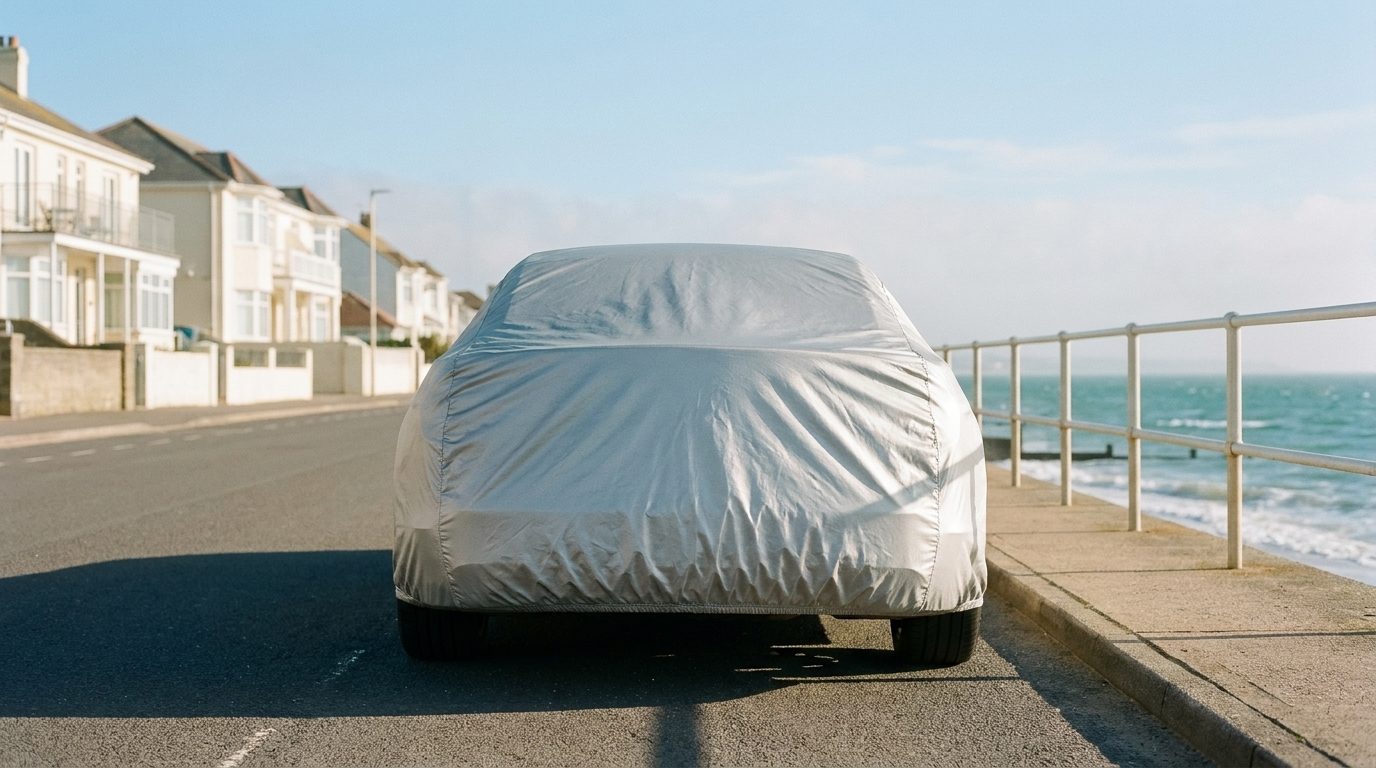
A car parked a short walk from the beach and one parked well inland are not sitting in the same air. Near the water, salt settles on the car whether or not it rains. Ordinary humidity or a night of dew can be enough to turn it corrosive. Here is how that works, and the four habits that keep it in check.
- Distance matters. In a University of Hawaii study for the state's Department of Transportation, the salt reaching bus shelters across Oahu fell the farther inland they stood, though readings could swing sharply between nearby spots.
- Humidity alone can set salt off. Ordinary salt forms a very corrosive solution above 75% relative humidity, and magnesium chloride, which sea air also carries, does the same at 35%, according to the Canadian Conservation Institute.
- Dew counts as wet weather. The National Weather Service defines dew as moisture that condenses on objects near the ground once they cool below the dew point, so a car can be wet by morning without a drop of rain.
- Cover it with something that breathes. The National Park Service's guidance for vehicles in storage calls for a breathable, water-resistant cover, and warns that road-salt residue left on a vehicle promotes corrosion whenever the humidity climbs.
What the coast is actually doing to a parked car
Two things matter most near the coast: how much salt reaches the car, and how often that salt gets wet enough to turn corrosive. Neither one needs a storm to do its work.
Researchers from the University of Hawaii, working for the state's Department of Transportation, measured chloride on the roof beams of 126 sheltered bus stops across Oahu. Chloride is the part of sea salt that speeds up corrosion. The bus stops ran from the shoreline to the middle of the island. Their conclusion: the deposition rate decreases with distance from the coast. It is not a smooth slope, though. The report notes that wind speed and direction, vegetation, the lay of the land and probably wave height push the numbers around. Readings can change sharply over short distances, and stretches of coast behind offshore reefs, which calm the surf, appeared to get less. The same report explains why the salt matters: chlorides in water speed up corrosion. That is why structures in coastal areas corrode faster than ones never exposed to salt.
Salt does not need rain to start that reaction. The Canadian Conservation Institute's guidance on humidity puts numbers on it. Sodium chloride, ordinary table salt, deliquesces above 75% relative humidity: it pulls moisture out of the air and forms a very corrosive solution. Magnesium chloride, which the institute notes is found in sea water and so in the air near the sea, does the same at just 35%. Below those lines the crystals are relatively harmless. Above them, in the institute's words, they become an aggressively corroding salt solution. And a car does not need rain to get wet, either: dew forms on anything near the ground that cools below the dew point.
Where it works matters too. The National Park Service's vehicle-storage guide writes about cars that were driven on salted roads and never properly cleaned. It tells owners to check the frame and suspension for active corrosion. Whenever the humidity climbs, that salt residue promotes corrosion which, in the guide's words, given enough time, will destroy the structural integrity of the entire vehicle.
For what rain and overnight damp do to a parked car, see rain, dew and your car.
Four habits that keep salt from working
None of this takes long on its own, and it is the part you control: the salt keeps working for as long as it sits on the car.
Wash the salt off on a schedule, not just after it rains
Salt in coastal air lands on the car whether or not a drop of rain falls, and washing it off takes away the salt that humidity would otherwise turn corrosive. Snow country has a rule for road salt: Consumer Reports advises a wash every month through snow season, more often when the car is coated in salt, with the wheel wells and undercarriage sprayed too. Near the water there is no off season, so treat that monthly wash as a year-round minimum.
Give it a chance to dry out between humid spells
Drying matters as much as washing. The Hawaii report found that surfaces exposed to wind or sun, where drying happens quickly and often, are less prone to corrosion than sheltered spots where moisture stays in contact with the metal. For a parked car, that means airflow. Avoid a spot so sheltered and still that the car never dries out between humid days, and towel it dry after a wash rather than leaving it wet overnight.
Check the cabin for damp once in a while
Inside the car, damp floor mats, carpet and upholstery are the worry. The Canadian Conservation Institute's figures for leather, and for fabric that is dirty, put visible mold at about 100 days at 70% relative humidity, about 10 days at 80% and about 2 days at 90% or more, at warm temperatures around 77°F (25°C).
The EPA's guidance for homes carries the same principle: dry water-damaged areas and items within 24 to 48 hours to prevent mold growth, and keep indoor humidity below 60%. Crack a window on a dry day, and if a floor mat ever gets properly wet, pull it out and let it dry fully before it goes back in.
TipIf the cabin smells damp when you open the door, take it seriously. As the Canadian Conservation Institute puts it, if something feels or smells damp, it usually is.
Cover it with something that breathes
For vehicles in storage, the National Park Service's conservation guidance is specific: use a breathable, water-resistant cover. The same guide warns that road-salt residue left on a vehicle promotes corrosion whenever the humidity climbs. That is close to the AllGuard Platinum Shield's job description. It is silver 300D polyester (D stands for denier, a measure of the yarn's weight), with a UV treatment and a polyurethane coating that helps it shed rain. Inside is a fleece liner, and the fabric breathes.
Garage or driveway, cover it right
Where the car sleeps decides which cover it needs. A car that lives in a garage is out of the dew and the weather; one parked in a driveway, carport or open lot near the water is not. For how every kind of weather treats a parked car, the full weather guide covers snow, sun, hail, sap and rain side by side.
- WashWash the car at least once a month, all year. After salted roads or mud, spray the wheel wells and undercarriage too.
- DryTowel off anything that got properly wet rather than leaving it wet overnight.
- CheckOpen the doors and trunk now and then and check for a damp or musty smell. Pull out a wet mat and dry it before it sits for days.
- CoverPut a breathable, water-resistant cover on a clean, dry car whenever it will sit for more than a day or two.
Questions owners ask
Does living near the ocean really mean more salt lands on the car?
As a rule, yes. A University of Hawaii study for the state's Department of Transportation measured salt on bus shelters at 126 sites across Oahu and concluded that the deposition rate decreases with distance from the coast. Wind, vegetation, terrain and probably how hard the waves break can still make readings swing sharply between nearby spots.
At what humidity does salt start to corrode metal?
The Canadian Conservation Institute puts ordinary salt, sodium chloride, at 75% relative humidity: above that, it pulls moisture out of the air and forms a very corrosive solution, rain or no rain. Sea air also carries magnesium chloride, which does the same at just 35%. Below those lines, the institute calls the crystals relatively harmless.
Can overnight dew affect a car even when it never rains?
Yes. The National Weather Service defines dew as moisture that condenses on objects near the ground once their temperature falls below the dew point, so a car can be wet in the morning after a night with no rain at all. Any salt already on the car has that moisture to work with.
What should a cover do for a car that lives near salt air?
The National Park Service's guidance for vehicles in storage is a breathable, water-resistant cover, and the same guide warns that road-salt residue promotes corrosion whenever the humidity climbs. The AllGuard Platinum Shield is built that way: weather-resistant, with breathable fabric.
Keep it under a cover that breathes.
AllGuard Platinum Shield is weather-resistant, with breathable fabric, so trapped moisture can escape. It is matched to your exact car.
Sources (8)
- Chloride was measured on the roof beams of 126 sheltered bus stops across Oahu; the deposition rate decreases with increasing distance from the coast, varies sharply over short distances with wind, vegetation, terrain and waves, and appears lower behind offshore reefs. cee.hawaii.edu
- Chlorides make water a more efficient electrolyte and accelerate corrosion, so structures in coastal areas corrode faster; areas exposed to wind or sun, where drying occurs quickly, are less prone to corrosion than sheltered areas where moisture stays in contact. cee.hawaii.edu
- Sodium chloride deliquesces above 75% relative humidity and forms a very corrosive solution; magnesium chloride, found in sea water and in the air near the sea, deliquesces at 35%; above the critical humidity the relatively harmless crystals become an aggressively corroding salt solution. canada.ca
- Visible mold appears on leather and on dirty textiles in about 100 days at 70% relative humidity, about 10 days at 80% and about 2 days at 90 to 100%, at warm temperatures (about 25°C); if surroundings feel or smell damp, they usually are. canada.ca
- Dew is moisture that has condensed on objects near the ground whose temperatures have fallen below the dewpoint temperature. forecast.weather.gov
- National Park Service conservation guidance: cover vehicles in storage with a breathable, water-resistant cover; check the frame and suspension for active corrosion; road-salt residues left on a vehicle promote corrosion whenever the humidity climbs, and given enough time will destroy the structural integrity of the entire vehicle. nps.gov
- Dry water-damaged areas and items within 24 to 48 hours to prevent mold growth; keep indoor humidity below 60 percent. epa.gov
- Consumer Reports advises a monthly car wash during snow season, or more often if the car is coated in salt, including the undercarriage and wheel wells. consumerreports.org